

Our Verdict
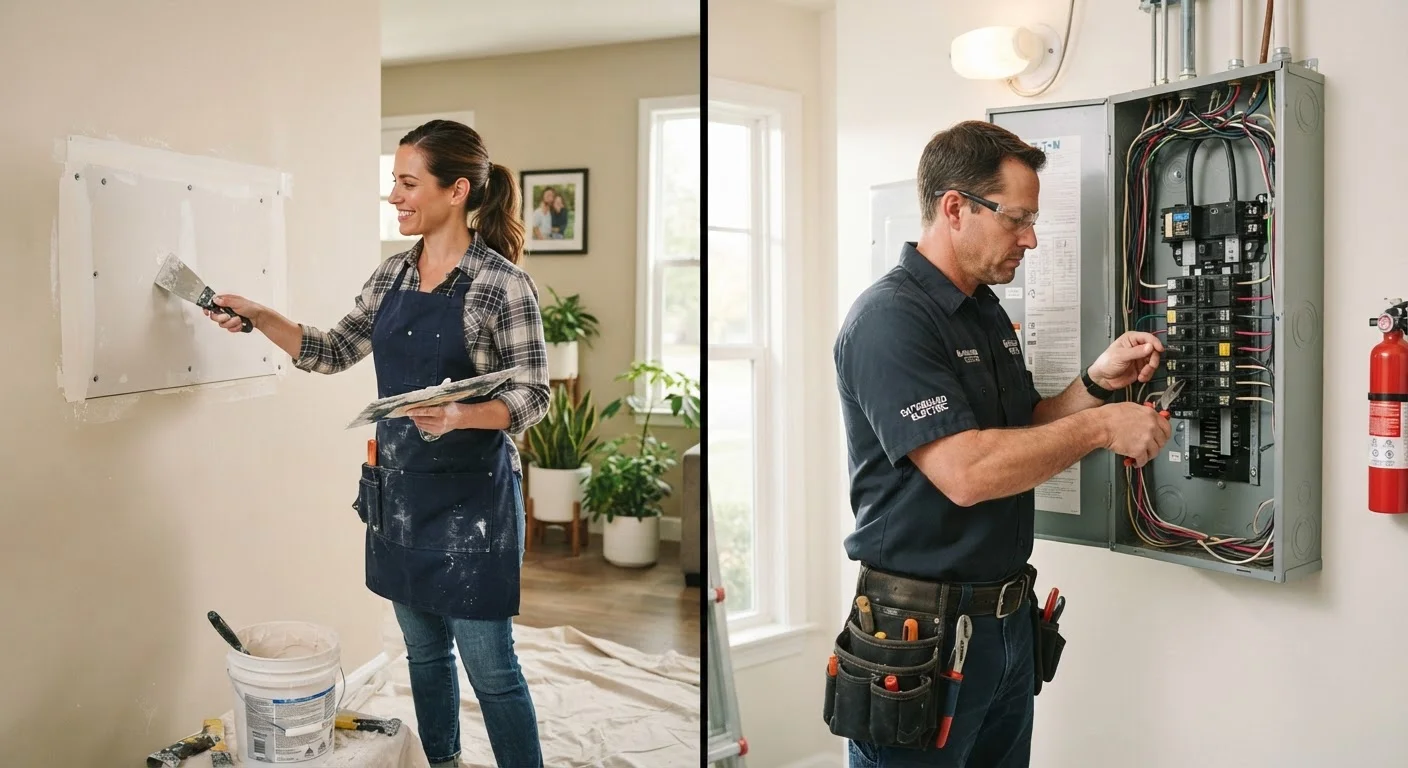
Most homeowners can safely handle surface-level maintenance and minor repairs with basic tools and careful preparation. However, any work involving electrical systems beyond outlets, gas lines, structural elements, or roofing typically warrants a licensed professional. The risk - to your safety, your home's value, and your insurance coverage - is simply too great to treat those as weekend projects.
| Best for | Recommended |
|---|---|
| Confident, tool-equipped homeowners with basic trade knowledge | DIY |
| Projects involving electrical panels, gas, or load-bearing structures | Licensed Professional |
| Repairs that require permits or inspections | Licensed Professional |
| Routine maintenance like caulking, painting, or minor plumbing fixtures | DIY |
The Core Question: Competence, Consequence, and Code
Every home repair decision comes down to three factors: your actual skill level, the consequence of getting it wrong, and whether local building codes require a licensed trade. A leaky faucet that goes badly means a call to a plumber. A gas line repair done incorrectly can mean a fire or fatality. The stakes are not equal - and neither should your decision-making process be.
Before picking up a tool, honestly assess whether you have the knowledge, proper equipment, and physical capacity to complete the job safely. Then consider whether the repair intersects with systems - electrical, gas, plumbing-into-mains, or structural - where mistakes carry serious consequences. Finally, check whether the work is typically governed by local permit requirements. See our guide to when permits are required for a useful overview of what commonly triggers official approval.
Repairs Most Homeowners Can Tackle Themselves
A wide range of home maintenance tasks are well within reach for careful, prepared homeowners. These generally share a few characteristics: they don't involve hidden systems, mistakes are reversible, and the materials are forgiving.
- Patching drywall - Small holes and dings can be repaired with pre-mixed compound, a putty knife, and sandpaper. The skill ceiling is low and the risk is cosmetic only.
- Caulking and weatherstripping - Sealing gaps around windows, doors, and tubs is straightforward and improves energy efficiency meaningfully.
- Painting interior and exterior surfaces - With proper prep and ventilation, painting is one of the most accessible DIY projects. Older homes require extra caution; our article on working safely around lead paint and asbestos is essential reading before you start.
- Replacing faucet hardware and showerheads - Swapping fixtures that connect to supply lines (not running new plumbing) is manageable with basic tools and a water shutoff.
- Installing ceiling fans or light fixtures - If a circuit is already in place, this is a common DIY task - but always shut off the breaker and verify the circuit is dead before touching wiring.
Build In Extra Time for DIY Projects
Even on straightforward DIY repairs, set aside a realistic time budget. Rushing a repair to finish before the weekend ends is one of the most common causes of avoidable mistakes. If a task is taking longer than expected, it's better to pause and reassess than to push through and cut corners.
Even on straightforward DIY repairs, set aside a realistic time budget. Rushing a repair to finish before the weekend ends is one of the most common causes of avoidable mistakes.
When a Professional Is the Right Call
Some repairs should not be treated as DIY projects regardless of your confidence level. These are jobs where improper work can endanger your household, violate code, void your homeowner's insurance, or create costly problems when you sell.
| Task Type | DIY | Licensed Professional | |
|---|---|---|---|
| Skill requirement | Basic to moderate | Specialized training required | |
| Permit typically required | Rarely | Often | |
| Risk if done incorrectly | Low to moderate | High - safety or legal consequences | |
| Upfront cost | Lower (materials only) | Higher (labor + materials) | |
| Insurance implications | Minimal for simple repairs | Work often must meet code for coverage | |
| Examples | Caulking, painting, fixtures | Electrical panels, gas lines, structural work |
- Electrical panel upgrades or new circuit runs - Panel work carries serious electrocution and fire risk and nearly always requires both a licensed electrician and a permit. For a nuanced breakdown of where the DIY line sits, see the real story on DIY electrical work.
- Gas line repairs or appliance connections - Gas work is regulated in virtually every U.S. jurisdiction. Never attempt to run, repair, or modify a gas line without a licensed professional.
- Structural changes - Removing or modifying walls without understanding their role can compromise your home's structural integrity. Our explainer on load-bearing vs. non-load-bearing walls covers why this distinction matters.
- Roof replacement or major repairs - Heights, weather exposure, and the precision needed to prevent water intrusion make roofing a high-consequence task better left to experienced roofers.
- Mold remediation beyond minor surface growth - Large mold infestations indicate moisture problems and may involve health risks that professional remediation companies are equipped to handle safely.
When you do need to hire out, know how to vet your contractor properly. Our contractor vetting checklist outlines what to verify before any work begins.
Thinking Through Cost, Risk, and Long-Term Value
DIY repairs can save real money on labor - but only when completed correctly. A failed DIY attempt that requires professional correction often costs more in total than calling a pro from the start. Factor in tool purchases, material waste from trial and error, and the potential for compounding damage before deciding.
It's also worth thinking about how repairs affect your home's long-term value. Unpermitted or code-violating work can surface during a home inspection and create complications at resale. A home maintenance reserve fund is a practical financial buffer that helps cover the cost of professional repairs without derailing your budget when they arise.
Unpermitted Work Can Create Serious Problems
Repairs or renovations completed without required permits can complicate your home's resale, trigger code enforcement action, and in some cases void your homeowner's insurance for related claims. Always verify local requirements before beginning significant work - when in doubt, a brief call to your local building department can clarify what's needed.
If you're planning renovations with resale in mind, keep in mind that not every upgrade pays back equally. Our look at which home renovation projects tend to recoup well can help you prioritize where to spend.
The goal is a home that's safe, functional, and maintained to a standard that protects both the people inside and the investment you've made. DIY is a valuable tool - used at the right times, on the right jobs.
The content on this site is provided for informational purposes only and should not be considered a substitute for professional advice. While we strive to provide accurate and up-to-date information, we make no guarantees regarding its completeness or accuracy. Always consult a qualified professional for advice specific to your circumstances before making any decisions.