

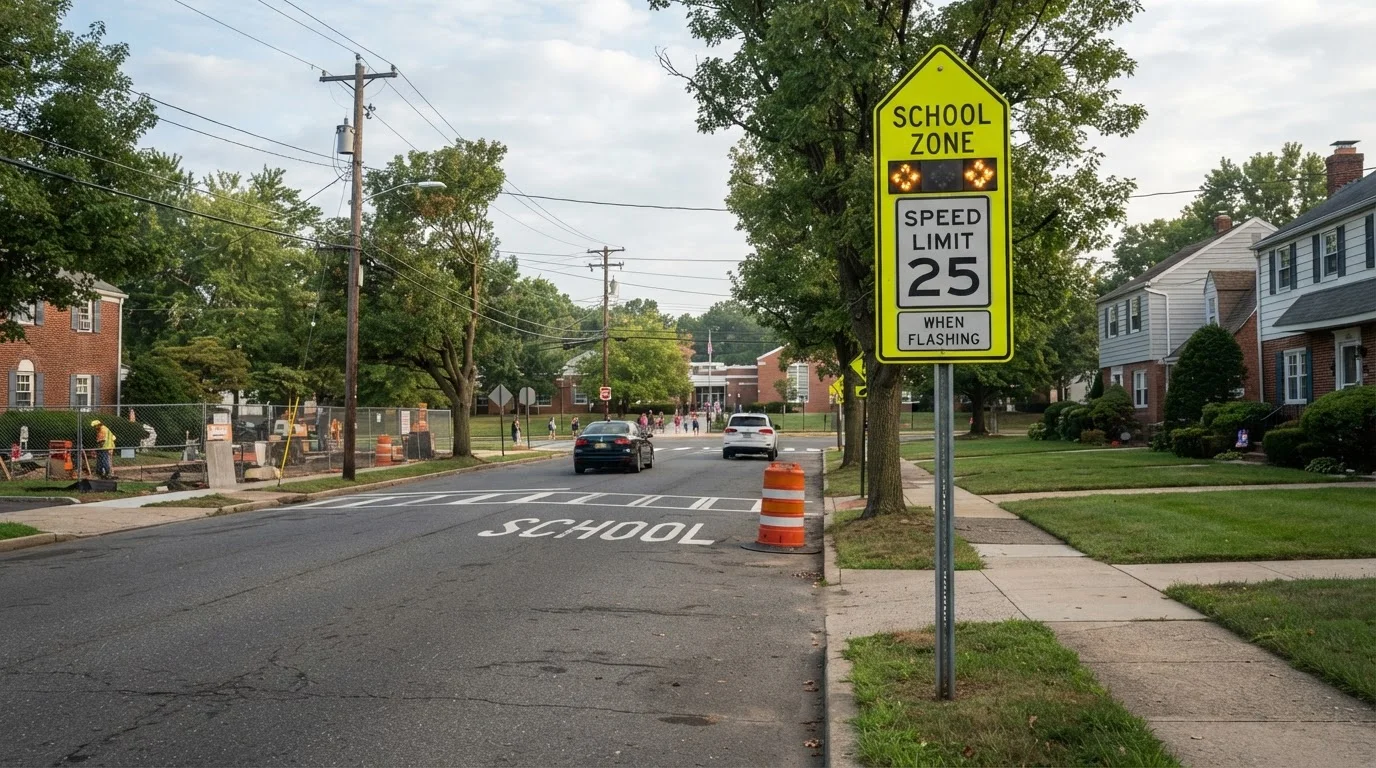
School Zones: Speed Limits, Hours, and Common Violations
School zone rules exist to protect children during arrival and dismissal windows - the periods of highest pedestrian activity. Most states post school zone speed limits between 15 and 25 mph, and enforcement is often stricter than on standard roadways. Fines in school zones are typically doubled, and in many jurisdictions a violation carries additional points on a driver's license.
Key rules that apply in virtually every state:
- Obey posted signs, not assumptions. Speed limits are only active during posted hours or when flashing beacons are operating. If no hours are listed and no beacon is active, verify local ordinance - some states apply limits whenever children are visibly present, regardless of posted times.
- Never pass a stopped school bus displaying its stop arm or red lights. On a two-lane undivided road, all traffic in both directions must stop. On a divided highway with a median, oncoming traffic may be exempt in some states, but lanes traveling in the same direction must always stop.
- Do not block crosswalks. Stopping in a crosswalk - even briefly - is a violation and a direct safety hazard to students.
Understanding how speed affects stopping distance is especially relevant here: at 25 mph, the average vehicle requires roughly 85 feet to stop after the driver reacts. At 15 mph, that figure drops to approximately 44 feet - a meaningful difference when a child steps off a curb.
| Typical school zone speed limit | 15-25 mph (Varies by state and posted hours) |
| School zone fine multiplier | 2× standard fine (most states) (State traffic statutes vary) |
| Construction zone penalties | Doubled fines; license suspension possible (Applies in all 50 states) |
| Move Over laws in effect | All 50 U.S. states (As enacted through state legislatures) |
| Vehicles covered by Move Over laws | Police, fire, EMS; many states add tow trucks and utility vehicles (Coverage varies by state statute) |
| School bus stop-arm rule | All traffic must stop on undivided roads (Oncoming traffic rules vary on divided highways by state) |
Construction Zones: What the Law Requires Beyond Slowing Down
Work zone crashes injure and kill both workers and drivers every year. All 50 states have enhanced penalties for speeding in active construction zones - in many, fines are doubled when workers are present, and some states suspend licenses after repeat violations.
Speed limits in construction zones are legally enforceable the moment signs are posted, even if no workers are currently visible. "No workers present" is not a legal defense for speeding in a posted zone.
Additional obligations drivers frequently overlook:
- Lane changes are restricted. Many zones require merging well before the lane closure. Zipper merging - where two lanes alternate entry into one - is the method most traffic engineers recommend, but some states post explicit instructions. Follow the posted guidance.
- Flaggers have authority equivalent to traffic control signals. Ignoring a flagger's stop signal carries the same legal weight as running a red light in most states.
- Following distance should increase. Uneven pavement, unexpected stops, and worker proximity all demand extra buffer space. Safe following distance calculations should be adjusted upward in work zones - many safety agencies recommend at least four seconds of gap rather than the standard two to three.
Adverse weather compounds construction zone hazards significantly. Driving in rain, snow, or fog within an active work zone requires slowing further and increasing awareness of workers wearing high-visibility gear who may be harder to spot in low light.
Active construction zone
A posted work area where reduced speed limits and other traffic controls are legally in effect. The zone is considered active as soon as signs are posted, regardless of whether workers are physically present at that moment.
Move Over law
A traffic law requiring drivers to change lanes away from, or reduce speed near, stationary emergency, law enforcement, or roadside service vehicles displaying warning lights. All U.S. states have enacted some version of this law.
Flagger
A trained worker stationed in or near a construction zone to direct traffic using hand signals, flags, or paddles. Flagger instructions carry the same legal authority as posted traffic control devices.
Stop arm (school bus)
The extendable red sign with flashing lights deployed from the driver's side of a school bus when children are boarding or exiting. When activated, surrounding traffic is legally required to stop in most states.
Emergency Vehicles and Move-Over Laws
Every U.S. state has a Move Over law requiring drivers to change lanes or slow down when passing stationary emergency vehicles with lights activated. These laws have expanded in recent years to cover tow trucks, utility vehicles, and road maintenance equipment in many states - not just police, fire, and ambulance units.
The standard requirement:
- On a multi-lane road, move over one full lane away from the stopped vehicle if traffic safely allows.
- If a lane change is not possible - due to traffic or road configuration - reduce speed significantly below the posted limit and be prepared to stop.
When an emergency vehicle is actively approaching with lights and siren:
- Pull to the right edge of the roadway and stop. Do not stop in an intersection.
- Remain stopped until the vehicle has fully passed and it is safe to proceed.
- On a one-way road, pull to whichever curb is nearest and stop.
Intersections require special caution. If you have a green light but an emergency vehicle is approaching the intersection, you are still required to yield - a green light does not override the right-of-way of an authorized emergency vehicle operating lights and sirens.
Penalties for Move Over violations range from fines to license suspension, depending on the state and whether the violation resulted in injury. Laws in this area have been strengthened significantly following incidents involving highway workers and first responders.
For additional context on right-of-way rules at intersections, see our guides on four-way stop rules and navigating roundabouts.
The content on this site is provided for informational purposes only and should not be considered a substitute for professional advice. While we strive to provide accurate and up-to-date information, we make no guarantees regarding its completeness or accuracy. Always consult a qualified professional for advice specific to your circumstances before making any decisions.