

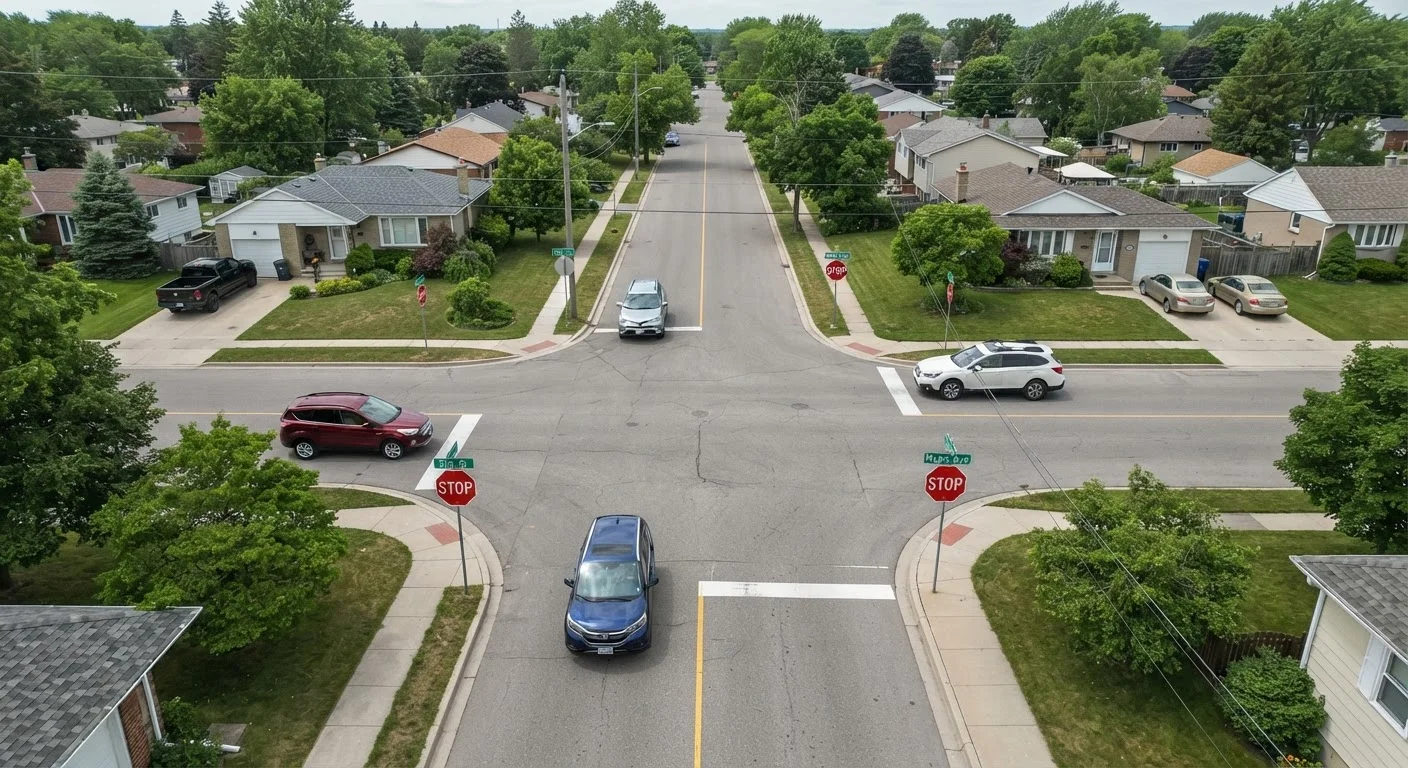
The Rules Are Simpler Than Drivers Make Them
Four-way stops operate on two core rules: first to stop, first to go, and when arrival times are equal, yield to the driver on your right. That's the foundation. Everything else - confusion, near-misses, and the awkward standoff - stems from drivers misapplying or ignoring these two principles.
The problem isn't that drivers don't know rules exist. Most do, in a general sense. The problem is that they apply shortcuts, social habits, and assumptions that don't match how the law actually works. At a four-way stop, the intersection doesn't care which road is wider, who is in more of a hurry, or who waves most enthusiastically.
For a broader look at how right-of-way rules play out in more complex situations, see our guide on highway merging and right-of-way.
~40%
Of intersection crashes involve stop sign violations
The Federal Highway Administration has identified stop sign running - including failure to yield at all-way stops - as a leading cause of intersection crashes in the U.S.
700+
Annual U.S. deaths linked to stop sign violations
The Insurance Institute for Highway Safety (IIHS) reports that more than 700 people are killed each year in crashes involving stop sign violations across the country.
The Most Common Mistakes - and What to Do Instead
The following errors account for the majority of four-way stop conflicts. Each one has a clear, rule-based correction.
Assuming the busier road always has priority.
Why it happens: Drivers are conditioned by yield signs and uncontrolled intersections where traffic volume implies priority. At an all-way stop, all roads are equal - traffic volume is irrelevant.
Failing to come to a complete stop before assessing arrival order.
Why it happens: Drivers eager to keep moving slow down but don't fully stop, which makes it impossible to accurately determine who arrived first - and violates traffic law.
Not yielding when turning left across oncoming straight-through traffic.
Why it happens: When two vehicles from opposite directions reach the stop simultaneously, drivers sometimes assume they have equal standing regardless of intended direction. They do not - a left turn crosses the path of opposing traffic.
Waving other drivers through out of turn.
Why it happens: It feels polite and avoids the awkward standoff. But the waving driver cannot see the full intersection, and the waved driver may proceed into a conflict with a third vehicle.
Misreading simultaneous arrival when two vehicles are side by side.
Why it happens: Two cars arriving from adjacent approaches at the same moment creates confusion about which direction counts as "right." Drivers often freeze or both proceed at once.
Right of Way Cannot Be Given Away
Many drivers believe they can "give" their right of way to another driver by waving them through. Legally, this is not how right of way works. If an accident occurs because you waved someone into a conflict, you may share liability. Communicate with lights and position - not hand gestures that could be misread.
Special Situations Drivers Often Mishandle
Three vehicles arriving simultaneously: Apply the right-yield rule sequentially. The driver with no one to their right goes first. Work clockwise from there. It sounds complicated in the abstract but resolves quickly when drivers follow the rule instead of making eye contact and guessing.
Pedestrians and cyclists: They have the right of way at intersections regardless of arrival order. A pedestrian stepping into the crosswalk resets the entire sequence - all vehicles wait. This is a legal requirement, not a courtesy.
Large vehicles and limited visibility: If a truck or van is blocking your view of approaching vehicles, do not assume the intersection is clear. Creep forward slowly after stopping to improve your sightline before proceeding.
Rolling Stops Are Illegal - and Dangerous
A stop sign requires a complete stop: zero miles per hour, vehicle fully stationary. Slowing to 2-5 mph without stopping is a moving violation in every U.S. state and eliminates your ability to accurately judge arrival order. It also dramatically reduces your reaction time if a pedestrian or cyclist enters the intersection.
Four-way stop rules also apply differently in school zones and construction zones, where additional restrictions may be posted. See our reference on school zones, construction zones, and emergency vehicle rules for what those situations require. If you're curious how all-way stops compare to modern roundabout design, roundabouts and why drivers find them confusing covers the differences in detail.
The content on this site is provided for informational purposes only and should not be considered a substitute for professional advice. While we strive to provide accurate and up-to-date information, we make no guarantees regarding its completeness or accuracy. Always consult a qualified professional for advice specific to your circumstances before making any decisions.