

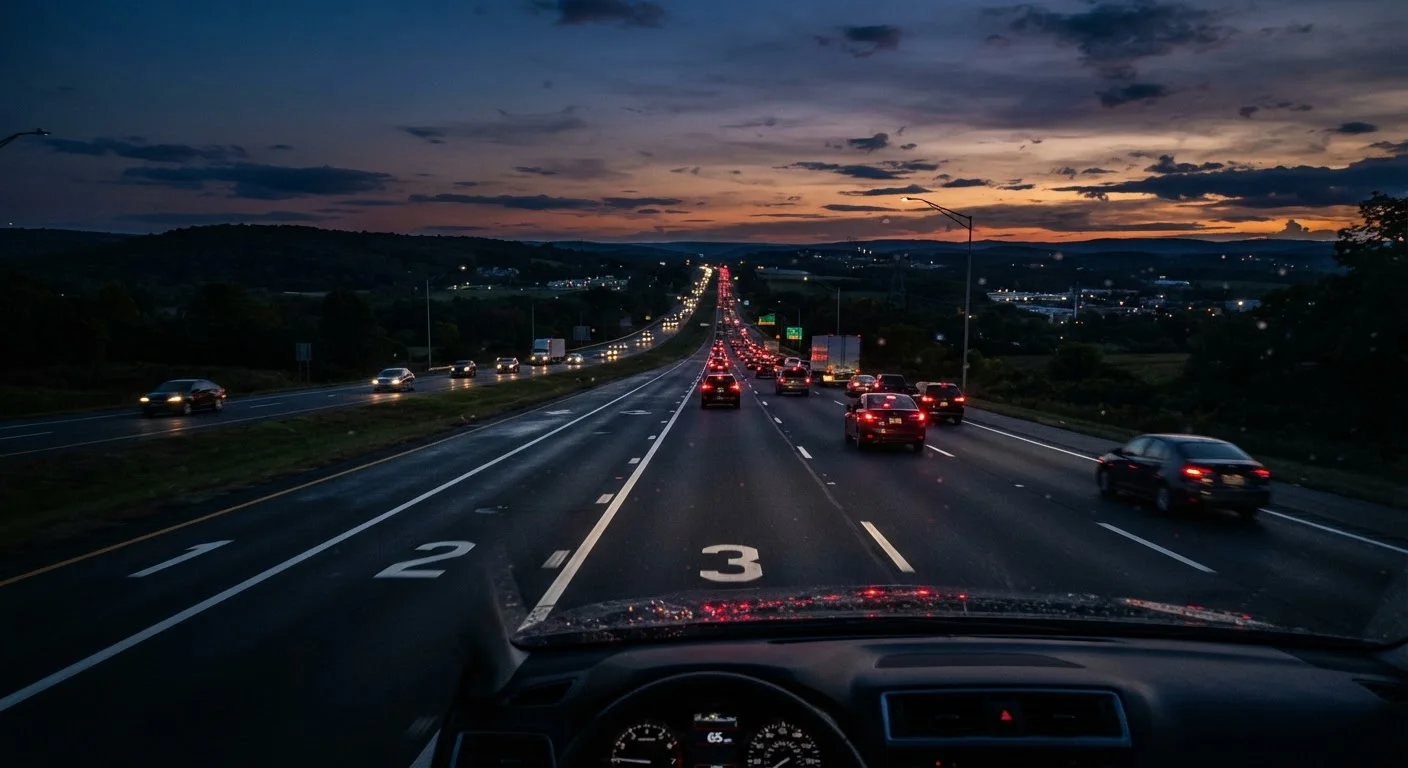
The Two Phases Every Driver Needs to Understand
When a hazard appears on the road, stopping your vehicle is not a single action - it is a two-part process, and understanding both parts is essential to staying safe.
The first phase is reaction distance: the ground your vehicle covers between the moment you perceive a danger and the moment your foot actually depresses the brake pedal. For an alert, undistracted driver, this typically takes about 1.5 seconds. At 60 mph, that's roughly 132 feet of travel before any braking begins.
The second phase is braking distance: how far the car continues to travel while the brakes are actively working. This depends on your initial speed, road surface, tire condition, and braking system effectiveness.
Add them together and you get total stopping distance - the number that actually determines whether you avoid a collision. Many drivers unconsciously plan only for braking distance, underestimating how far they've already traveled before the brakes even engage. This misperception is one of the most common factors in rear-end crashes.
~240 ft
Estimated total stopping distance at 60 mph
Based on general traffic engineering references assuming an alert driver on dry pavement - actual distances vary by vehicle and conditions.
1.5 sec
Average reaction time for an alert driver
Federal Highway Administration guidance cites 1.5 seconds as a commonly used design standard; impairment or distraction increases this substantially.
4×
Braking distance increase when speed doubles
Because kinetic energy scales with the square of velocity, doubling speed roughly quadruples the distance needed to dissipate it through braking.
Why Speed Is an Exponential Problem, Not a Linear One
Here's where physics works against intuition. Most drivers assume that going twice as fast simply means needing twice the distance to stop. In reality, braking distance scales with the square of speed because kinetic energy - the energy that brakes must overcome - increases exponentially.
A rough comparison illustrates this clearly:
- At 30 mph: approximately 75 feet of total stopping distance (dry pavement, alert driver)
- At 60 mph: approximately 240-270 feet - roughly 3.5 times greater, not 2 times
- At 70 mph: distances can exceed 350 feet under the same conditions
These figures are general estimates and can vary significantly based on vehicle type, tire condition, and road surface. The core principle, however, is consistent: small increases in speed produce disproportionately large increases in stopping distance.
This is why speed limits on curves, school zones, and wet-road conditions are set conservatively. It's not bureaucratic caution - it's physics. For a deeper look at how these principles fit into an overall safe-driving approach, see our guide to defensive driving.
Following Distance: Translating Physics Into Practice
The three-second following distance rule is the most practical way to apply stopping distance knowledge in real driving. It works like this: when the vehicle ahead passes a fixed landmark - a sign, a shadow line, a bridge support - begin counting. If you reach that same point before three seconds have elapsed, you are following too closely.
Three seconds functions as a minimum for dry pavement at normal speeds. In rain, extend to four seconds. In fog, heavy traffic, or on roads where stopping distances are less predictable, five seconds or more is appropriate. At highway speeds, three seconds represents well over 200 feet of clearance - but that gap can disappear almost instantly in a sudden stop scenario.
Adjust Your Following Distance for Conditions
Three seconds is the minimum following distance on dry roads at normal speeds. In rain, increase to four seconds; in fog or on ice, extend to five or more. When towing a trailer, add at least one additional second regardless of weather. These adjustments cost almost no extra time on a journey but substantially reduce your collision risk.
Tailgating is one of the leading contributors to rear-end collisions, which are among the most common crash types in the U.S. according to federal traffic safety data. The perceived time saved by following closely is negligible compared to the risk created.
Conditions that demand greater following distance than most drivers instinctively allow include: rain or wet pavement, towing a trailer, driving at night, and traveling downhill. Nighttime driving amplifies many hazards, including reduced visibility that shortens your effective reaction window.
Road Conditions, Tire Health, and Brake Maintenance
Even with perfect technique, your stopping distance is constrained by your vehicle's mechanical condition. Worn tires reduce traction on both wet and dry surfaces - a tire with low tread depth cannot grip the road as effectively, which extends braking distance beyond textbook estimates. Similarly, brake pads that have worn thin lose their ability to transfer braking force efficiently.
Road surface matters just as much. Dry asphalt offers the highest friction. Wet asphalt reduces traction by roughly 30-50%. Packed snow and ice can reduce it far more dramatically, with stopping distances on ice sometimes exceeding those on dry pavement by a factor of four or more. If your vehicle maintenance routine doesn't include periodic tire and brake checks, those figures become unpredictable.
Temperature also affects braking performance. Cold brakes - especially on the first stops of a drive - are less effective than warm ones. This is particularly relevant in winter conditions where both the road surface and the braking system begin the journey cold.
This article is provided for general educational purposes. Always drive in accordance with posted speed limits, local traffic laws, and the conditions present on your specific road. For concerns about your vehicle's braking system or tires, consult a qualified mechanic.
Frequently Asked Questions
The three-second rule means you should stay at least three seconds behind the vehicle ahead. Pick a fixed object on the road; when the car in front passes it, count three full seconds before you reach the same point. In rain, fog, or at highway speeds, extend this to four or five seconds.
Stopping distance increases exponentially with speed because kinetic energy grows with the square of velocity. Going from 30 mph to 60 mph doesn't double your stopping distance - it roughly quadruples it. This is why even modest speed reductions in hazardous conditions have a significant safety impact.
Yes. At 60 mph, a vehicle travels approximately 88 feet per second. Even a one-second reaction time - considered average for an alert, unimpaired driver - means your car moves nearly 90 feet before the brakes even engage. Fatigue, distraction, and impairment all extend this window.
Wet pavement can increase stopping distance by roughly 50% compared to dry conditions, and ice or snow can extend it several times over. Traction is the limiting factor, and modern ABS systems help prevent wheel lockup but cannot overcome physics entirely.
Yes. Heavier vehicles carry more kinetic energy at any given speed, which requires more braking force and distance to dissipate. This is especially relevant for drivers of trucks, SUVs, or vehicles towing trailers - all of which need greater following distances.
The content on this site is provided for informational purposes only and should not be considered a substitute for professional advice. While we strive to provide accurate and up-to-date information, we make no guarantees regarding its completeness or accuracy. Always consult a qualified professional for advice specific to your circumstances before making any decisions.