

Our Verdict
Rain, snow, and fog each create distinct hazards that require tailored responses. No single adjustment - reducing speed alone, for instance - is sufficient across all three. Drivers who understand the specific demands of each condition and rehearse the right habits before encountering them are meaningfully safer than those who rely on instinct alone.
| Best for | Recommended |
|---|---|
| Drivers navigating wet roads and light rain | Rain driving techniques |
| Drivers in winter climates with snow and ice | Snow and ice driving techniques |
| Drivers encountering low-visibility fog events | Fog driving techniques |
Why Each Condition Requires a Different Approach
It's tempting to treat all bad weather as one category - slow down and be careful - but rain, snow, and fog each attack a different aspect of safe driving. Rain primarily compromises tire traction and can cause hydroplaning. Snow and ice reduce both traction and braking efficiency to a far greater degree, while also changing how a vehicle responds to steering inputs. Fog strips away visibility without affecting the road surface at all, creating a unique risk where your car handles normally but you simply cannot see far enough ahead to react in time.
Understanding these distinctions is the foundation of safer driving in adverse conditions. The adjustments that protect you in each scenario are genuinely different - sometimes even contradictory. For a deeper look at how stopping distances change under different road surfaces, see our article on speed limits and following distance.
Driving in Rain: Traction, Hydroplaning, and Following Distance
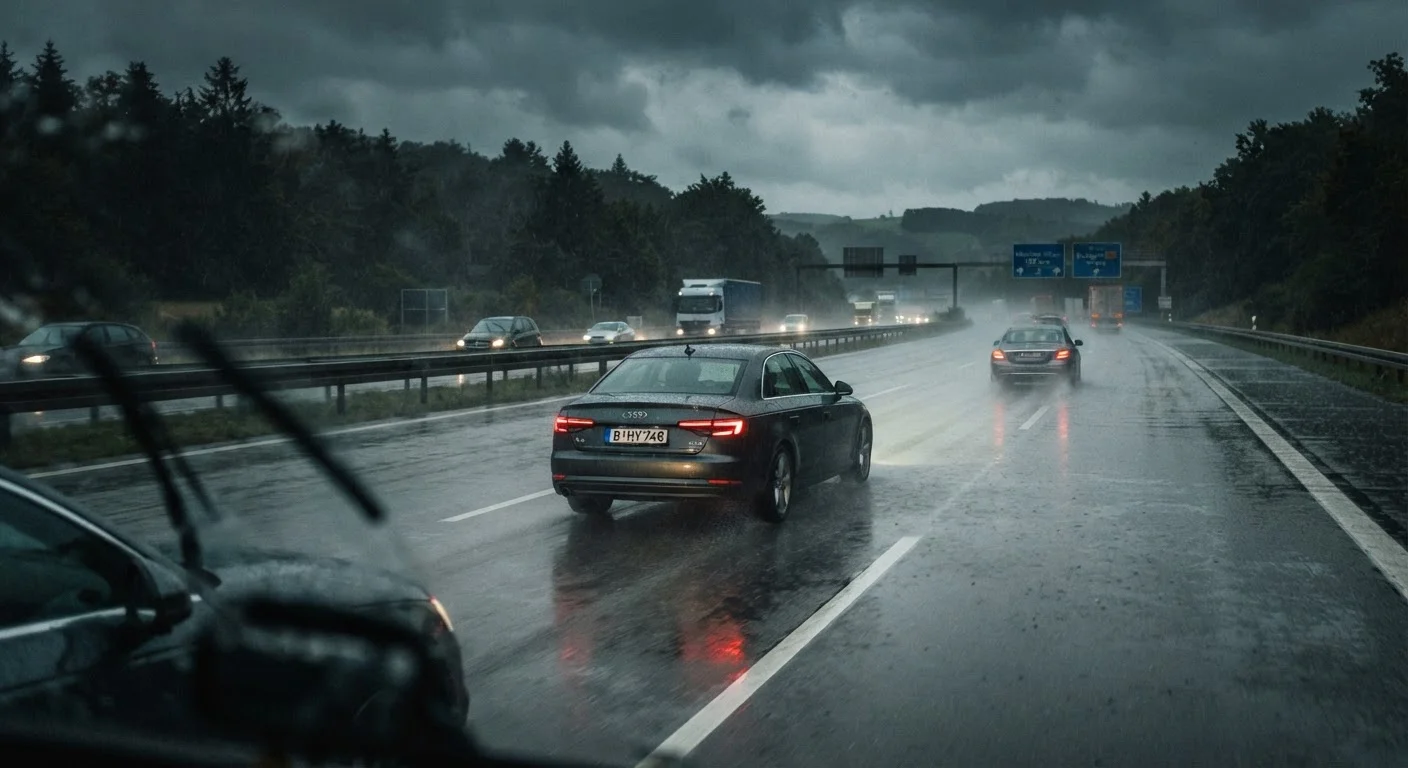
Rain creates a film of water between your tires and the road surface. At speed, this can cause hydroplaning - where a tire rides on top of the water rather than maintaining contact with the pavement, resulting in a near-total loss of steering control. The risk increases with speed, worn tread depth, and standing water depth.
- Reduce speed gradually before wet sections - sudden braking on wet pavement can cause skidding.
- Increase following distance to at least 4-5 seconds. Wet roads can double your stopping distance compared to dry conditions.
- Turn on headlights - many states require lights when wipers are in use, and it dramatically improves your visibility to other drivers.
- Avoid cruise control on wet roads. If a tire hydroplanes, cruise control may accelerate the wheel in an attempt to maintain speed, worsening the loss of control. See our guide on when cruise control is and isn't appropriate.
- If you hydroplane: ease off the accelerator gently, avoid braking hard, and steer straight or very slightly in the direction you want to go until traction returns.
Check Your Tire Tread Before Wet-Weather Drives
The minimum legal tread depth (2/32 of an inch in most states) is not the same as the safest tread depth for wet roads. Many safety organizations suggest replacing tires at 4/32 of an inch for drivers who regularly encounter rain. An easy field check: insert a quarter into a tread groove - if you can see the top of Washington's head, tread is getting low. Worn tires dramatically reduce rain performance regardless of how carefully you drive.
Driving in Snow and Ice: Control, Momentum, and Preparation
Snow and ice represent the most demanding conditions most drivers will encounter. Traction losses are severe, braking distances can increase by four to ten times compared to dry pavement, and oversteer or understeer can occur with minimal provocation. Front-wheel drive, rear-wheel drive, and all-wheel drive vehicles all behave differently on ice - knowing your drivetrain matters.
| Rain | Snow / Ice | Fog | |
|---|---|---|---|
| Primary hazard | Reduced traction, hydroplaning | Severely reduced traction and braking | Severely reduced visibility |
| Recommended following distance | 4-5 seconds minimum | 8-10 seconds minimum | Greater than normal; match sight distance |
| Speed adjustment | Reduce below posted limit | Reduce significantly; post limit assumes dry road | Reduce to match visible stopping distance |
| Headlight setting | Low beams on | Low beams on | Low beams; add fog lights if equipped |
| Cruise control | Avoid - hydroplaning risk | Avoid - reduces driver control | Generally avoid - variable conditions |
| If conditions worsen severely | Pull over safely, wait it out | Pull over; avoid stopping on highway lanes | Pull off road entirely, hazards on |
Beyond drivetrain awareness, your technique must change fundamentally. Apply all inputs - braking, accelerating, steering - slowly and smoothly. Abrupt movements break traction. Leave a following distance of at least 8-10 seconds. On highways in active snow, consider driving well below posted limits; those limits assume dry pavement.
Vehicle preparation before winter travel is non-negotiable. Check that your tires have adequate tread, your battery is tested for cold weather, and your wiper blades are functioning. For a broader approach to year-round vehicle readiness, see our article on keeping a car safe and road-legal long-term. If you drive in states with traction laws, review chain and traction tire requirements by state.
Driving in Fog: The Visibility-Only Hazard
Fog is uniquely disorienting because the road itself is unchanged - but your ability to perceive it collapses. Dense fog can reduce visibility to under 100 feet, which at 45 mph means you're covering that distance in just over 1.5 seconds. That leaves almost no reaction window.
- Use low-beam headlights, not high beams. High beams reflect off the fog particles back toward you, creating a bright wall that makes visibility worse.
- Use fog lights if your vehicle has them - they're positioned lower and produce a flat, wide beam designed for exactly this condition.
- Reduce speed significantly. Your speed should match your sight distance: if you can only see 200 feet ahead, you need to be able to stop within 200 feet.
- Increase following distance well beyond normal. Brake lights ahead may be your only warning, and in dense fog they appear with very little lead time.
- If fog becomes dangerously thick, pull completely off the road - beyond the shoulder if possible - turn off your headlights to avoid other drivers steering toward them, and activate your hazard lights.
Fog shares some visibility challenges with nighttime driving. For context on how darkness creates similar hazards, see our piece on why night driving is riskier than most drivers realize.
Before You Drive: Preparation Matters as Much as Technique
The habits you build before getting in the car are inseparable from what happens on the road. Worn wiper blades, bald tires, and a fogged-up interior don't just reduce comfort - they directly undermine your ability to use the techniques above. Tire tread depth determines whether your rain management or snow techniques will actually work. A defogged windshield is a prerequisite for safe fog navigation.
Run through a vehicle check before any severe-weather trip. Our pre-trip safety checklist for everyday drivers covers what to verify before departure. If conditions are severe enough that you're uncertain whether the drive is safe, it's a legitimate decision to delay. No arrival is worth a crash that better timing could have avoided.
The content on this site is provided for informational purposes only and should not be considered a substitute for professional advice. While we strive to provide accurate and up-to-date information, we make no guarantees regarding its completeness or accuracy. Always consult a qualified professional for advice specific to your circumstances before making any decisions.