

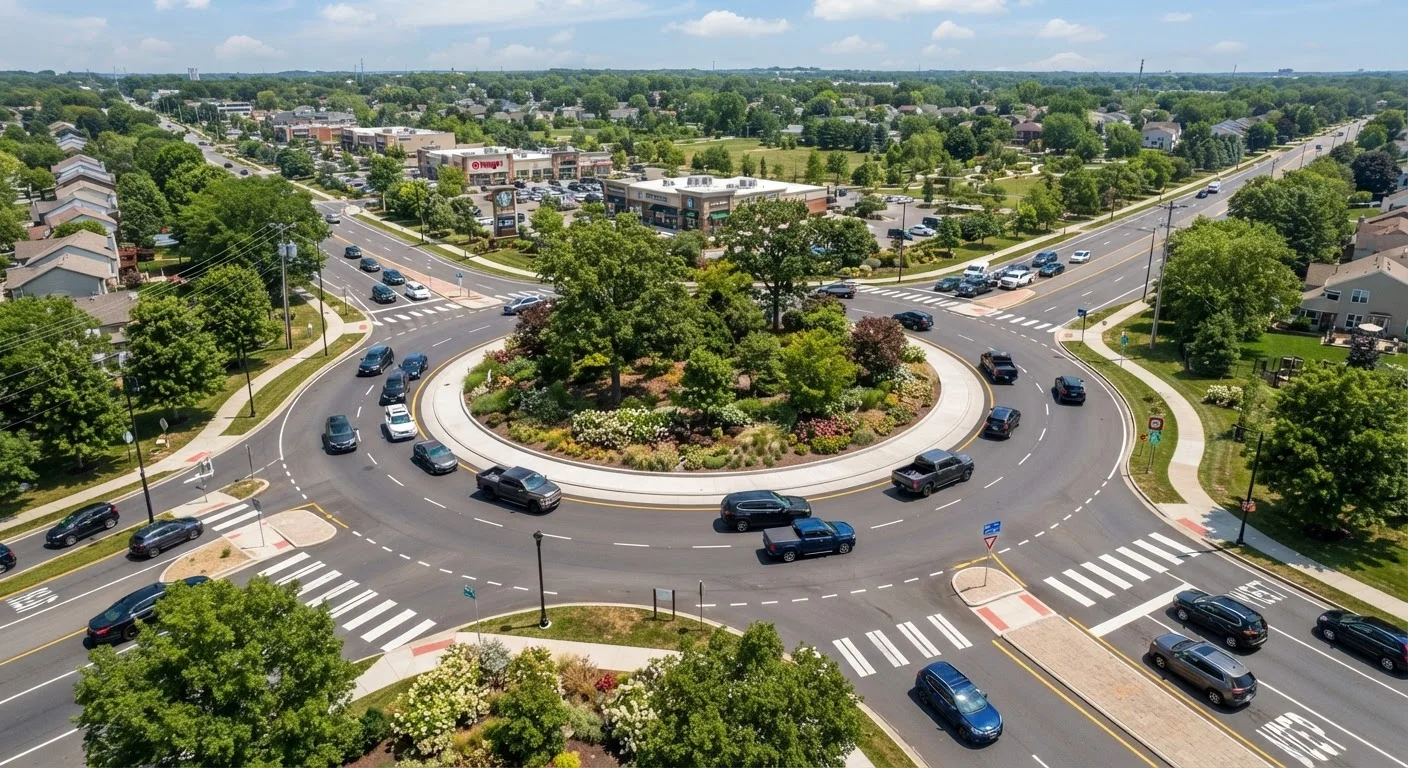
The Basic Rules - and Why They Feel Counterintuitive
Most American drivers learned to navigate intersections controlled by traffic lights or stop signs, where a fixed signal tells you exactly when to move. Roundabouts replace that certainty with a yield-based system that requires drivers to read live traffic conditions and make real-time decisions. That shift in responsibility is the primary reason roundabouts feel unfamiliar.
The core rule is simple: yield to vehicles already in the circle. When you approach the entry, you slow down, look left for circulating traffic, and only merge in when there's a safe gap. Once you're inside, you have the right of way over vehicles waiting to enter. You exit at your desired road, signaling right as you approach it.
Where drivers frequently go wrong is assuming the intersection functions like a four-way stop - waiting for an imagined "turn" rather than merging into available gaps. That hesitation causes rear-end crashes at entries and unnecessary delays. For a closer look at how stop-sign logic differs from yield-based systems, see what drivers get wrong about four-way stops.
~75%
Reduction in injury crashes at converted intersections
The Insurance Institute for Highway Safety (IIHS) has documented roughly a 75% reduction in injury crashes when traditional intersections are converted to roundabouts.
8 vs. 32
Conflict points: roundabout vs. four-way intersection
A single-lane roundabout has approximately 8 vehicle conflict points, compared to 32 at a conventional four-way signalized intersection.
15-25 mph
Typical design speed inside a roundabout
Modern roundabouts are geometrically designed to encourage circulating speeds between 15 and 25 mph, significantly reducing crash severity compared to higher-speed intersections.
Navigating Multi-Lane Roundabouts
Single-lane roundabouts are relatively straightforward once you understand the yield rule. Multi-lane roundabouts add a layer of complexity: you must select your lane before entering, because changing lanes inside the circle is dangerous and, in most states, illegal.
The general principle works like this:
- Right lane: Use for exits in the first half of the roundabout - typically a right turn or the first straight-through exit.
- Left lane: Use for exits further around the circle - straight-through exits and left-turn equivalents.
However, lane assignments vary by roundabout design, so pavement markings and overhead guide signs are your most reliable source of direction. Approach slowly enough to read them before committing to a lane. Once inside, hold your lane consistently. Signal your intended exit as you pass the exit before yours, giving other drivers and pedestrians a clear indication of your path.
This kind of active, anticipatory decision-making is at the heart of defensive driving principles. Reading the road ahead, choosing your position early, and signaling clearly are habits that apply just as much at roundabouts as anywhere else.
Pick Your Lane Before the Yield Line
In multi-lane roundabouts, the time to choose your lane is on the approach road - not at the entry, and certainly not inside the circle. Slow down enough to read the pavement markings and overhead signs before you reach the yield line. Once you commit to a lane, hold it through the entire roundabout. Changing lanes inside is both dangerous and typically prohibited.
Why Roundabouts Are Safer - and What the Data Shows
The safety case for roundabouts is well established in traffic engineering research. The Insurance Institute for Highway Safety (IIHS) has documented that converting traditional intersections to roundabouts reduces injury crashes by roughly 75 percent and fatal crashes by an even higher margin. The geometry explains why.
At a standard signalized intersection, vehicles can collide at right angles at speed - the type of crash that directs enormous force into the side of a vehicle, where occupant protection is most limited. Roundabouts eliminate that scenario. All traffic moves in the same direction, and the curved path forces drivers to slow down. Any collision that does occur tends to be a glancing, lower-speed impact rather than a broadside.
There are also fewer conflict points. A typical four-way signalized intersection has 32 potential vehicle-to-vehicle conflict points. A single-lane roundabout has just 8. Fewer conflict points mean fewer opportunities for crashes.
Understanding how speed directly affects stopping distance - and therefore crash severity - reinforces why roundabout geometry works. See how speed and stopping distance relate for the underlying physics.
Special Situations: Emergency Vehicles, Cyclists, and Pedestrians
A few specific situations cause disproportionate confusion at roundabouts and are worth addressing directly.
Emergency vehicles
If you hear or see an emergency vehicle while inside a roundabout, do not stop inside the circle. Continue to your nearest exit, pull over, and let the vehicle pass. Stopping mid-roundabout blocks circulation and creates hazards for everyone.
Cyclists
Cyclists may either ride through the roundabout in the vehicle lane - in which case they have the same rights and responsibilities as a car - or use a designated shared-use path around the perimeter. Either way, yield to them as you would any vehicle or pedestrian.
Pedestrians
Crosswalks at roundabouts are deliberately set back from the circulating road, located on the entry and exit legs. This design gives pedestrians a safer crossing environment and gives drivers a predictable place to expect foot traffic. Yield to pedestrians before entering and before exiting, treating these crosswalks with the same attention you'd give any marked crossing. Rules around yielding in special zones are also covered in our guide to special zone driving rules.
Frequently Asked Questions
Vehicles already circulating inside the roundabout have the right of way. Drivers approaching the entry must yield until a safe gap exists. This is the foundational rule and the most common source of confusion for drivers unfamiliar with roundabouts.
Choose your lane before you enter, based on your exit. Generally, the right lane is used for right turns and sometimes straight-through exits, while the left lane is for straight-through and left-turn exits. Look for pavement markings and overhead signs - they vary by location.
No. You should never stop inside a roundabout except to avoid a collision. If an emergency vehicle approaches, exit the roundabout first, then pull over. Stopping inside the circle creates a serious collision risk for other drivers.
Yes, according to research by the Insurance Institute for Highway Safety (IIHS). Roundabouts eliminate high-speed, right-angle collisions - the type most likely to be fatal - because all traffic moves in the same direction at reduced speeds. Studies have shown substantial reductions in fatal and serious injury crashes at converted intersections.
Most modern roundabouts include a mountable apron - a slightly raised paved ring around the center island - that allows long vehicles like semi-trucks to use additional space when turning. Drivers of large vehicles should proceed slowly and follow any posted guidance signs.
Pedestrian crosswalks at roundabouts are positioned on the entry and exit legs, set back from the circulating roadway. Drivers must yield to pedestrians in these crosswalks before entering or exiting. Pedestrians should cross one direction of traffic at a time using the splitter island as a refuge.
The content on this site is provided for informational purposes only and should not be considered a substitute for professional advice. While we strive to provide accurate and up-to-date information, we make no guarantees regarding its completeness or accuracy. Always consult a qualified professional for advice specific to your circumstances before making any decisions.