

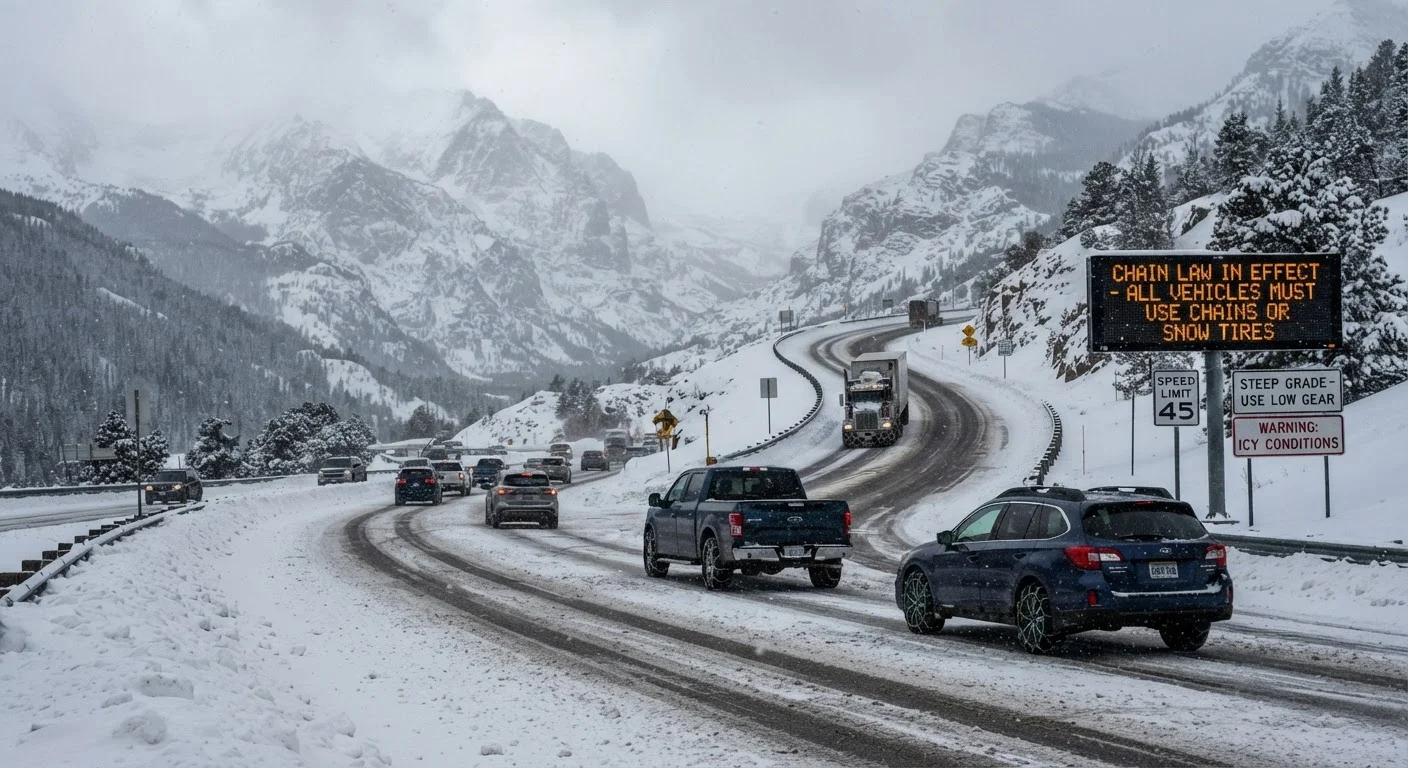
Why Winter Traction Laws Exist - and Why They Vary
Winter traction laws are state-level safety regulations designed to keep roads passable and reduce accident risk during snow and ice events. Because road conditions, terrain, and storm frequency differ dramatically across the country - a Colorado mountain pass is nothing like a North Carolina freeway in a rare ice storm - states have each developed their own frameworks for when and where traction requirements apply.
Understanding these rules matters for any driver who travels between states in winter, navigates mountain routes, or lives where seasonal storms are unpredictable. Fines for non-compliance are real, but more importantly, so is the physical risk of operating an inadequately equipped vehicle on snow-packed or icy roads.
For a broader look at tire readiness before any season, see our tire pressure and tread depth primer - the fundamentals of tread depth apply directly to winter tire selection.
| States with active chain laws | Approximately 10-12 western and mountain states (Based on state DOT regulations as of most recent review) |
| California chain control levels | 3 (R-1, R-2, R-3) (California Department of Transportation (Caltrans)) |
| Colorado minimum tread for traction law compliance | 3/16 inch (Colorado Department of Transportation) |
| Three-peak mountain snowflake test standard | Minimum 10% better snow traction than reference tire (Rubber Manufacturers Association / industry standard) |
| Studded tire permitted states | Approximately 37 states allow studs seasonally (Varies by state, typically October-April window) |
| Minimum legal tread depth (general) | 2/32 inch in most states (Standard U.S. regulatory threshold; winter tire laws may set higher minimums) |
Key Terms: Chains, Traction Tires, and Control Devices
State laws use specific terminology that matters when you're reading a highway sign or a state transportation bulletin. Below are the core terms you'll encounter.
Tire chains
Metal link chains that wrap around a tire's tread to improve grip on snow and ice. They are the most widely accepted traction device under mandatory chain laws and are typically required on drive axles.
Traction tires
Tires that meet a state-defined minimum standard for winter performance, typically including dedicated snow tires (marked with the three-peak mountain snowflake symbol), studded tires, or all-season tires with sufficient tread depth. The exact definition varies by state.
Chain control level
A tiered system used by states like California and Nevada to indicate the severity of required traction equipment. Higher levels (e.g., R-3 in California) restrict access to vehicles with chains regardless of drivetrain type.
Three-peak mountain snowflake (3PMSF)
A symbol molded into a tire's sidewall indicating it has passed a standardized winter performance test. Many states' traction tire definitions require this marking to qualify for exemptions from chain mandates.
Traction law
A regulation requiring vehicles to be equipped with tires and/or equipment that meets a defined traction standard, activated when road conditions deteriorate. Colorado's traction law, for example, specifies minimum tread depth and tire type requirements on designated routes.
Cable chains
A lighter-duty alternative to traditional link chains, using steel cables instead of chain links. Some states accept cable chains as compliant devices; others restrict their use to passenger vehicles only, not commercial trucks.
One important distinction: many states distinguish between requiring traction devices and recommending them. Advisory signs mean conditions are deteriorating; mandatory signs mean you must comply or face a fine and potential forced removal from the road.
A State-by-State Overview of Chain and Traction Laws
No single federal law governs winter traction requirements - each state sets its own rules. The table below summarizes the general framework across states with notable winter regulations. Always verify current requirements with state DOT sources before travel, as activation thresholds can change seasonally or due to updated legislation.
| State | Requirement Type | Where It Applies | Key Detail |
|---|---|---|---|
| California | Chain control / R-1, R-2, R-3 system | Sierra Nevada, mountain highways (e.g., I-80, US-50, US-395) | R-1: chains or snow tires; R-2: chains or AWD with snow tires; R-3: chains on all vehicles regardless of drivetrain |
| Colorado | Traction law / chain law | I-70 mountain corridor and other designated routes | Traction law requires 3/16" tread or better plus AWD/4WD or snow tires; chain law requires chains or approved cables on commercial trucks |
| Washington | Traction tires or chains required | Mountain passes (e.g., Snoqualmie, Stevens, White) | "Traction tires" defined as studded, studdable, or those meeting WSDOT's tread specification |
| Oregon | Traction tires or chains | Cascades and Coast Range routes | Chains required for commercial vehicles; passenger vehicles need traction tires or chains during activation |
| Nevada | Chain requirement (R-O, R-1, R-2) | US-50, I-80 mountain sections, and others | Enforcement is active and fines apply; AWD/4WD vehicles may be exempt at R-1 but not R-2 |
| Idaho | Traction device law | Mountain and northern routes | Studded snow tires, chains, or approved cables; generally applies November through March |
| Montana | No mandatory chain law statewide | N/A statewide | Drivers are expected to use judgment; unsafe vehicle operation is enforceable regardless |
| Wyoming | Traction device requirements | I-80, mountain passes, and high-altitude routes | WYDOT issues requirements dynamically during storms; noncompliant vehicles can be stopped |
| New York | No mandatory chain law | N/A statewide | Winter tires are strongly encouraged; chains are not prohibited but rarely required |
| Virginia | Chains permitted in certain conditions | Mountain zones, southwestern regions | Chains may be mandated on specific roads during storms; check VDOT advisories |
States with infrequent but severe winter events - including Georgia, Tennessee, and the Carolinas - may issue emergency chain or traction requirements on specific routes during ice events, activated by the state DOT in real time. Travelers in these states should monitor state transportation agency alerts during any winter weather system.
Regulations Change - Always Verify Before You Travel
State traction laws and chain requirements are updated periodically and can be activated dynamically during active weather events. A highway pass that had no chain requirement last winter may have new rules this season. Before any mountain or cross-state winter trip, consult the relevant state DOT website directly - most offer real-time road condition and chain control updates by route. Do not rely solely on third-party apps or last season's knowledge.
What Drivers Should Do Before Winter Travel
Compliance begins before you leave the driveway. Here's a practical framework for winter preparedness:
- Know your route's requirements. Check the state DOT websites for every state you'll cross. California's Caltrans, Colorado DOT, and WSDOT all maintain real-time chain control pages.
- Understand your vehicle's drivetrain. AWD and 4WD may satisfy some traction-tire exemptions but rarely satisfy chain requirements at the most severe control levels. Know which exemptions apply to your vehicle.
- Carry chains even when not required. Conditions can change rapidly on mountain routes. Having chains in your vehicle - and knowing how to install them before you need to - is a practical safety measure.
- Check tread depth before the season. Most winter traction laws specify a minimum tread depth. A tire at or below 2/32" is legally worn out in most states and will not perform adequately on snow regardless of its type designation.
- Practice chain installation at home. First-time installation in a snowstorm on a dark mountain shoulder is dangerous. Practice in your driveway before the season starts.
For a complete vehicle readiness routine, our pre-trip safety checklist covers all major systems to inspect before any drive, including in winter conditions. And if you want to refine how you drive once conditions deteriorate, adjusting your driving habits for snow and ice walks through technique adjustments that matter most.
Winter traction laws are one part of a larger picture of road-legal vehicle operation. Our guide to keeping a car safe and road-legal long-term covers how to stay current on seasonal and year-round requirements.
This article is for general informational purposes only. Traction laws and chain requirements are subject to change and vary by route, season, and conditions. Always verify current requirements directly with the relevant state Department of Transportation before traveling.
The content on this site is provided for informational purposes only and should not be considered a substitute for professional advice. While we strive to provide accurate and up-to-date information, we make no guarantees regarding its completeness or accuracy. Always consult a qualified professional for advice specific to your circumstances before making any decisions.