

The Data Makes the Case
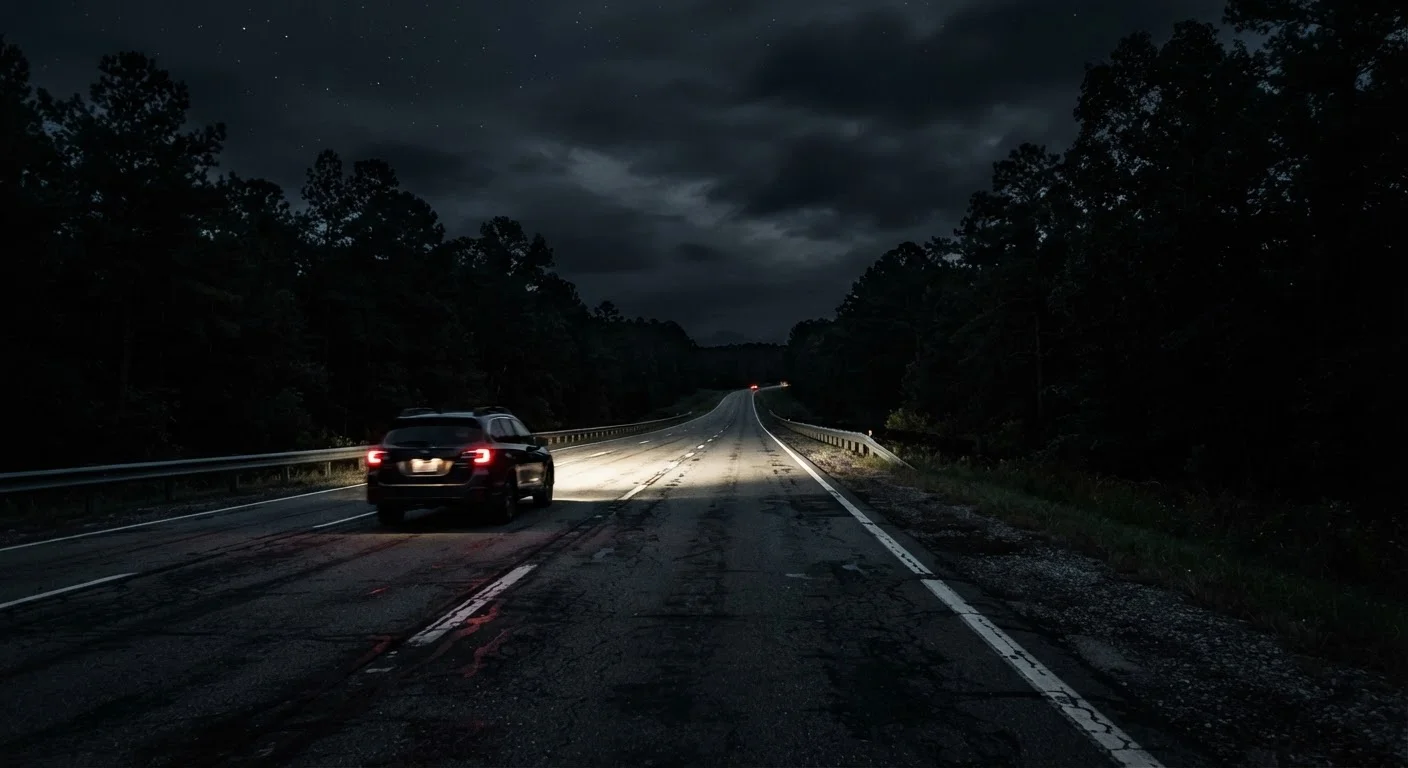
Most drivers feel reasonably comfortable on familiar roads after dark, which may be exactly the problem. Familiarity breeds underestimation. According to the National Highway Traffic Safety Administration (NHTSA), roughly 50 percent of all traffic fatalities occur at night, even though nighttime accounts for only about 25 percent of total vehicle miles traveled. That math produces a fatality rate per mile roughly three times higher after dark than during daylight hours.
The reasons are layered. Darkness degrades every visual input drivers rely on: peripheral vision narrows, depth perception weakens, and the ability to judge the speed of oncoming vehicles deteriorates. Human eyes are not optimized for low-contrast environments - and a road at night, even a well-lit one, is fundamentally a low-contrast environment.
~50%
Of fatal crashes occur at night
According to NHTSA data, approximately half of all traffic fatalities happen after dark despite nighttime representing only about a quarter of miles driven.
75%+
Of pedestrian fatalities occur at night
NHTSA consistently reports that the large majority of pedestrian traffic deaths take place during nighttime hours, when both visibility and impairment risks are elevated.
3x
Higher fatal crash rate per mile at night
When total miles driven are accounted for, the fatality rate after dark is roughly three times higher than during daylight, reflecting compounded visibility and behavioral risks.
Fatigue compounds the problem significantly. The body's circadian rhythm naturally promotes drowsiness in the late evening and again in the pre-dawn hours, regardless of how much sleep a driver has had. Drowsy driving impairs reaction time, lane-keeping, and hazard detection in ways that closely mirror alcohol impairment. Nighttime driving stacks these physiological disadvantages on top of the visual ones.
Why Nighttime Crashes Are Different in Character
Nighttime fatal crashes skew heavily toward certain patterns that daytime crashes do not. Pedestrian fatalities are dramatically overrepresented after dark - the NHTSA has consistently found that more than 75 percent of pedestrian fatalities occur at night. This is partly because pedestrians are genuinely harder to see, and partly because both drivers and pedestrians are more likely to be impaired.
Alcohol-impaired driving is another defining feature of nighttime crash data. Fatal crashes between midnight and 3 a.m. involve impaired drivers at rates far exceeding any daytime window. This is not incidental - it reflects the social and behavioral patterns surrounding nighttime driving as much as any physical hazard.
Rural roads pose a particular challenge after dark. Compared with urban streets, rural roads typically have no streetlights, more wildlife crossing hazards, higher posted speed limits, and less forgiving roadsides. A driver whose headlights illuminate only 200-250 feet ahead - a standard low-beam range - is traveling beyond their ability to stop in time at highway speeds. This mismatch between visibility distance and stopping distance is sometimes called "overdriving your headlights," and it is far more common than most drivers realize. See our guide to stopping distances for the underlying math.
“Darkness is not merely an inconvenience for drivers - it fundamentally changes the information environment in ways that most people consistently underestimate. The crash data reflects that underestimation.”
— Jonathan Adkins, Chief Executive Officer, Governors Highway Safety Association
Best Practices That Meaningfully Reduce Nighttime Risk
The following practices are grounded in crash data, vehicle physics, and human factors research. They are ordered by the breadth of risk they address, not by difficulty.
Keep your headlights properly aimed and your lenses clean.
Misaligned headlights reduce effective illumination range and can blind oncoming drivers, while oxidized or fogged lenses cut light output by up to 80 percent. Neither defect is obvious from the driver's seat, which means many drivers don't realize they're operating with severely degraded lighting.
Increase your following distance to at least four seconds after dark.
The standard three-second following distance assumes adequate visibility and a fully alert driver. At night, both conditions are compromised. Adding an extra second provides a buffer for the longer perception-reaction time that low-light conditions impose.
Use high beams on unlit roads and dim them promptly for oncoming traffic.
High beams roughly double effective visibility range compared to low beams, yet many drivers never use them out of habit or uncertainty about when it's appropriate. Failing to switch them off for oncoming vehicles, however, temporarily blinds other drivers and creates its own hazard.
Actively scan for pedestrians, cyclists, and animals beyond the lit roadway.
Nighttime pedestrian fatalities are heavily concentrated in situations where the pedestrian was visible - but the driver was not actively scanning. The edge of the road, medians, and intersections are higher-risk zones that deserve deliberate attention, not just a glance.
Plan night driving to avoid the highest-risk fatigue windows.
Circadian biology makes the hours between midnight and 6 a.m. especially dangerous for drivers, with a secondary dip in alertness in the mid-afternoon. Scheduling long-distance night travel to avoid these windows - or building in rest stops - is one of the most effective fatigue countermeasures available.
Reduce speed below posted limits when visibility is compromised.
Speed limits are set for conditions that include adequate visibility; they are not guarantees of safety in darkness, fog, or rain. Driving at a speed that keeps your stopping distance within your headlight range - not just within the legal limit - is the correct standard.
Start Tonight: Quick Wins for Immediate Impact
Not every safety improvement requires a schedule change or a mechanic's appointment. Several of the highest-impact adjustments can be made right now, before your next after-dark drive.
Distraction compounds every nighttime hazard described above. Cognitive load narrows the attentional field at a time when the visual field is already narrowed by darkness. If you haven't already reviewed the evidence on in-car phone use, our analysis of hands-free driving risks is worth the read. And if your nighttime driving tends to happen on longer road trips, adverse weather conditions add yet another layer of complexity that demands separate preparation.
The content on this site is provided for informational purposes only and should not be considered a substitute for professional advice. While we strive to provide accurate and up-to-date information, we make no guarantees regarding its completeness or accuracy. Always consult a qualified professional for advice specific to your circumstances before making any decisions.