

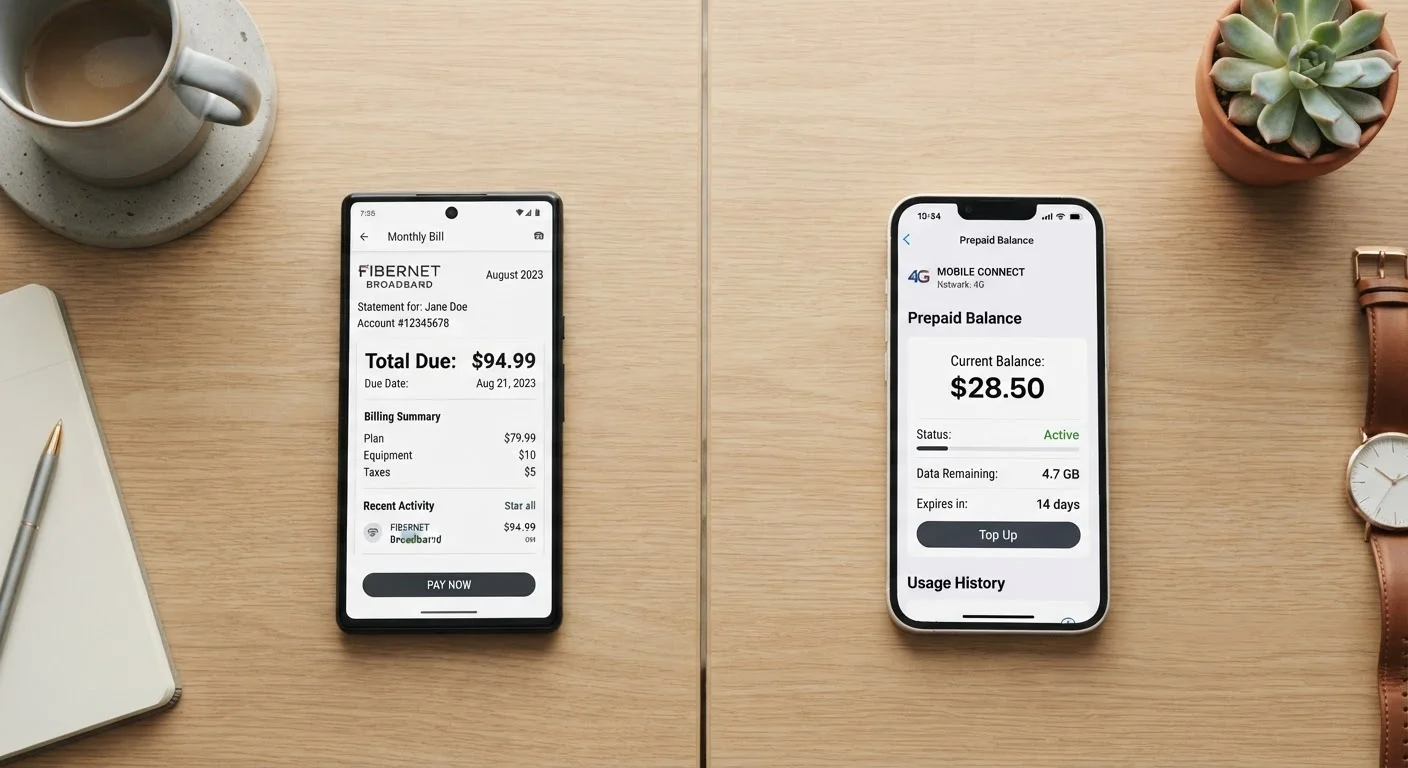
Option A
Prepaid Wireless
The pay-as-you-go, no-commitment approach.
Best for: Consumers who want cost control, no credit check, and the freedom to switch carriers without penalty.
Option B
Postpaid Wireless
The traditional monthly billing model with broader perks.
Best for: Consumers who want the latest devices on installment plans, multi-line family accounts, and premium network priority.
How the Two Billing Models Actually Work
The core distinction between prepaid and postpaid wireless is timing: when you pay relative to when you use service.
Prepaid means you load funds or purchase a plan before service begins. Your phone works until the balance or plan period runs out. There's no billing cycle, no invoice, and no obligation to renew. If you stop paying, service simply stops - there's nothing to collect.
Postpaid works like most utility bills. You use service throughout the month, and the carrier invoices you afterward. Because the carrier is extending service before receiving payment, it typically runs a credit check when you open the account. That check helps the carrier assess whether you're likely to pay the bill at month's end.
This timing difference cascades into nearly every other distinction between the two plan types - from device financing to network priority to how easy it is to leave a carrier.
| Criterion | Prepaid Wireless | Postpaid Wireless |
|---|---|---|
| Payment timing | Pay before service begins | Billed after monthly use |
| Credit check required | No | Yes, typically |
| Contract or commitment | None | Implied via device financing |
| Device financing options | Generally unavailable | Installment plans common |
| Network deprioritization | Earlier during congestion | Later during congestion |
| Ease of switching carriers | Very easy, no penalties | May owe device balance |
| Multi-line family discounts | Limited availability | Common and scalable |
| Security deposit risk | None | Possible with poor credit |
Credit, Commitments, and What It Costs to Leave
One of the most practical differences for many consumers is the credit check. Postpaid accounts are essentially a short-term credit arrangement - you're being trusted to pay at the end of each billing cycle. Carriers verify that trust through a credit inquiry, which can affect your credit score slightly and may result in a security deposit requirement if your history is limited or poor.
Prepaid plans skip this entirely. There's no application, no soft pull, and no deposit. That makes prepaid a genuine option for people rebuilding credit, new to the US credit system, or simply unwilling to share financial history with a carrier. For context on how credit inquiries work in other financial contexts, see our overview of secured vs. unsecured credit cards.
Postpaid plans also tend to involve implicit or explicit commitments. Even when carriers advertise "no contracts," device installment plans create a financial tie - leave before paying off the phone and you may owe the remaining balance immediately. Prepaid plans carry no such obligation. You can cancel, pause, or switch at the end of any plan period without a financial consequence tied to your account.
Postpaid Doesn't Always Mean "Better"
Carriers often market postpaid plans as the premium tier, but the right choice depends entirely on your usage habits, financial situation, and how much you value flexibility. A prepaid plan on a major carrier's network can deliver equivalent coverage and speeds in most markets. The differences in deprioritization and device financing are real, but they may not matter for your specific circumstances.
Network Priority, Coverage, and What Prepaid Customers Should Know
A persistent myth is that prepaid plans use inferior or separate networks. In most cases, that's not accurate - prepaid plans from major carriers, and plans from mobile virtual network operators (MVNOs), run on the same towers as postpaid service.
The real difference is deprioritization - a policy buried in most carrier service agreements. When a cell tower becomes congested, carriers manage traffic by temporarily slowing data speeds for lower-priority customers. Postpaid subscribers are generally deprioritized last. Prepaid customers, and especially MVNO customers, are deprioritized first. In practice, this matters most in densely populated areas during peak hours. In less congested markets, most prepaid customers never notice a difference.
Before signing any plan, it's worth reading how deprioritization is described in the service terms. Our guide on what wireless plan fine print is actually telling you breaks down how to find and interpret these clauses.
~40%
US wireless subscribers on prepaid
Industry analysts have estimated that roughly 40% of US wireless connections are on prepaid or MVNO plans, reflecting widespread adoption beyond just budget-conscious consumers.
24-36 months
Typical postpaid device installment term
Most major US carriers structure smartphone financing across 24 or 36 monthly payments, creating a long implicit commitment even on "no-contract" postpaid plans.
Devices, Financing, and Plan Flexibility
Device financing is almost exclusively a postpaid feature. Installment plans that spread a phone's cost across 24 or 36 months are tied to your postpaid account and credit profile. Trade-in promotions - where a carrier credits you for an old device toward a new one - are similarly structured around postpaid commitments. Understanding the mechanics of those deals before agreeing to them is important, and our article on trade-in programs and device payment plans covers the structure in detail.
Prepaid customers who want a new phone typically purchase it outright or bring an existing unlocked device. This requires more upfront capital but eliminates carrier lock-in. For more on why device lock status matters when switching plans, see our explainer on unlocked phones vs. carrier-locked devices.
On the plan side, prepaid offers more agility. You can change plan tiers, switch carriers, or pause service month to month. Postpaid accounts with financed devices are stickier by design. If you're evaluating whether you're currently on the wrong plan type entirely, our guide on assumptions that cost people money when picking a wireless plan is a useful reference before making any changes.
The content on this site is provided for informational purposes only and should not be considered a substitute for professional advice. While we strive to provide accurate and up-to-date information, we make no guarantees regarding its completeness or accuracy. Always consult a qualified professional for advice specific to your circumstances before making any decisions.