

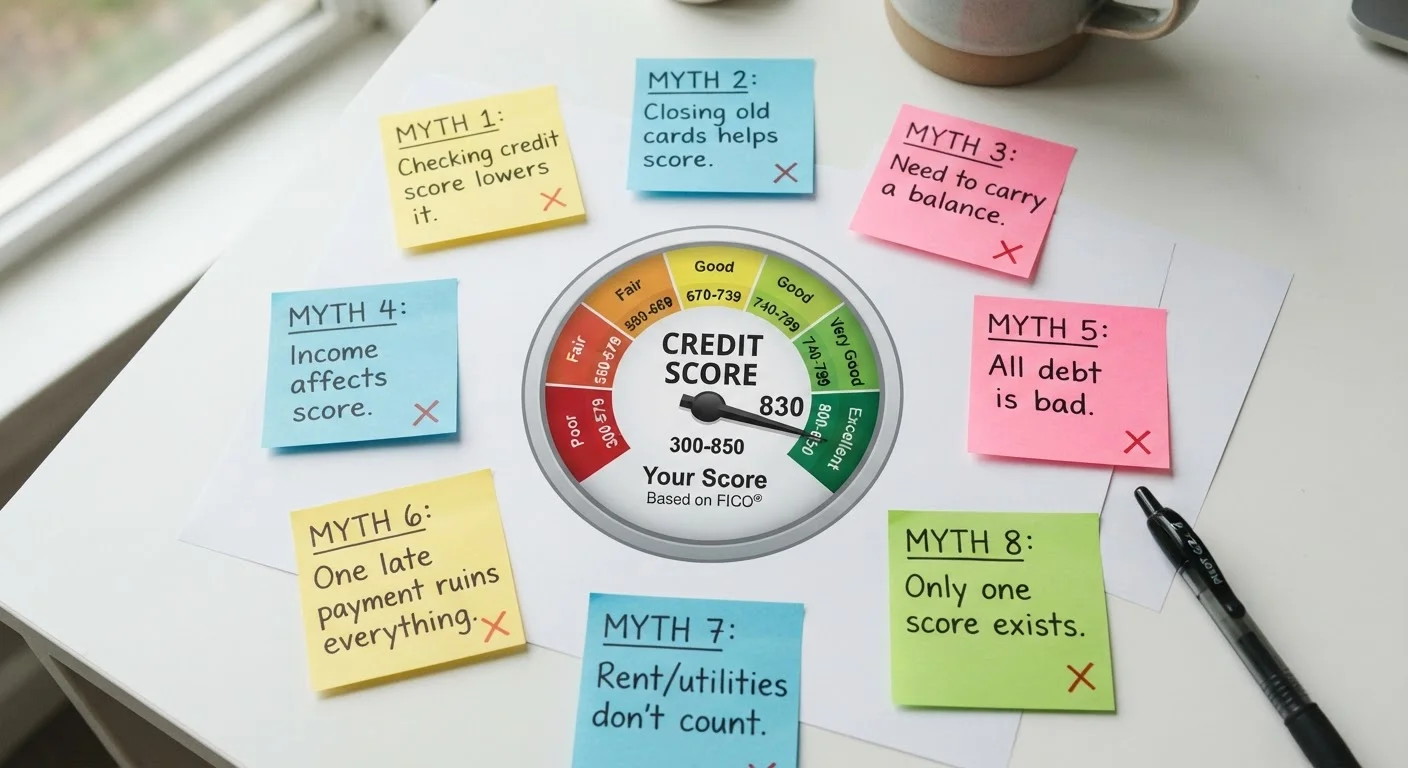
Why Credit Myths Spread and Why They Stick
Credit scores govern some of the most consequential financial decisions Americans face - mortgage approvals, car loans, apartment applications, even some job screenings. Yet the system remains opaque to most people, creating fertile ground for myths that circulate as fact through word of mouth, social media, and well-meaning but misinformed advice.
Understanding what your score actually measures is the first line of defense. If you haven't already, it's worth reading what your credit score actually measures before acting on anything you've heard. Below, we tackle the most persistent myths head-on.
Myth
Checking your own credit score will lower it.
Fact
Checking your own score is a 'soft inquiry' and has absolutely no effect on your credit score.
Credit inquiries come in two forms: hard and soft. A hard inquiry occurs when a lender reviews your credit as part of a credit application - this can temporarily lower your score by a few points. A soft inquiry occurs when you check your own score, or when a lender pre-screens you for an offer. Soft inquiries are invisible to other lenders and carry zero scoring weight. Monitoring your own score regularly is actually a recommended habit - it helps you catch errors or signs of identity theft early.
Myth
Your income directly affects your credit score.
Fact
Income is not a factor in any standard credit score model, including FICO and VantageScore.
Credit scores are calculated from information in your credit report: payment history, amounts owed, length of credit history, credit mix, and new credit. Your salary, wages, or household income appear nowhere in that report and contribute nothing to your score. A high earner with missed payments can have a poor score, while someone earning a modest income can have an excellent score by managing credit responsibly. Income does matter to lenders evaluating your ability to repay - but that assessment happens separately from the score itself.
Myth
Carrying a small balance on your credit card each month builds your credit score.
Fact
Paying your balance in full each month is better for your score and avoids interest charges entirely.
This myth likely persists because people conflate using credit with carrying a balance. What actually helps your score is demonstrating responsible use - meaning charging to the card and paying on time. Leaving a balance does not signal financial health to scoring models; it simply means you're paying interest for no scoring benefit. Keeping your utilization ratio low (generally below 30%, and ideally lower) is far more important than ensuring a balance rolls over month to month.
Myth
Once negative items are seven years old, your credit record is wiped clean.
Fact
Seven years is the general reporting limit for most negative items, but the timeline and scope vary by item type.
Under the Fair Credit Reporting Act (FCRA), most negative information - late payments, collections, charge-offs - can stay on your report for up to seven years. However, Chapter 7 bankruptcy can remain for up to 10 years. Additionally, removing old negative items doesn't automatically produce a great score; if you haven't built positive credit history in the meantime, your file may simply be thin rather than strong. The goal should be actively building good history, not waiting for bad history to expire.
Myth
You only have one credit score.
Fact
You have many credit scores - different models and bureaus can produce meaningfully different numbers.
There are three major credit bureaus (Equifax, Experian, and TransUnion), and each may hold slightly different information about you. On top of that, there are multiple scoring models - different versions of FICO, VantageScore, and industry-specific models used for auto loans or credit cards. The score a mortgage lender pulls may differ from the score shown on your bank's mobile app. Understanding this variability helps you interpret your scores accurately rather than anchoring to a single number as definitive.
Myth
Closing unused credit cards is always a smart financial move.
Fact
Closing credit cards can raise your utilization ratio and shorten your credit history, both of which may lower your score.
When you close a card, you lose that card's available credit limit, which means any existing balances now represent a larger share of your total available credit - pushing your utilization ratio higher. If the card is one of your oldest accounts, closure can also reduce the average age of your credit history. Neither outcome is beneficial for your score. Keeping low-fee or no-fee cards open and occasionally using them for a small purchase (then paying in full) is generally the safer approach.
How Knowing the Facts Can Protect Your Financial Health
Acting on a credit myth can produce real, lasting consequences. Closing a card you rarely use - because it feels responsible - may shorten your credit history and inflate your credit utilization ratio (the share of available credit you're currently using), both of which drag your score down. For a deeper look at why that happens, see our guide on why closing old credit cards can hurt you.
Similarly, consumers who believe that carrying a balance builds goodwill with lenders are paying unnecessary interest for zero credit benefit. That myth - and others like it - is examined in detail in our article on myths about carrying credit card debt.
Myth-Based Decisions Can Cause Real Score Damage
Acting on misinformation - closing old cards, avoiding credit checks, or deliberately carrying a balance - can actively harm the score you're trying to protect. Before making any significant change to your credit behavior, verify the underlying assumption with a credible source such as the Consumer Financial Protection Bureau (CFPB) or consult a nonprofit credit counselor. Small misunderstandings can translate into points lost that take months to recover.
One more nuance worth noting: when you apply for a mortgage or auto loan and want to rate-shop across lenders, most modern scoring models treat multiple inquiries for the same loan type within a 14-45 day window as a single inquiry. That means comparison shopping for rates carries far less scoring risk than many people fear. For the full picture on how inquiries work, see our explainer on hard inquiries, soft inquiries, and your credit score.
3 in 5
Americans with at least one credit report error
A Federal Trade Commission study found that approximately 1 in 5 consumers had an error on at least one of their three credit reports - underscoring the value of regular monitoring.
35%
Share of FICO score from payment history
Payment history is the single largest factor in standard FICO score models, making on-time payments the highest-leverage habit for building or maintaining good credit.
Finally, it's worth remembering that your credit score and your credit report are related but distinct. Lenders often review both. Understanding how they differ is essential context when you're trying to improve your financial profile. For a full view of what lenders actually examine beyond the score itself, see what lenders look at when you apply for a loan.
This article is for general informational and educational purposes only and does not constitute personalized financial or legal advice. Consult a qualified financial professional regarding your individual circumstances.
The content on this site is provided for informational purposes only and should not be considered a substitute for professional advice. While we strive to provide accurate and up-to-date information, we make no guarantees regarding its completeness or accuracy. Always consult a qualified professional for advice specific to your circumstances before making any decisions.