

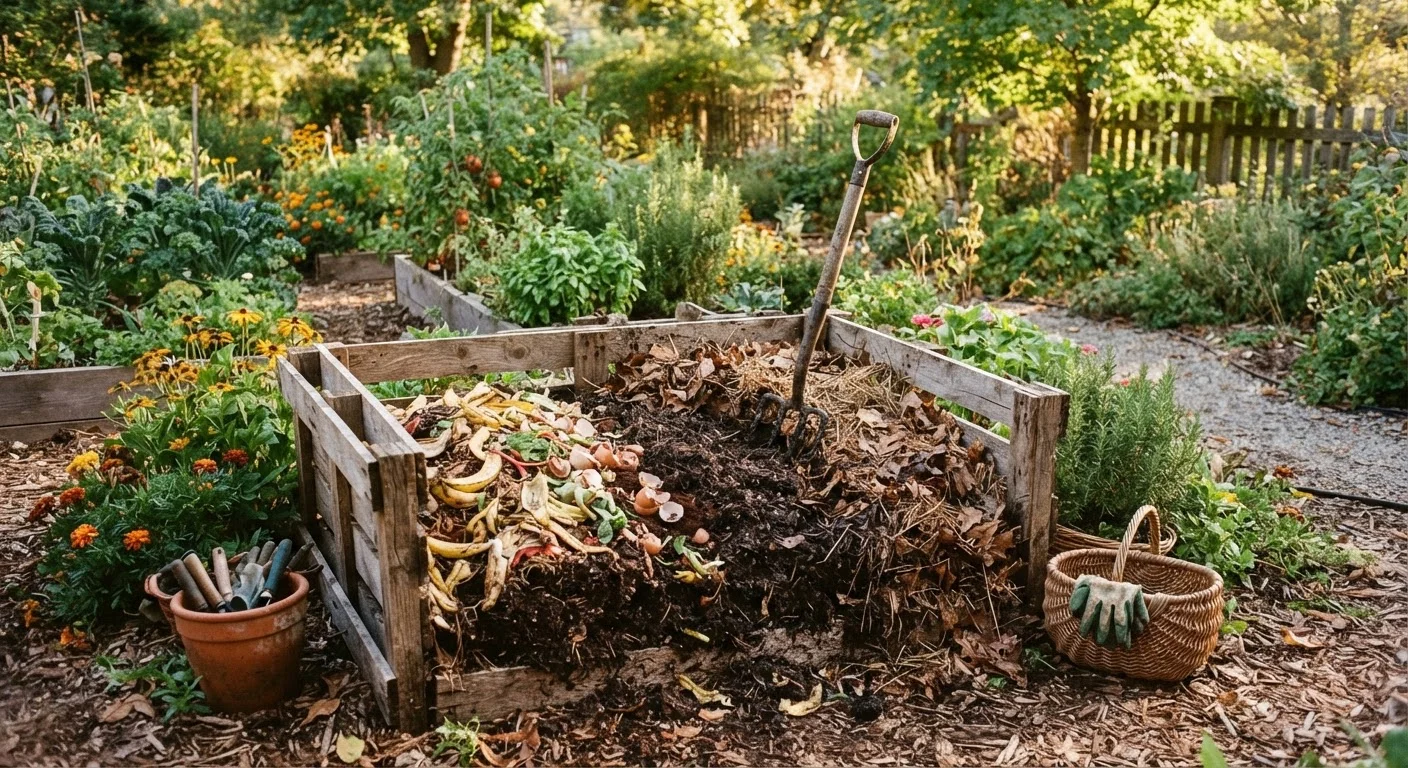
Why Composting Gets Overcomplicated
Search for composting advice online and you'll quickly encounter thermometers, moisture meters, turning schedules, and a vocabulary that sounds more like chemistry than gardening. This complexity discourages people who could be composting successfully with almost no effort. The core process - microbes and fungi breaking down organic material into a stable, nutrient-rich soil amendment - happens whether you optimize it or not.
The guides that emphasize precision are written for people who want the fastest possible results or who manage large-scale systems. For a home gardener trying to reduce food waste and improve their soil, a much simpler approach works just fine. Understanding a handful of real facts replaces all that complexity.
Myth
Composting requires a specific bin system and careful carbon-to-nitrogen ratios to work.
Fact
A loose pile on the ground will decompose without any bin or measuring - nature does this without instructions.
Many composting guides lead with elaborate three-bin systems and ratios like "30:1 carbon to nitrogen." For beginners, this creates the impression that composting is a technical process with strict rules. In reality, organic matter breaks down on its own in any configuration. A simple heap in a corner of your yard, turned occasionally and kept moderately moist, will produce usable compost over time. Ratios and bins speed the process and manage odor, but they aren't prerequisites for success.
Myth
Compost piles always smell terrible and attract pests.
Fact
A well-managed pile has an earthy, soil-like smell. Odors and pests usually trace back to a single correctable issue.
Odor problems typically mean the pile is too wet, lacks airflow, or contains too many nitrogen-heavy materials (like fresh food scraps) without enough dry carbon material (like dead leaves or cardboard). Adding dry browns and turning the pile to introduce oxygen usually resolves the smell within a few days. Pests are mainly attracted by meat, dairy, or cooked food - leaving those out of a backyard pile eliminates most pest pressure.
[warning_callout]Myth
You need a large yard to compost - it isn't practical for small spaces.
Fact
Compact methods like worm bins (vermicomposting) or countertop fermentation systems work in apartments and on patios.
Vermicomposting uses red wiggler worms in a contained bin roughly the size of a storage tote. It processes kitchen scraps quickly and produces a nutrient-rich castings material ideal for container plants. This method fits under a kitchen sink or on a shaded balcony. If you're already growing in containers, see our container gardening guide for pairing these nutrient sources with small-space growing setups.
Myth
Compost takes years to make and isn't worth the effort for home gardeners.
Fact
Hot, actively managed piles can produce finished compost in as little as four to eight weeks.
Timeline depends on particle size, moisture, turning frequency, and material balance. Shredded or chopped materials, regular turning (every few days), and the right moisture level accelerate microbial activity dramatically. Even a passive, unmanaged pile typically finishes in three to six months - fast enough to benefit the same growing season. Finished compost looks dark, crumbles easily, and smells like forest floor. If you're incorporating compost into a new garden bed, our vegetable garden starting guide covers soil prep in more detail.
Myth
Only yard waste belongs in a compost pile - kitchen scraps cause problems.
Fact
Most kitchen scraps are excellent compost ingredients; only a short list of items should be avoided.
Fruit and vegetable peels, coffee grounds, eggshells, tea bags, and plain cooked grains all compost well. The materials to avoid in a home pile are meat, fish, dairy, oily foods, and anything diseased. These items can create odors and attract unwanted wildlife. Everything else from a typical kitchen - the majority of what most households discard - is fair game and actually accelerates decomposition due to its high moisture and nitrogen content.
[important_callout]What Finished Compost Actually Does for Your Soil
Compost improves soil in several ways that synthetic fertilizers don't replicate. It adds organic matter, which feeds beneficial microbial communities and improves soil structure. Sandy soils retain moisture better; clay soils drain and aerate more effectively. These structural benefits persist long after the nutrients have been used by plants.
Finished compost also buffers soil pH, making nutrients more accessible to roots across a wider range of conditions. When worked into planting beds or used as a top dressing, it supports the kind of living soil that healthy plants depend on. If you're looking at how compost fits alongside other soil-improvement strategies, our overview of year-round lawn and garden care includes seasonal timing for amending beds. For a related comparison, mulch types and their uses covers what mulch does differently from compost - both have a place in a well-managed yard.
~30%
Share of household waste that is compostable
The U.S. Environmental Protection Agency estimates that food and yard waste together make up roughly 30% of what Americans throw away - material that could be composted instead of landfilled.
4-8 weeks
Time to finished compost with active management
University cooperative extension programs commonly cite this range for hot, actively turned piles with shredded materials and balanced moisture.
Gardeners interested in reducing ongoing maintenance may also find that compost-enriched soil supports native plants, which are already adapted to regional conditions and require fewer inputs over time.
The content on this site is provided for informational purposes only and should not be considered a substitute for professional advice. While we strive to provide accurate and up-to-date information, we make no guarantees regarding its completeness or accuracy. Always consult a qualified professional for advice specific to your circumstances before making any decisions.