

Start here
Why Tires Deserve More Attention Than They Get
Core skill
Tire Pressure: What PSI Means and How to Check It
Next
Tread Depth: Reading the Warning Signs
Then
Tire Rotation: Why Position Matters
Wrap up
Putting It All Together
Why Tires Deserve More Attention Than They Get
Tires are the only part of your vehicle in contact with the road. Every braking force, every turn, every acceleration is transmitted through four contact patches roughly the size of a hand. Yet tire care is one of the most overlooked parts of routine vehicle ownership.
Neglected tires don't just wear out faster - they compromise handling, increase stopping distances, and raise the risk of a blowout at highway speed. The good news: the three core tasks covered here (monitoring pressure, measuring tread, and rotating on schedule) take minimal time and require no specialized skills. For a broader look at how tire care fits into year-round vehicle upkeep, see the seasonal car maintenance checklist.
Tire Pressure: What PSI Means and How to Check It
PSI (pounds per square inch) is the unit used to measure tire pressure. Every vehicle has a manufacturer-recommended PSI for its tires - and that number lives on a sticker inside the driver's door jamb or in the owner's manual. Do not use the number molded onto the tire sidewall; that figure represents the maximum the tire can physically hold, not the safe operating pressure for your specific vehicle.
PSI
Pounds per square inch - the unit used to measure the air pressure inside a tire. Your vehicle's recommended PSI is specific to your car, not to the tire brand.
Tread depth
The measurement of how much rubber remains in the grooves of a tire. More depth means better grip, especially in wet conditions.
Tire rotation
Moving each tire to a different position on the vehicle (e.g., front-left to rear-left) to even out the wear each tire experiences over time.
Wear indicator bars
Small raised rubber ridges built into tire tread grooves that become flush with the surface when tread reaches the legal minimum depth of 2/32 inch.
Cold inflation pressure
The tire pressure measured after the vehicle has been parked for at least three hours, before heat from driving raises the reading. Always check and set pressure when tires are cold.
Directional tires
Tires designed to rotate in only one direction, identified by an arrow on the sidewall. They require a specific rotation pattern and cannot simply be swapped side-to-side.
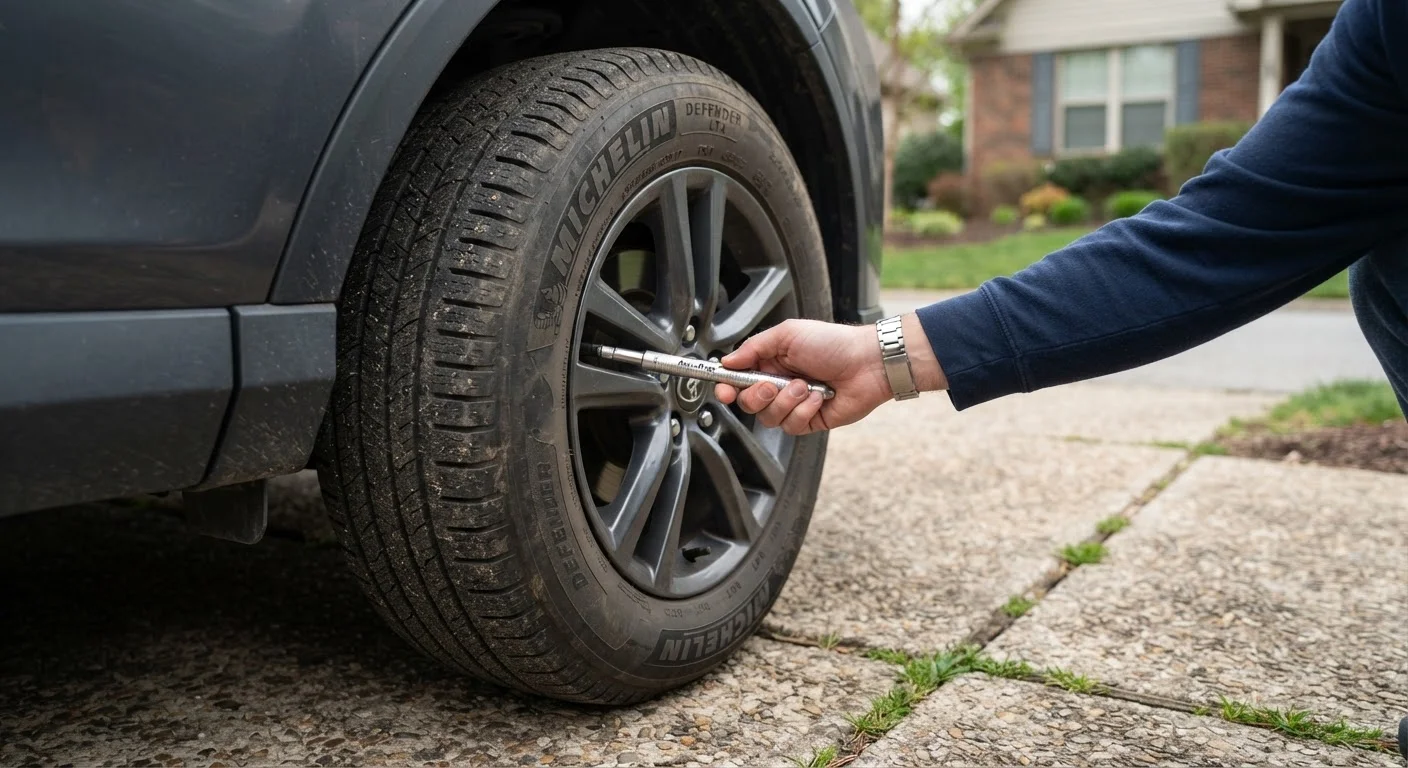
To check pressure correctly, use a digital or dial-type tire gauge when the tires are cold - meaning the car hasn't been driven for at least three hours. Driving heats the air inside tires and temporarily raises pressure readings. Remove the valve cap, press the gauge firmly onto the valve stem, and read the result.
Temperature affects pressure significantly. For roughly every 10°F drop in ambient temperature, tires lose about 1 PSI. This is why a tire that was properly inflated in summer may be noticeably low by January. Check pressure at the start of each season at minimum, and more frequently during large temperature swings.
Keep a gauge in the glovebox
A simple digital tire gauge costs under $15 and takes up almost no space. Keeping one in your glovebox means you can check pressure anywhere, anytime - not just when you're near a gas station. Many gas station gauges are inaccurate from heavy use, so having your own is a worthwhile habit.
Tread Depth: Reading the Warning Signs
Tread depth is measured in 32nds of an inch. New passenger tires typically start at 10/32" to 11/32". In most U.S. states, the legal minimum is 2/32" - at that point, tires must be replaced. But wet-road stopping distance degrades well before you hit that floor; many safety experts suggest considering replacement at 4/32".
The simplest field check is the penny test: place a penny in a tread groove with Lincoln's head pointing into the tire. If you can see the top of Lincoln's head, tread is at or below 2/32" and replacement is overdue. For a 4/32" check, use a quarter - if you can see the top of Washington's head, you're approaching the point where wet-weather performance suffers noticeably.
Modern tires also have built-in wear indicator bars - small raised rubber bars molded into the grooves at the 2/32" level. When tread wears flush with these bars, it's time to replace. Check multiple grooves and locations across each tire, as uneven wear can mean one area is dangerously low while another still looks fine.
Tire Rotation: Why Position Matters
Tires wear differently depending on where they're mounted. Front tires on front-wheel-drive vehicles handle steering, braking, and propulsion - so they wear faster. On rear-wheel-drive vehicles, the rear tires bear the propulsion load. Even on all-wheel-drive vehicles, weight distribution and drivetrain dynamics create uneven wear across the four positions.
Rotation moves tires to different positions on a schedule - typically every 5,000 to 7,500 miles, or roughly every other oil change for many drivers. The specific pattern (front-to-rear, cross-rotation, or X-pattern) depends on whether your tires are directional (designed to roll only one way) or non-directional. A qualified technician can advise on the right pattern for your setup.
Skipping rotation doesn't just shorten tire life - it can void tire warranties, create handling imbalances, and mean replacing two tires far sooner than the other two. For context on how rotation fits into the full maintenance schedule, the routine maintenance timing guide lays out intervals for every major task.
Don't skip rotation because tires 'look fine'
Wear that's dangerous to handling can be invisible to the naked eye, especially in early stages. Uneven wear also tends to accelerate once it starts - a tire that seems acceptable today may deteriorate quickly over the next few thousand miles. Sticking to a rotation schedule prevents this compounding effect.
Putting It All Together
These three habits - checking pressure monthly, monitoring tread depth, and rotating on schedule - form the foundation of safe tire ownership. None require special tools beyond a $10 gauge and a penny. Together, they extend tire life, protect fuel efficiency, and reduce the risk of a dangerous failure on the road.
Before any road trip, a quick tire check should be part of your pre-departure routine. The pre-trip safety checklist covers tires alongside lights, fluids, and other go/no-go items. Drivers in northern states should also review winter traction laws and chain requirements, since some states mandate specific minimum tread depths for winter travel.
If you're unsure about the condition of your tires or how to interpret what you find, have a qualified tire technician inspect them. A professional evaluation costs little and can prevent a far more expensive - or dangerous - outcome down the road.
Frequently Asked Questions
Check tire pressure at least once a month and before any long road trip. Pressure changes with temperature, so it's especially worth checking at the start of each season. Always check tires when they're cold - meaning the car has been parked for at least three hours.
Underinflated tires flex more than designed, generating excess heat that accelerates wear and can lead to a blowout. They also reduce fuel efficiency and make the vehicle harder to steer and stop. Even tires that look fine visually can be significantly underinflated.
No - that number is the maximum pressure the tire can hold, not the recommended operating pressure for your vehicle. Always use the PSI listed on the sticker inside your driver's door jamb or in your owner's manual.
Insert a penny into a tread groove with Lincoln's head pointing down. If you can see the top of his head, the tread is at or below 2/32 inch - the legal minimum in most states - and the tires need replacing. Visible wear indicator bars in the grooves signal the same threshold.
No. Front tires typically wear faster on front-wheel-drive vehicles because they handle both steering and propulsion. Rear tires wear faster on rear-wheel-drive vehicles. Regular rotation equalizes this wear across all four tires, extending their collective lifespan.
No - these are two distinct services. Rotation moves tires to different positions on the vehicle to even out wear. Alignment adjusts the angles at which tires contact the road. Both are important, and misalignment can cause rapid, uneven wear even with regular rotation.
The content on this site is provided for informational purposes only and should not be considered a substitute for professional advice. While we strive to provide accurate and up-to-date information, we make no guarantees regarding its completeness or accuracy. Always consult a qualified professional for advice specific to your circumstances before making any decisions.