

Why the Owner's Manual Is the Right Starting Point
Most drivers rely on sticker reminders from the last oil change shop, vague memories, or advice passed down from family. While those sources aren't worthless, they're not specific to your vehicle. Your owner's manual is. It was written by the engineers who designed your engine, transmission, and drivetrain - and the maintenance schedule inside it reflects exactly what your vehicle needs to operate as intended.
Generic maintenance advice floating around online is often based on older technology or conflates different vehicle types. Modern engines using full-synthetic oil, for instance, can go significantly longer between changes than older motors designed for conventional oil. The only way to know your vehicle's actual interval is to check your manual. For a broader look at how common maintenance assumptions go wrong, see what drivers commonly get wrong about regular maintenance.
What you will need
How to Read the Maintenance Schedule
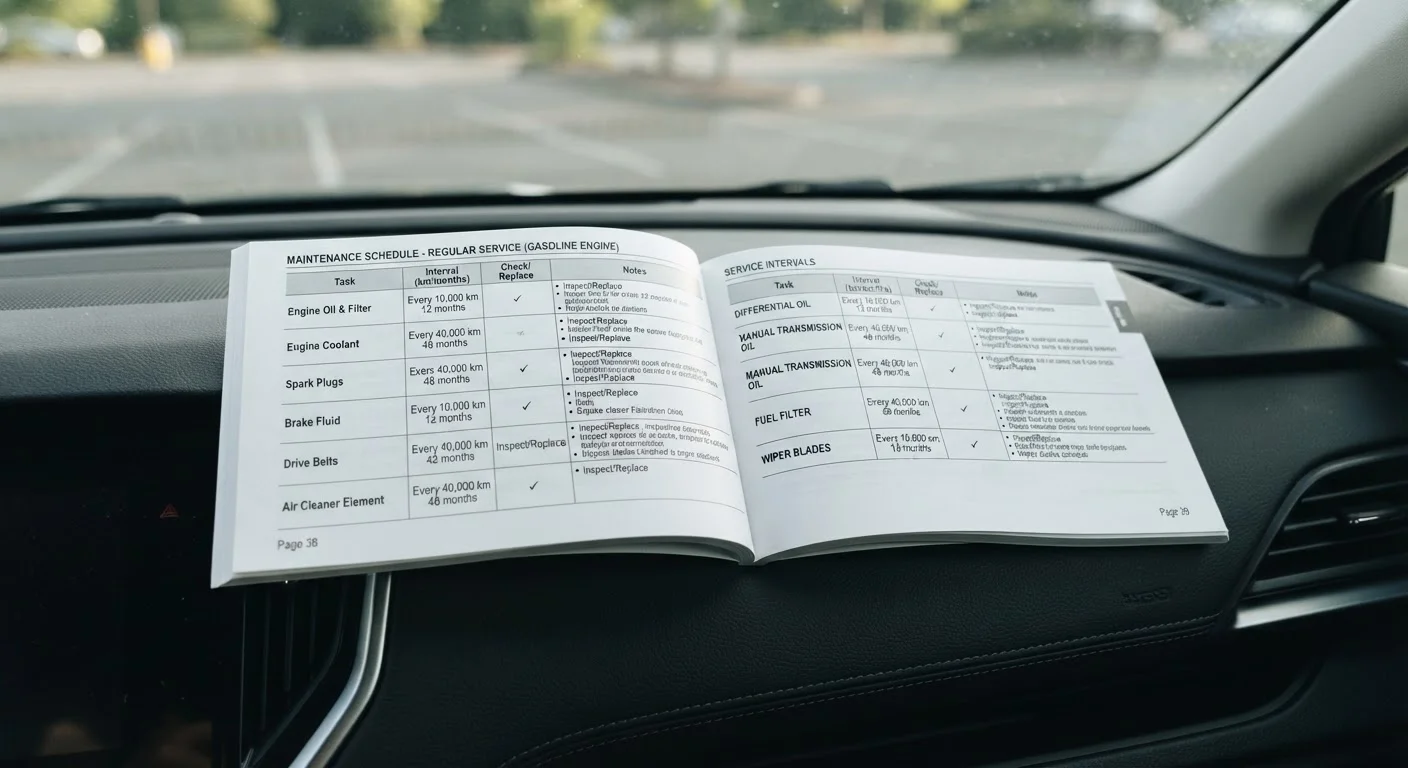
The maintenance section of most owner's manuals is organized as a table or series of tables. Understanding the structure takes only a few minutes once you know what you're looking at.
Locate the Maintenance Schedule in Your Manual
Owner's manuals are typically 200-500 pages long, but the maintenance schedule is usually in a clearly labeled chapter - look for headings like "Scheduled Maintenance," "Maintenance Schedule," or "Service Intervals" in the table of contents. Some manuals place it near the back; others near the middle. Digital versions of most owner's manuals are available through the manufacturer's website if your printed copy is missing.
Identify the Interval Format
Maintenance intervals in the schedule are expressed in one of two ways - mileage, time (months), or both. When both appear, the rule is straightforward: service is due at whichever threshold arrives first. For example, if the schedule says "every 5,000 miles or 6 months," and you've driven only 3,000 miles but six months have passed, the service is still due. Time-based intervals exist because oil and fluids degrade even when a vehicle sits unused.
Match Each Service Item to Your Current Mileage
Using your current odometer reading, scan down the schedule to find which services are already due and which are upcoming. Most schedules group services into tiers: items due at every interval (e.g., oil and filter), items due at moderate intervals (e.g., tire rotation, cabin and engine air filter checks), and longer-range items (e.g., transmission fluid, spark plugs, coolant flush). Make a list of anything that is overdue or coming due within the next 3,000-5,000 miles. For more detail on specific service items and their typical timing, see routine maintenance tasks and when they're actually due.
Note Inspection Items vs. Replacement Items
Not every line in the schedule requires an automatic replacement. Some items are listed as inspect, meaning a qualified technician should evaluate the component's condition and replace it only if warranted. Others specify replace unconditionally at a set interval. Knowing the difference helps you have more informed conversations with a service advisor and avoid paying for unnecessary replacements - or missing genuinely needed ones. Items like cabin and engine air filters are good examples: they're often inspected first, with replacement depending on conditions.
Determine Which Service Track Applies
Flip back a few pages from the schedule table and read the manufacturer's definitions for normal versus severe service conditions. Check each condition against your typical driving patterns. If your driving qualifies as severe, note that the intervals in the severe column - not the normal column - are the ones you should follow. Mark this clearly on your service list so there's no confusion when you book your next appointment.
Normal vs. Severe Service: Which Schedule Applies to You
Most owner's manuals include two separate maintenance tracks: Normal and Severe (sometimes called "Special Operating Conditions"). The severe schedule calls for more frequent service intervals and applies when driving regularly involves any of the following:
- Frequent short trips under 5 miles, especially in cold weather
- Stop-and-go city driving or heavy traffic commuting
- Towing, hauling, or carrying heavy loads
- Dusty, muddy, or off-road environments
- Extreme heat or cold climates
If several of these describe your daily driving, the severe schedule is the appropriate one to follow - even if your commute feels routine. Many drivers who think they qualify for normal service actually fall into the severe category. Check your manual's definitions carefully; they're usually listed just above or below the schedule tables.
When in Doubt, Default to Severe
If your driving conditions sit on the borderline between normal and severe, choose the severe schedule. The cost difference between servicing slightly early versus servicing late is almost always lower than the cost of repairing accelerated wear. Your engine and transmission will benefit from the extra margin.
Putting the Schedule Into Practice
Knowing what the schedule says is only useful if you act on it consistently. Once you've identified which services are due and on what timeline, the next step is building a tracking system. A simple log - even a notepad kept in the glove box - lets you record the date, mileage, and service performed each time work is done. This makes it far easier to anticipate upcoming services rather than react to overdue ones. See our guide to keeping a vehicle maintenance log for a practical approach that also protects resale value and warranty coverage.
If your vehicle has accumulated significant mileage, the manufacturer's standard schedule may need to be supplemented with additional attention to wear-prone components. Building a maintenance routine for a high-mileage vehicle covers how to adapt your approach as a car ages. For a quick reference on what specific services are typically due at various mileage points, routine car maintenance intervals explained is a useful companion resource.
Missed Services Can Affect Warranty Coverage
Manufacturers can deny warranty claims on components that failed due to documented neglect of the prescribed maintenance schedule. If your vehicle is still under a factory or extended warranty, staying current with the manual's schedule - and keeping receipts - is important protection. Review your warranty documentation alongside the maintenance schedule to understand what's required.
The content on this site is provided for informational purposes only and should not be considered a substitute for professional advice. While we strive to provide accurate and up-to-date information, we make no guarantees regarding its completeness or accuracy. Always consult a qualified professional for advice specific to your circumstances before making any decisions.