

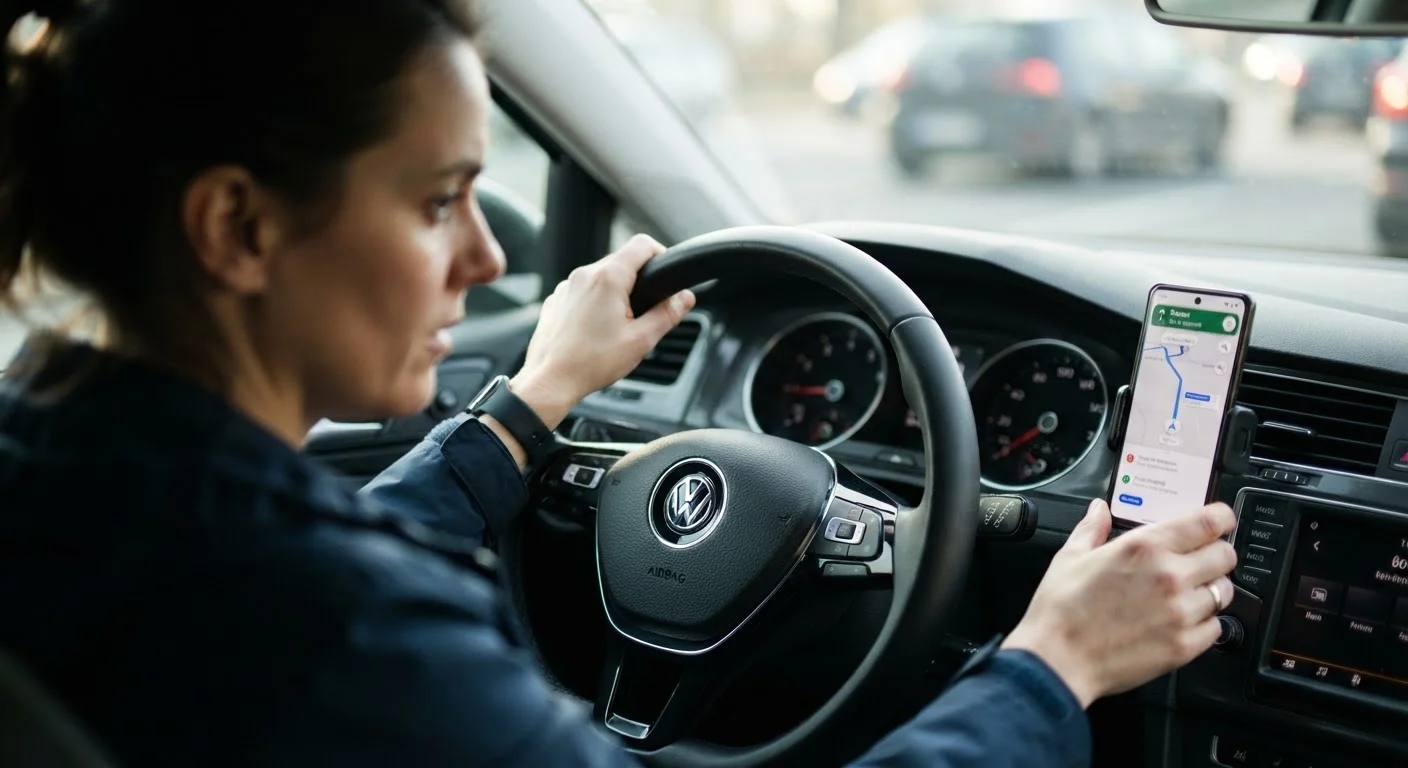
The Gap Between Legal and Safe
Most U.S. states allow drivers to use hands-free devices while behind the wheel. That legal permission has reinforced a widespread belief: if it's lawful, it must be reasonably safe. The research tells a more complicated story.
Cognitive distraction - the mental load of processing a conversation - persists whether your phone is in your hand or connected via Bluetooth. Studies from the AAA Foundation for Traffic Safety and other research institutions have found that the brain does not multitask so much as it rapidly switches attention, and that switching carries a measurable cost. When attention shifts to a phone conversation, the mental bandwidth available for scanning the road, anticipating hazards, and reacting to sudden changes drops significantly.
This article walks through the most common assumptions drivers hold about phone use and distraction - and what the evidence actually supports. If you're interested in how other everyday conditions compound driving risk, our piece on night driving hazards is a useful companion read.
Myth
Using a hands-free device is essentially safe because my hands stay on the wheel.
Fact
Hands-free use reduces manual distraction but does not eliminate cognitive distraction, which research consistently identifies as a primary driver of impairment.
The danger of phone use while driving isn't just about where your hands are - it's about where your mind is. Neuroscience research describes this as "inattention blindness": drivers in phone conversations can look directly at an object and fail to consciously register it. AAA Foundation research has measured this effect, finding that some voice-based tasks leave the brain in a state of elevated distraction for up to 27 seconds after the task is completed.
Myth
Talking on the phone while driving is no different from having a conversation with a passenger.
Fact
Passengers are co-present observers who instinctively pause conversation during difficult driving moments; remote callers have no awareness of road conditions and do not.
A passenger sees the same hazards you do and naturally stops talking when a complex situation arises - a merging truck, a sudden brake light, a tight curve. A caller on the other end of the phone has none of that context and continues the conversational demand uninterrupted. Research published in transportation safety literature has documented this distinction, identifying the passenger as a "second set of eyes" that actually supports safer driving in some conditions, while remote calls consistently do not.
Myth
If I'm an experienced driver, my skills compensate for any distraction from phone use.
Fact
Experience does not neutralize the cognitive load imposed by phone conversations; research shows experienced drivers are similarly impaired under distraction conditions.
Driving experience improves certain automatic skills - smooth braking, lane discipline, mirror checks - but it does not expand the brain's finite attentional capacity. When that capacity is partly consumed by a phone conversation, the deficit in hazard detection and response time appears across driver experience levels. Overconfidence in one's ability to handle distraction is itself a documented risk factor. Notably, the effect is consistent enough that researchers use it as a benchmark in distraction studies rather than a variable.
Myth
Voice-activated systems in modern cars are safe to use because they're designed for driving.
Fact
In-vehicle voice systems still impose measurable cognitive distraction, with some rated as creating higher mental demand than a hands-free phone call.
Modern infotainment systems are more integrated than a mounted smartphone, but integration does not equal safety. AAA Foundation research evaluated multiple factory-installed voice systems and found that composing a message or navigating menus via voice commands required sustained mental engagement that diverted attention from the road for several seconds. The design of the interaction - not whether it's built into the car - determines the cognitive load. Systems that require multiple verbal steps, confirmations, or corrections are particularly demanding.
Myth
A quick glance at a phone notification takes only a second and poses minimal risk.
Fact
At highway speeds, a single second of diverted visual attention covers roughly 88 feet - and brief glances at screens often last longer than drivers estimate.
Drivers consistently underestimate how long their eyes leave the road when checking a notification. Studies using instrumented vehicles have found that even "quick" glances at infotainment screens or phones frequently exceed two seconds. At 65 mph, two seconds of inattention covers nearly 190 feet. Manual interaction with a device - even unlocking a screen - also takes the driver's hand off the wheel and eyes off the road simultaneously, compounding the risk. This applies equally to reading a text, checking a navigation prompt, or glancing at a social notification.
What the Evidence Says - and What Drivers Should Do About It
The practical takeaway from the research is straightforward: no phone conversation behind the wheel is without risk, regardless of how it's conducted. Voice-activated assistants, often marketed as a safer alternative, introduce their own distraction window. A study from the University of Utah found that using voice-based systems to compose messages created sustained mental distraction lasting several seconds after the interaction ended - enough time to travel the length of a football field at highway speed.
4x
Crash risk increase from phone use while driving
Research reviewed by the National Safety Council estimates that phone use while driving quadruples crash risk, comparable to findings from multiple independent studies.
27 sec
Post-task distraction window after voice commands
AAA Foundation for Traffic Safety research found that cognitive distraction from some voice-activated tasks persists for up to 27 seconds after the task ends.
~88 ft
Distance traveled at 60 mph in one second
At typical highway speeds, even a one-second lapse in visual attention covers significant ground, leaving little margin to react to sudden hazards.
The most effective countermeasure is also the least popular: don't use your phone at all while driving. Practically, that means activating Do Not Disturb or a driving mode before you pull out of a parking space, not after you're already on the road. For passengers, the dynamic is different - a passenger can naturally pause conversation when traffic demands increase, while a remote caller has no awareness of road conditions and keeps talking regardless.
Fatigue and distraction also compound each other. If you're on a long drive, the cognitive cost of a phone conversation is higher because your baseline alertness is already reduced. See our guide on managing driver fatigue on long road trips for strategies that address both issues together.
Voice Texting Is Not a Safe Workaround
Dictating a text message while driving is commonly perceived as a low-risk alternative to typing. Research does not support this assumption. Composing a message verbally still requires sustained cognitive engagement, and the process of listening to a message read aloud adds a second layer of distraction. The message content itself - especially emotionally charged communication - compounds the effect. When possible, wait until you've stopped to send or receive any messages.
The content on this site is provided for informational purposes only and should not be considered a substitute for professional advice. While we strive to provide accurate and up-to-date information, we make no guarantees regarding its completeness or accuracy. Always consult a qualified professional for advice specific to your circumstances before making any decisions.