

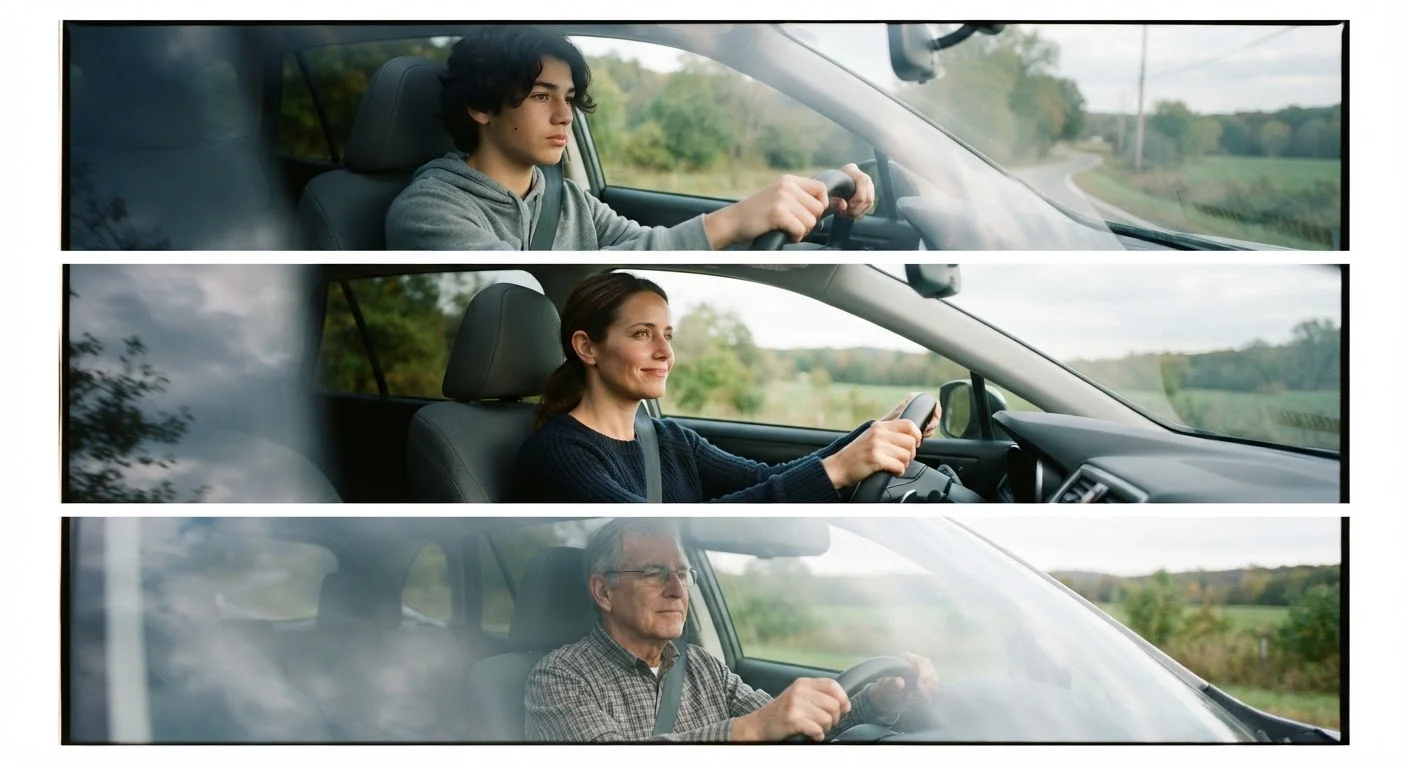
Why Age Matters for Crash Risk
Driving is not a fixed skill that you either have or don't. It evolves - and so does the nature of the risk you carry on the road. Data from the National Highway Traffic Safety Administration (NHTSA) consistently shows that crash rates follow a distinctive U-shaped curve across a lifetime: highest in the earliest years of driving, declining through middle age, then rising again in later life - though for different reasons than at the start.
Understanding why risk changes - not just that it does - is what allows drivers, parents, and policymakers to take targeted action. A 17-year-old and a 78-year-old may both be statistically higher-risk drivers, but the causes are almost entirely different. Treating them identically produces bad advice for both.
3x
Teen crash fatality rate vs. drivers 20+
Per mile driven, 16-17-year-olds face roughly three times the fatal crash rate of drivers aged 20 and older, according to NHTSA data.
~50%
Teen driving fatalities occurring at night
CDC data indicates that nearly half of teen driver fatalities occur between 9 p.m. and 6 a.m., despite lower overall nighttime traffic.
Higher
Injury severity for older drivers in crashes
NHTSA research consistently shows that drivers 70+ sustain more severe injuries in comparable crashes than younger adult drivers, due to increased physical fragility.
Teen and New Drivers: The Highest-Risk Window
Drivers aged 16-19 are involved in crashes at rates far exceeding any other age group relative to miles driven. The NHTSA reports that the fatal crash rate per mile driven for 16- to 17-year-olds is roughly three times that of drivers 20 and older. The root cause isn't attitude alone - it's a combination of genuine inexperience and still-maturing cognitive development.
Teens lack the mental library of pattern recognition that experienced drivers use automatically. They struggle more with hazard anticipation, scanning intersections, and managing multiple stimuli simultaneously. Peer passengers amplify the problem: research shows that crash risk for teen drivers increases significantly with each additional teen passenger in the vehicle.
Nighttime driving is particularly dangerous for this group. Nearly half of teen driving fatalities occur between 9 p.m. and 6 a.m., according to CDC data. Most U.S. states address this directly through graduated driver licensing (GDL) systems, which restrict nighttime driving and passenger numbers during supervised phases. See our guide to the graduated license system for a detailed breakdown of how these restrictions work and why each phase matters.
For parents supervising a new teen driver, prioritize nighttime and highway practice in controlled conditions before license graduation - not after. The GDL system creates a window; use it actively.
Supervised exposure to genuinely challenging conditions builds the pattern-recognition skills that reduce crash risk in the unsupervised phase. Limiting practice to low-stakes environments leaves gaps that appear when conditions change.
Older drivers should ask their physician directly whether any prescribed medication lists drowsiness, dizziness, or slowed reflexes as a side effect - and discuss what that means for their specific driving routine.
Many medications with driving-relevant side effects are not spontaneously flagged during routine appointments. Proactively raising the question surfaces information that can prevent a serious crash.
Distraction is also a defining risk factor. New drivers are learning to process road conditions while simultaneously managing vehicle controls that experienced drivers handle automatically. Adding a phone - even hands-free - can overwhelm limited cognitive bandwidth. Our article on why hands-free isn't as safe as most drivers assume explains the cognitive science behind this.
Middle-Aged Drivers: Lower Risk, Different Threats
Drivers roughly between 35 and 64 represent the safest cohort by most crash-rate measures. Experience has built robust hazard-recognition skills, risk tolerance has moderated, and physical capability remains generally strong. Yet this group is not risk-free - it simply faces a different risk profile.
Fatigue is a primary concern. Middle-aged drivers are more likely to be commuting long distances, working irregular hours, or driving for work purposes. Drowsy driving carries crash risk comparable to drunk driving, and the effect is cumulative - it builds across a week of poor sleep, not just a single late night.
Distraction is equally significant. Smartphones, in-vehicle infotainment systems, and the general cognitive load of adult life mean middle-aged drivers are frequently not fully present even when their hands are on the wheel. This age group also tends to overestimate their ability to multitask safely behind the wheel.
Health conditions begin to emerge quietly in this window - early vision changes, hypertension medications that cause drowsiness, and musculoskeletal issues that reduce head-turn range. None of these automatically impairs driving, but they warrant active monitoring rather than passive assumption that driving ability is unchanged from age 30.
Older Drivers: Vulnerability, Not Recklessness
Drivers 70 and older are often portrayed as dangerous, but the picture is more nuanced. Older adults typically drive fewer miles, avoid high-risk conditions like nighttime and highway driving, and have far lower rates of alcohol involvement in crashes. Their per-driver crash rates are not extreme - but their per-mile crash rates rise, and critically, their injury severity when crashes occur is significantly higher than for younger adults.
The core issue is physiological: slower reaction times, reduced peripheral vision, increased glare sensitivity, and reduced neck flexibility all accumulate gradually. Medical conditions - particularly those affecting cognition, such as early-stage dementia - can impair driving before the driver or their family recognizes the change. Certain medications commonly used by older adults also carry documented effects on driving ability, including drowsiness and reduced coordination.
Cognitive Decline Can Be Gradual and Hard to Self-Detect
Early-stage cognitive impairment often affects driving ability before the individual or their family notices clear behavioral changes. Warning signs can include getting lost on familiar routes, difficulty judging speed or distance, and increased anxiety about driving. If family members or close friends raise concerns about an older driver's road behavior, those observations should be taken seriously and discussed with a healthcare provider - not dismissed as overcaution.
The practical implication is that older drivers benefit from honest, structured self-assessment. Tools such as the AARP's driver safety programs and AAA's Roadwise Driver assessment are designed to help older drivers evaluate their own capabilities without relying solely on self-perception, which tends to be overly optimistic. Regular vision checks and frank conversations with a physician about medication side effects are concrete, actionable steps.
Importantly, driving cessation carries its own risks - social isolation and reduced independence have real health consequences. The goal is not to push older drivers off the road prematurely, but to help them drive as safely and as long as possible, then transition thoughtfully when the time comes.
Strategies Every Driver Can Apply Right Now
Across all age groups, several evidence-backed habits consistently reduce crash risk:
- Eliminate phone use entirely while driving - not just while holding the phone. Cognitive distraction persists with hands-free devices.
- Adjust for conditions - speed limits are set for ideal conditions; rain, fog, and darkness all require meaningful speed reductions and increased following distance. See our guide to driving in adverse weather for condition-specific techniques.
- Keep the vehicle maintained - tire condition, brake health, and lighting all directly affect your ability to avoid crashes. Our article on keeping a car safe and road-legal long-term covers the maintenance habits that matter most.
- Recognize fatigue as a real impairment - if you are struggling to stay alert, pulling over is not optional; it is the only responsible choice.
- Schedule annual vision checks - vision changes are gradual and often unnoticed until formally tested. This applies at every age, not just older adulthood.
Risk never reaches zero, but it is meaningfully controllable. The drivers who understand their own risk profile - shaped by age, experience, health, and habits - are the ones best positioned to act on it.
The content on this site is provided for informational purposes only and should not be considered a substitute for professional advice. While we strive to provide accurate and up-to-date information, we make no guarantees regarding its completeness or accuracy. Always consult a qualified professional for advice specific to your circumstances before making any decisions.