

Start here
What Is a Graduated Driver Licensing System?
Next
Stage One: The Learner's Permit
Then
Stage Two: Restricted (Provisional) License
Continue
Stage Three: Full Licensure
Understand the reasoning
Why These Restrictions Exist
What Is a Graduated Driver Licensing System?
A Graduated Driver Licensing (GDL) system is a structured, multi-stage process that introduces new teen drivers to the road incrementally. Rather than issuing a full license the moment a teen passes a knowledge test, GDL programs require drivers to build skills and experience under progressively fewer restrictions over time.
Every U.S. state and the District of Columbia has adopted some version of a GDL system, though the specific rules - minimum ages, holding periods, and restrictions - differ by state. The goal is consistent: reduce the disproportionately high crash risk that affects new, young drivers during their first years behind the wheel.
Graduated Driver Licensing (GDL)
A multi-stage licensing process that gradually expands driving privileges as a new driver gains experience and demonstrates safe behavior.
Learner's Permit
The first-stage credential that allows a teen to practice driving only when a licensed adult supervisor is present in the vehicle.
Provisional License
A restricted license issued after passing a road test, allowing independent driving but with limits on nighttime hours, passengers, and phone use.
Holding Period
A minimum amount of time a teen must have a permit or restricted license before becoming eligible to advance to the next GDL stage.
Nighttime Curfew
A restriction that prohibits a provisional license holder from driving during certain late-night and early-morning hours, set by each state's GDL law.
Stage One: The Learner's Permit
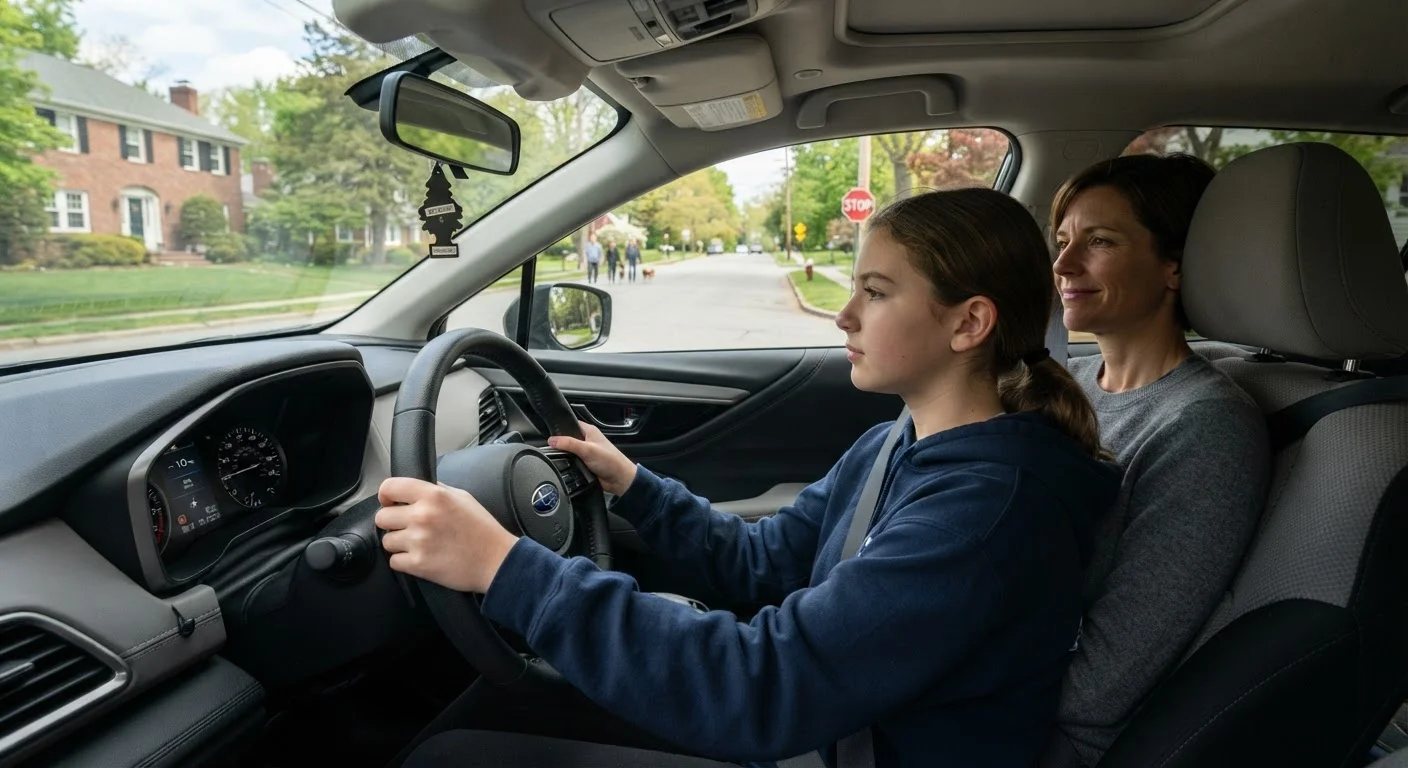
The first stage is the learner's permit, sometimes called an instructional permit. To obtain one, a teen typically must pass a written knowledge test covering traffic laws, road signs, and basic safety rules. Most states set the minimum age at 15 or 16.
During this phase, the teen may only drive with a licensed adult supervisor in the vehicle - usually someone 21 or older, though some states allow a licensed parent or guardian as young as 18. Driving is generally allowed during daylight hours, though supervised nighttime practice is often permitted and encouraged.
States typically require a holding period - a minimum number of months with the permit - before advancing. During this time, teens are usually required to log a set number of supervised practice hours, commonly ranging from 30 to 65 hours depending on the state.
Log More Than the Minimum Hours
State minimums for supervised practice are a floor, not a goal. Many driving experts suggest new teen drivers benefit from 100 or more hours of varied practice - including highway, night, rain, and heavy-traffic conditions. The more exposure to diverse situations during supervised practice, the better prepared a teen will be when driving independently.
Stage Two: Restricted (Provisional) License
After completing the learner's permit stage, a teen who passes a behind-the-wheel road test may receive a restricted or provisional license. This allows independent driving - but with meaningful limitations.
The most common restrictions include:
- Nighttime driving curfews: Many states prohibit driving between roughly 11 p.m. and 5 a.m., though exact hours vary.
- Passenger limits: New drivers are often barred from carrying more than one non-family teen passenger. This addresses the well-documented distraction risk posed by peer passengers.
- Cell phone bans: Most states prohibit all handheld and, in some cases, hands-free phone use during this stage.
Violations during the restricted phase can extend the holding period or result in suspension. This phase typically lasts six months to one year. For a broader look at how crash risk shifts across a driver's lifetime, see how risk profiles change with age.
Stage Three: Full Licensure
Once a teen has held the restricted license for the required period without serious violations, they become eligible for a full, unrestricted driver's license. In most states, this occurs around age 17 or 18.
At this point, nighttime and passenger restrictions are lifted. The driver is held to the same legal standards as any adult motorist. However, being fully licensed does not mean the learning process is complete - crash risk among drivers in their first two years of independent driving remains elevated regardless of age.
New drivers at every stage should be familiar with special road rules they'll encounter regularly. Our guide on school zones, construction zones, and emergency vehicles covers the situations new drivers often find most confusing.
Why These Restrictions Exist
The restrictions within GDL systems are not arbitrary. They target the specific, evidence-based risk factors most associated with teen crashes.
Nighttime driving is statistically more dangerous for all drivers, but the hazard is amplified for inexperienced teens who have not yet developed the scanning and hazard-recognition skills that come with road time. Teen passengers increase cognitive distraction; research has consistently found that crash risk rises with each additional peer passenger. Cell phone use impairs reaction time in ways that are particularly hazardous for drivers still developing core driving skills.
Studies examining states with stronger GDL requirements have found associations with lower teen crash fatality rates compared to states with weaker laws, though outcomes vary by implementation and enforcement. The Insurance Institute for Highway Safety and the Centers for Disease Control and Prevention both cite GDL as one of the most effective tools for improving teen driver safety.
GDL Rules Still Apply Even at Home
Some families inadvertently undermine GDL restrictions by allowing teens to drive past curfew or with multiple friends in the car when 'just going a short distance.' Violations that don't result in a traffic stop still reflect real risk exposure. Enforcing restrictions consistently - not just when enforcement is likely - is the safer approach.
Parents and guardians play a critical supporting role. Consistently modeling safe driving behavior, enforcing GDL rules at home even when law enforcement cannot, and continuing supervised practice beyond the minimum requirements all meaningfully contribute to a teen's long-term safety on the road.
Frequently Asked Questions
Most states allow teens to apply for a learner's permit at age 15 or 16, though a few states permit it at 14 in limited circumstances. Age requirements vary by state, so checking your state's DMV is the authoritative source.
Most states require between 30 and 65 hours of supervised practice, often with a portion completed at night. These minimums are set by state law and can differ significantly, so verify your state's specific requirement.
Many states cap passenger numbers during the restricted phase and may exempt immediate family members from those limits. However, the specifics depend entirely on your state's GDL law - there is no single national rule.
Violations can result in fines, extended time in the current GDL stage, or license suspension, depending on the state. Some states reset the holding period clock if a violation occurs during the restricted phase.
GDL systems are designed specifically for younger drivers, typically those under 18. Adults obtaining a first license generally go through a different process, though some states still impose a brief probationary period.
In many states, completing an approved driver's education course can reduce the required supervised driving hours or lower the minimum permit-holding period. Check your state DMV for course-related exemptions.
The content on this site is provided for informational purposes only and should not be considered a substitute for professional advice. While we strive to provide accurate and up-to-date information, we make no guarantees regarding its completeness or accuracy. Always consult a qualified professional for advice specific to your circumstances before making any decisions.