

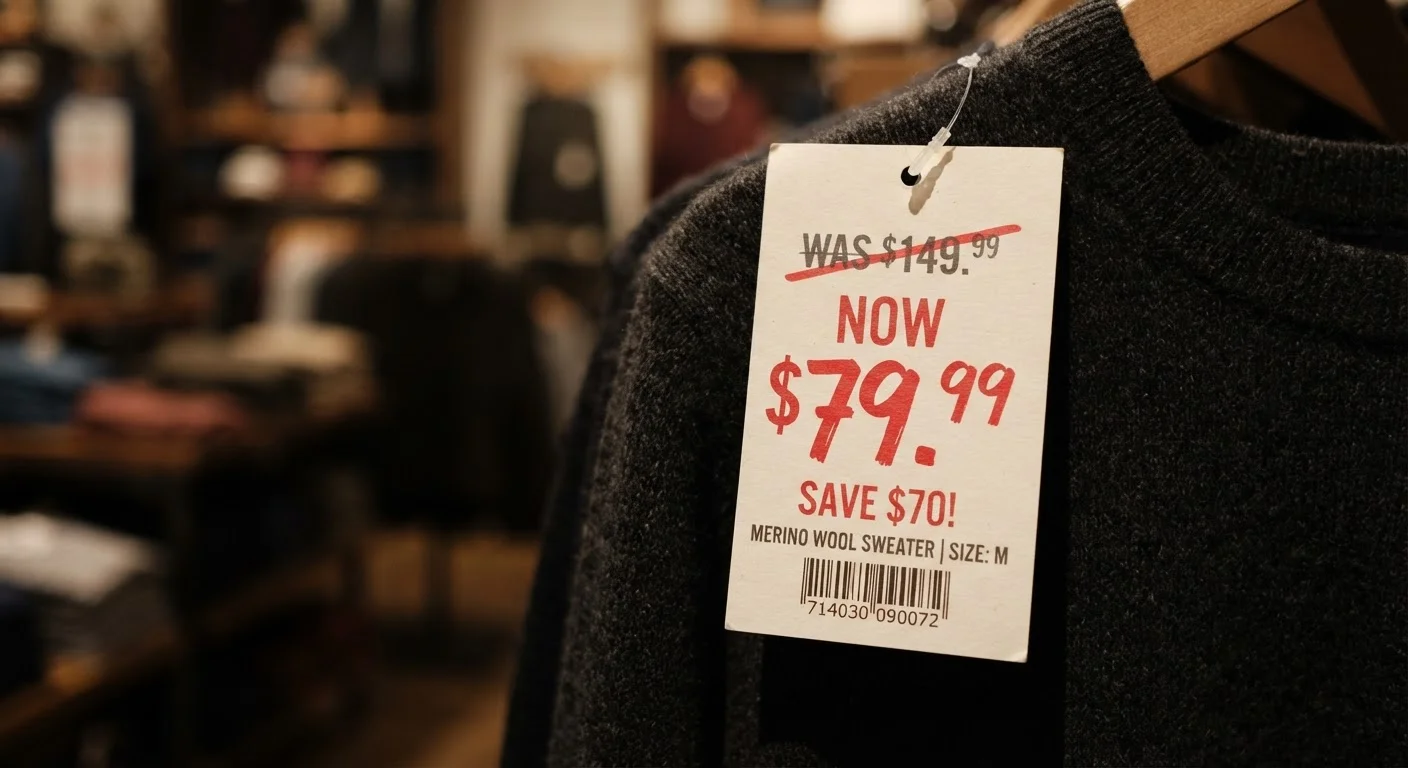
How Anchoring Works in a Shopping Context
When you walk past a jacket tagged at $249 - now $89, something automatic happens in your brain: the $249 becomes the reference point against which you judge the $89. The discount feels dramatic. The deal feels real. But here's the problem - you probably didn't know what that jacket was worth before you saw the tag.
This is anchoring in action. The anchor doesn't need to be accurate to be effective. It just needs to be present and visible before you start forming your own opinion. In retail environments, that anchor is almost always set by the seller - which means it's set with the seller's goals in mind, not yours.
Anchoring doesn't require deception to work. Even honest retailers benefit from showing a higher reference price simply because it frames the sale price as a win. The psychological contrast does the persuasive work automatically.
“The mind is not designed to evaluate things in absolute terms. It evaluates things relative to a reference point, and the reference point can be manipulated.”
— Daniel Kahneman, Nobel Prize-winning psychologist and author of 'Thinking, Fast and Slow'
Where Reference Prices Come From
"Original price," "regular price," "MSRP," "compare at" - these labels all serve a similar function: they establish a number your brain will treat as the baseline. But each label has a different meaning, and some are more meaningful than others.
- MSRP (Manufacturer's Suggested Retail Price) is a price the manufacturer recommends - but many retailers routinely sell below it, making MSRP a ceiling rather than a real market price.
- "Was" or "Original" prices are supposed to represent what the item previously sold for. U.S. regulations in most states require these to reflect actual prior transactions, but enforcement is inconsistent.
- "Compare at" prices often reflect what the item might cost at a different retailer - a comparison that can be selective or outdated.
Understanding these distinctions is part of reading promotional pricing accurately. Our explainer on sale prices vs. markdowns covers how these labels function differently in practice.
~$1 trillion
Annual U.S. retail sales influenced by promotional pricing
Promotional and sale events account for a substantial share of U.S. retail volume, underscoring how central reference pricing is to the industry's revenue model.
Over 60%
Shoppers who say discounts influence their purchase decisions
Consumer surveys consistently find that a majority of shoppers are more likely to buy when a discount is displayed, independent of the item's absolute price.
Practical Ways to Reduce the Anchoring Effect
You can't completely switch off a cognitive bias, but you can build habits that reduce its influence on your purchasing decisions.
Research the price before you see the tag
The most effective defense against anchoring is having your own reference point before the retailer sets one for you. Look up the item independently - check multiple sellers, use price-history tools where available, and note what similar products cost. When you arrive at a sale display with your own number in mind, the anchor loses much of its power.
Separate the discount from the value
Ask a different question than "how much am I saving?" - ask "is this price worth paying for what I'm getting?" A 60% discount on something you wouldn't have bought at full price isn't a deal. Anchoring works precisely because it shifts your attention from absolute value to relative contrast.
Account for the full cost
The sale price is rarely the complete picture. Accessories, maintenance, subscriptions, or ongoing costs can significantly change whether a price is genuinely attractive. The total cost of ownership framework gives you a more complete basis for comparison than any single sticker.
Check unit pricing for comparable items
In grocery and household categories especially, unit pricing cuts through promotional framing by expressing cost in consistent, comparable terms. Our guide to unit pricing explains how to use these labels to evaluate actual value rather than deal theater.
Set Your Own Anchor Before You Shop
Before entering a store or browsing a sale page, look up what you expect to pay for the item based on independent research. Write the number down if it helps. When you encounter the retailer's reference price, you'll have a benchmark that isn't theirs - which changes the entire framing of the evaluation.
Why This Matters Beyond Individual Purchases
Anchoring shapes more than individual buying decisions. It influences how people evaluate trade-ins, negotiate salaries, estimate project budgets, and assess real estate offers. In each context, whoever sets the first number gains a structural advantage in framing what follows.
For shoppers, recognizing this pattern is less about suspicion and more about reclaiming the evaluation on your terms. The original price on a tag is a piece of information - but it's information the retailer chose to display, in a specific way, for a reason. Treating it as one data point rather than a fixed truth is a straightforward way to make your purchasing decisions on the basis of actual value rather than engineered contrast.
For a broader look at how common shopping assumptions can lead you astray, see our piece on shopping myths that cost people money.
Frequently Asked Questions
It depends on how the reference price is used. Most U.S. states have regulations requiring that a "was" or "original" price reflect a price the item was actually offered at for a meaningful period. However, enforcement varies significantly, and many reference prices operate in gray areas.
Research the item independently before you see the tag. Check third-party price trackers, manufacturer websites, or retailer history tools. If the "original" price only appears alongside the sale price and nowhere else, that's a signal worth noting.
Yes, and often more aggressively. Online retailers can display crossed-out prices, countdown timers, and "limited stock" badges simultaneously - all of which reinforce the anchor and add artificial urgency. The same skepticism applies.
Awareness helps but doesn't eliminate the effect. Research consistently shows that even people who understand anchoring are still influenced by initial numbers. The most reliable defense is having independent price information before you evaluate a deal.
Ask what the item is worth to you, what it sells for elsewhere, and what the total cost will be over time - including accessories, maintenance, or subscriptions. The <a href="/travel-shopping/savvy-shopping/why-total-cost-of-ownership-matters-more-than-the-sticker-price">total cost of ownership framework</a> is a useful structure for this.
Not exactly - the terms have different meanings in retail practice. Understanding the distinction can help you read promotional pricing more accurately. See our explainer on <a href="/travel-shopping/savvy-shopping/sale-price-vs-markdown-what-retailers-actually-mean">sale prices vs. markdowns</a> for a full breakdown.
The content on this site is provided for informational purposes only and should not be considered a substitute for professional advice. While we strive to provide accurate and up-to-date information, we make no guarantees regarding its completeness or accuracy. Always consult a qualified professional for advice specific to your circumstances before making any decisions.