

Why Shopping Myths Persist
Retail environments are designed with psychology in mind. Shelf placement, pricing cues, and promotional language all influence how shoppers perceive value - and not always accurately. Many widely held shopping beliefs feel intuitive but don't hold up when examined against how pricing actually works. Acting on these myths can quietly drain money over time, not in a single dramatic loss, but purchase by purchase.
For a broader foundation on reading prices and evaluating value, see our guide to shopping with more confidence. The myths below address the most common and costly misconceptions.
Myth
Buying in bulk always saves money.
Fact
Bulk buying only saves money when the per-unit cost is genuinely lower and you use the entire quantity without waste.
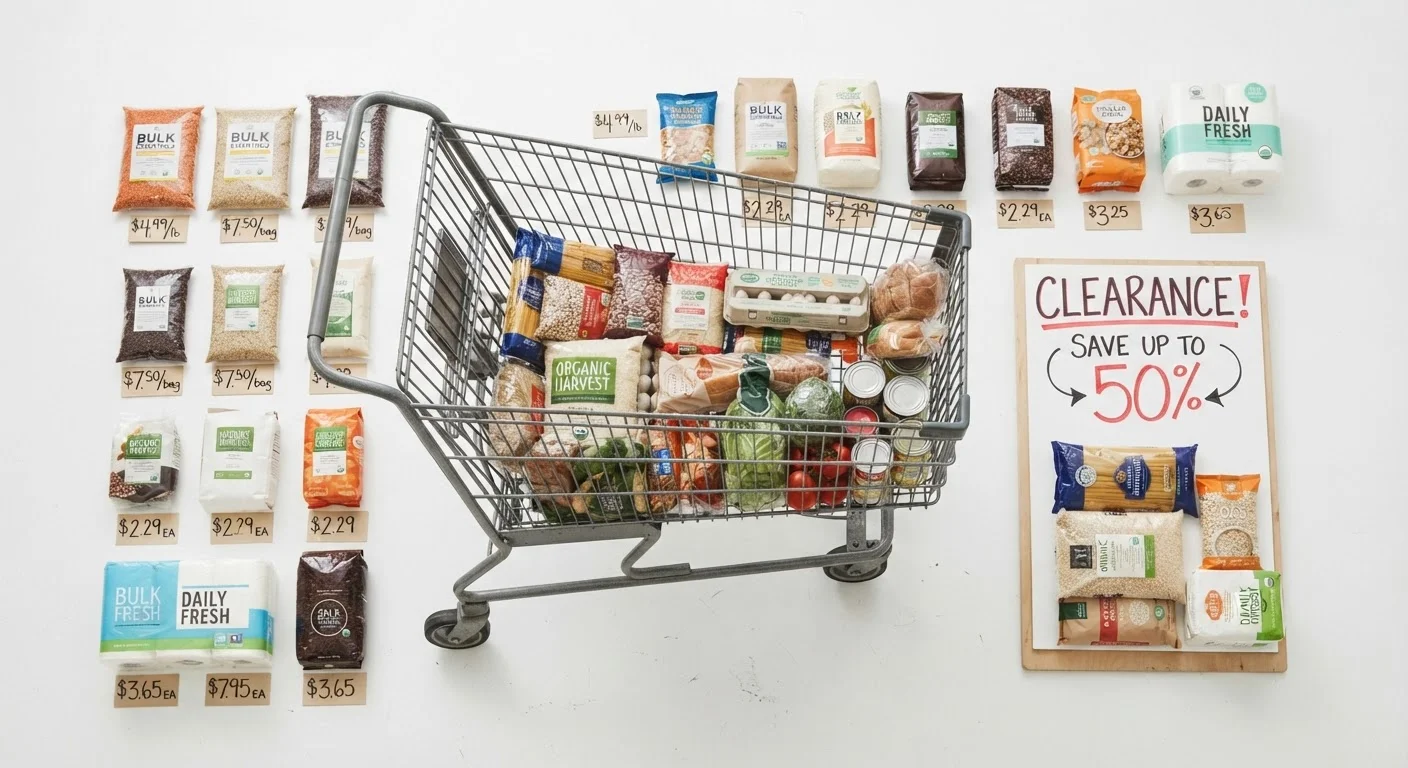
Warehouse-style bulk purchases often do offer a lower cost per unit - but that calculation only holds if the product gets fully used. Perishables that expire, cleaning supplies that sit unused, or items that get replaced by a better version before the supply runs out all erode those savings. Unit price labels on standard grocery shelves sometimes show that the smaller package is actually cheaper per ounce. Always compare unit prices, not just sticker prices, before assuming the bigger quantity is the better deal.
Myth
Clearance means the item is at its lowest possible price.
Fact
Clearance pricing reflects a retailer's need to move inventory - it's not benchmarked against prices elsewhere.
Clearance tags signal that a store wants the shelf space, not necessarily that the price is the lowest you'd find. The same item might be available at a lower price through another channel, or it may go on deeper markdown in a few weeks if it still doesn't move. Clearance sections are worth browsing, but treating them as a price guarantee leads shoppers to skip verification steps they'd normally take. A quick check against other sellers takes under a minute and can reveal whether the clearance price is genuinely competitive.
Myth
A higher price means better quality.
Fact
Price and quality correlate inconsistently across most everyday product categories.
Premium pricing can reflect genuine differences in materials, manufacturing, or testing - but it can equally reflect branding, packaging, or retail positioning. Consumer research organizations that conduct independent product testing regularly find that mid-priced items match or outperform more expensive alternatives across categories like small appliances, pantry staples, and personal care products. For any significant purchase, independent reviews and standardized test results are more reliable quality signals than price alone.
Myth
Sales always mean you're saving money.
Fact
A sale price is only a saving if the reference price it's marked down from was a price the item actually sold at regularly.
Retailers are not uniformly required to prove that a product sold at the listed original price before marking it down. In some cases, reference prices are set high to make discounts appear larger than they are - a practice regulators have scrutinized in various markets. Understanding the difference between a genuine markdown and a promotional price structure is important context. Our article on what sale price vs. markdown actually means explains how these distinctions work in practice.
Myth
Loyalty programs always pay off for the shopper.
Fact
Loyalty programs are structured to increase spending - the rewards rarely outpace the extra purchases they encourage.
Points, cashback, and member discounts are genuinely useful when they apply to purchases you'd make anyway. The problem is that these programs are designed to shift behavior - encouraging shoppers to consolidate spending at one retailer, make purchases earlier than planned, or buy more to hit a threshold. The incremental spending those incentives generate typically exceeds the value of rewards earned. Loyalty programs can be worth using passively; they're rarely worth changing purchasing habits to chase.
Myth
Online prices are always lower than in-store prices.
Fact
Online and in-store prices vary by retailer, product category, and timing - neither channel is consistently cheaper.
While online retail eliminates certain overhead costs, it also introduces shipping fees, return friction, and the possibility of counterfeit or misrepresented products that in-store shopping avoids. In-store prices on some categories - particularly clearance items, produce, and things that require same-day availability - can be lower than what's listed online. The online vs. in-store comparison breaks down when each channel tends to work in the shopper's favor.
What Savvy Shoppers Actually Do Differently
Correcting these myths doesn't mean becoming a suspicious or joyless shopper. It means building a few reliable habits. Checking unit prices before assuming a larger package is cheaper, verifying a clearance item's price against other channels, and questioning whether a sale price reflects a genuine reduction - these are low-effort steps with meaningful impact. Our look at habits of people who rarely overpay covers how consistent shoppers approach these situations in practice.
~30%
Estimated food waste in U.S. households
USDA estimates suggest roughly 30-40% of the U.S. food supply is wasted, much of it at the consumer level - which directly affects the math on bulk grocery purchases.
3 in 5
Loyalty members who don't redeem rewards
Research from loyalty program analysts has found that a substantial share of enrolled members accumulate points they never actually redeem, reducing the real-world value of membership.
Understanding how promotional pricing actually works is equally useful. The distinction between a markdown and a sale price matters more than most shoppers realize - see what retailers actually mean by sale price for a clear breakdown. And if you want to use unit pricing - one of the simplest tools available - unit pricing labels explained walks through how to read shelf tags correctly.
Seasonal Sales Aren't Always the Lowest Prices
Major sale events can create genuine savings on certain categories, but the pressure of a timed event often pushes shoppers to buy things they wouldn't have otherwise. Before a sale, it's worth checking whether the category follows a predictable discount cycle - some items hit their lowest prices at specific points in the year that don't align with major promotional events. See how seasonal pricing cycles work for a general overview.
For larger, less routine purchases, time pressure is often the factor that causes the most regret. Where big purchase decisions go wrong outlines the most common failure points and how to avoid them.
The content on this site is provided for informational purposes only and should not be considered a substitute for professional advice. While we strive to provide accurate and up-to-date information, we make no guarantees regarding its completeness or accuracy. Always consult a qualified professional for advice specific to your circumstances before making any decisions.