

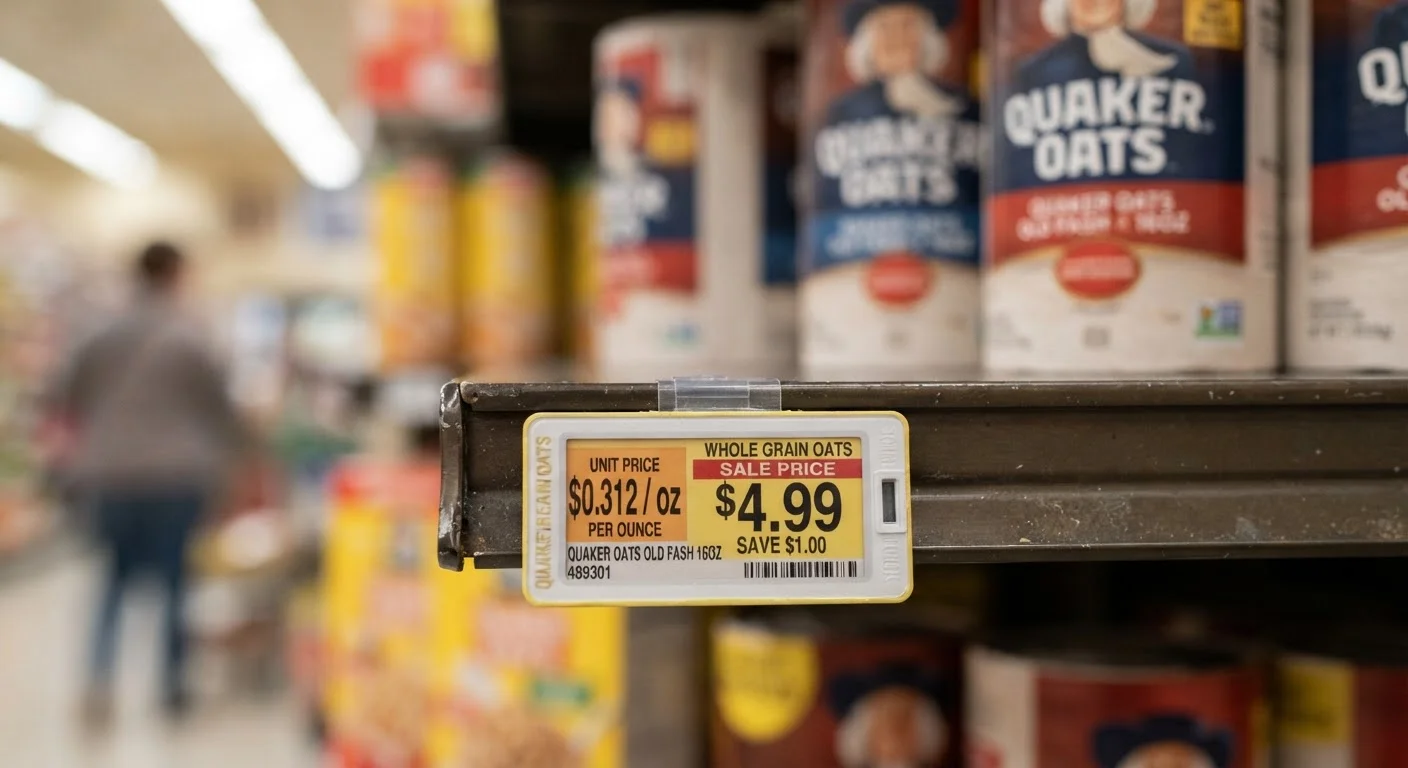
What the Small Number on the Shelf Tag Actually Tells You
Most shoppers focus on the big, bold price on the shelf tag. That number tells you what leaves your wallet at checkout - but it doesn't tell you whether you're getting a reasonable amount of product for that money. That's what the unit price is for.
The unit price strips away package size as a variable. Whether a product comes in a 10-oz bottle or a 32-oz bottle, the unit price converts both to the same denominator - price per ounce - so you can make a direct comparison. It's the grocery store equivalent of comparing apples to apples.
Unit prices are usually tucked into a corner of the shelf label in smaller print. On a typical tag, you might see $3.49 in large font, and then somewhere below it: $0.22/oz. That smaller figure is the number that actually matters for comparison purposes.
Units Vary by Product Category
Unit prices aren't always expressed in ounces. Beverages may show price per liter or per fluid ounce; paper products per sheet or per roll; cleaning supplies per load or per ounce. Always check which unit is being used before comparing two products - mismatched units make the comparison meaningless without manual conversion.
Why Sticker Price Alone Misleads You
Retailers know that shoppers gravitate toward the total price. A $4.99 jar looks cheaper than an $8.99 jar - until you notice the first is 12 oz and the second is 32 oz. At that point, the $8.99 jar is often the better value. But without checking unit prices, most people would reach for the cheaper-looking option.
This gap between perception and value is especially visible during sales. A product marked "on sale" might have a lower total price but a higher unit price than the store brand sitting next to it at full price. Understanding how retailers use promotional framing can help here - sale price vs. markdown distinctions matter more than many shoppers realize.
The same logic applies to bulk purchases. Buying in bulk isn't automatically cheaper per unit - it depends entirely on the unit price. Common shopping myths often treat bulk buying as a universal win, but the shelf tag tells a more nuanced story.
~30+
U.S. states with some form of unit pricing law
According to consumer advocacy research, more than 30 states have enacted unit pricing statutes, though scope and enforcement vary considerably.
Up to 30%
Potential savings when comparing unit prices consistently
Consumer education organizations have noted that shoppers who regularly compare unit prices can meaningfully reduce grocery spending, though results vary by product category and shopping habits.
How to Use Unit Pricing Effectively
The most important habit is simply looking for the unit price before you pick up a product. Here's how to put it to practical use:
- Match units before comparing: Make sure both products you're comparing use the same unit of measure. A price per ounce and a price per pound aren't directly comparable without conversion.
- Check across sizes within the same brand: The medium size is sometimes a worse value than buying two smalls or one large. Let the unit price tell you.
- Check across brands: Store brands frequently have a lower unit price than name brands, but not always. Verify rather than assume.
- Apply it online too: Most grocery and household product websites list unit prices on the product page, making digital comparison straightforward.
Unit pricing is also one of the clearest antidotes to anchoring effects in retail. When a large "original price" makes a sale price look dramatic, unit pricing cuts through the noise by grounding the comparison in actual quantity. For more on how reference prices can distort your perception of value, see why anchoring shapes how deals feel.
When Unit Pricing Gets Complicated
Unit pricing is useful, but it has limits worth knowing. First, not all unit prices on the same shelf use the same unit of measure. Some products are priced per ounce while a nearby competitor is priced per count - which makes a direct comparison impossible without doing your own math. This happens with paper products in particular, where one brand might show price per sheet and another shows price per roll.
Second, unit price doesn't factor in quality, concentration, or how the product is actually used. A cleaning concentrate priced higher per ounce than a ready-to-use version might still be the more economical option once diluted. Similarly, a more absorbent paper towel might deliver more value per sheet than a cheaper one you'd use twice as much of.
Third, perishables add a dimension unit pricing can't capture. A larger package with a better unit price isn't a better value if you'll throw half of it away. Waste offsets savings.
Thinking about the full cost of a purchase - not just the shelf price or even the unit price - is a useful habit beyond groceries too. The concept of total cost of ownership extends this same logic to bigger purchases like appliances or electronics.
Frequently Asked Questions
It's usually printed in smaller type at the top or bottom of the shelf label, beneath or beside the larger total price. It's typically formatted as a dollar amount followed by the unit of measure, such as '$0.18/oz' or '$1.24/100 ct'. Some stores highlight it, others don't - look carefully.
Not always. Retailers occasionally price smaller packages at a lower unit cost, particularly during promotions or to clear inventory. The only way to know for certain is to compare the unit prices directly, not assume based on package size.
Unit pricing laws vary by state. Some states require it broadly for food and household products; others have no mandate. Even where required, enforcement and display consistency can differ by retailer and store location.
Yes. Most major grocery and retail websites display unit prices on product listing pages, often near the total price. The same comparison logic applies - standardize to the same unit of measure before comparing products.
It can. Paper products, cleaning supplies, personal care items, and even some hardware products often include unit pricing. The units will vary - price per sheet, per load, per square foot - but the comparison method is identical.
The content on this site is provided for informational purposes only and should not be considered a substitute for professional advice. While we strive to provide accurate and up-to-date information, we make no guarantees regarding its completeness or accuracy. Always consult a qualified professional for advice specific to your circumstances before making any decisions.