

Why Discount Structure Matters
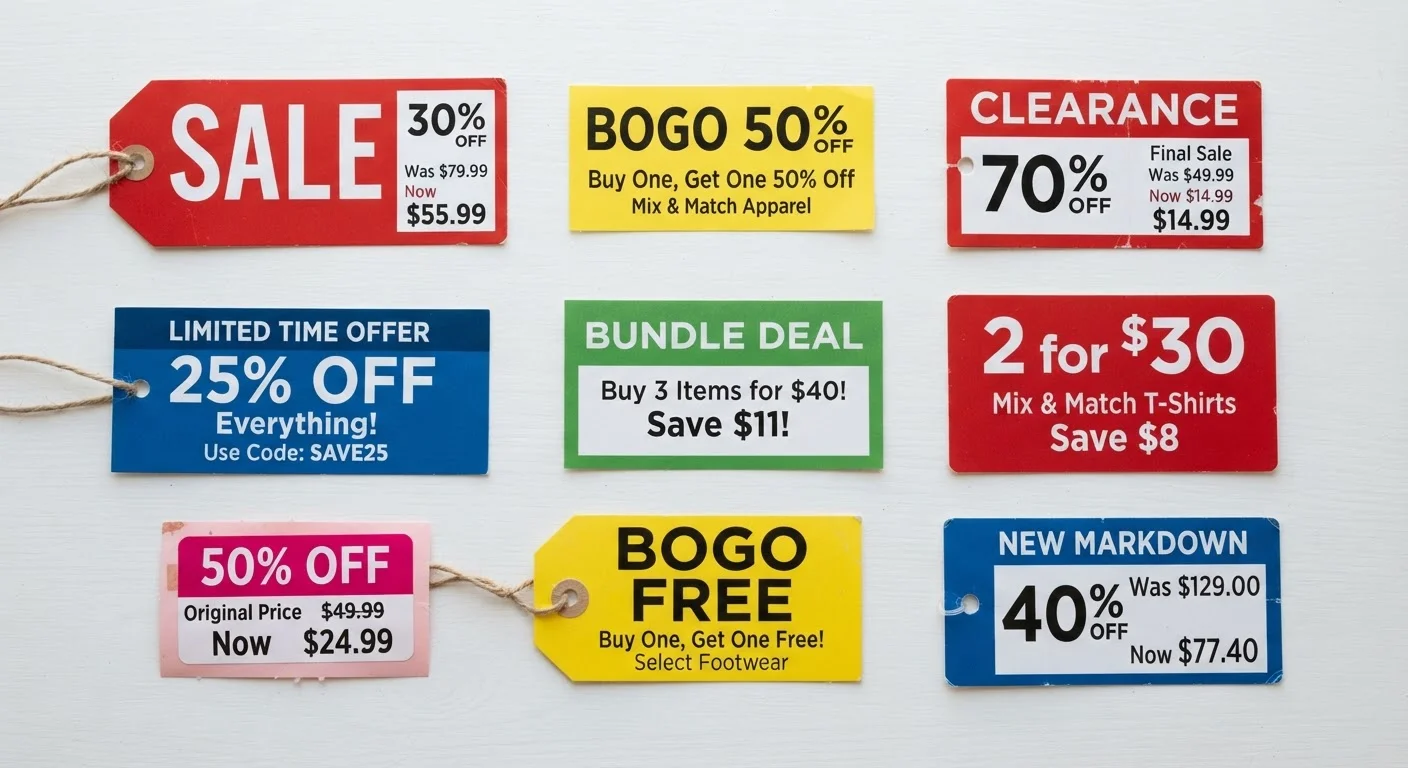
Not every discount is built the same way. A 30% off sign, a buy-one-get-one offer, and a bundle deal can each save you money - but how much you actually save depends entirely on the mechanics behind each structure and what you were already planning to buy.
Retailers design these formats to move inventory, increase basket size, or clear seasonal stock. That doesn't make them bad deals, but it does mean the value to you depends on your needs, not just the headline number. Understanding the basic logic behind each type lets you compare them on equal footing rather than reacting to marketing language.
This reference breaks down how each structure works, what to watch for, and when each type tends to benefit consumers. For context on how promotional pricing is framed at the retail level, see how retailers distinguish sale prices from markdowns.
| Percentage-Off: Savings Condition | Single-item purchase; no additional buy required |
| True BOGO Effective Rate | 50% per unit (only when both units are used) |
| BOGO 50% Off Effective Rate | 25% per unit when buying two |
| Bundle Value Depends On | Whether you need all included items |
| Most Transparent Format | Percentage-off (when reference price is stable) |
| Hardest to Compare Directly | Bundle deals (component prices often unpublished) |
Percentage-Off Discounts
A percentage-off discount reduces the listed price by a stated fraction - 20% off, 40% off, and so on. This format is the most straightforward: the math is simple, and the savings apply to a single item without requiring you to buy more than one.
Where it gets complicated: The value depends on the accuracy of the original price. If the reference price was inflated before the promotion, the "discount" may reflect less real savings than it appears. This is why understanding the difference between a sale price and a markdown is useful context.
When it benefits you: Percentage-off works well for individual purchases of items you need at their current price point. It's easy to compare across retailers since the math is universal. It tends to deliver genuine value when applied to items with stable, consistent pricing - such as appliances or electronics with published manufacturer prices.
Percentage-Off Discount
A price reduction expressed as a fraction of the listed retail price. The savings are applied to a single item and require no additional purchase to activate.
BOGO
Abbreviation for 'buy one get one.' A promotional structure where purchasing one item unlocks a discount or free offer on a second item of the same or lesser value.
Bundle Deal
A pricing structure that groups two or more products or services together at a combined price lower than purchasing each separately - when those items are sold individually at all.
Reference Price
The original or 'regular' price against which a discount is calculated. When reference prices are inflated before a sale, the stated discount may overstate actual savings.
Effective Discount Rate
The real percentage saved per unit after accounting for all purchase conditions - such as how many units you must buy or whether you would have purchased all bundled items anyway.
Buy-One-Get-One (BOGO) Deals
BOGO promotions come in several forms: buy one get one free, buy one get one 50% off, or buy two get one free. The defining characteristic is that savings are conditional on purchasing multiple units.
The key calculation: A true BOGO (free second item) is effectively a 50% discount per unit when you need two of something. If you only need one, the savings drop to zero - or worse, you've spent money on something you didn't need.
BOGO 50% off works out to a 25% savings per unit when you buy two. That's meaningful but less dramatic than the phrasing suggests.
When it benefits you: BOGO deals are strongest for consumables or frequently replaced items - household products, personal care goods, pantry staples - where you'll use both units before expiration or loss of quality. They're less advantageous for perishables you can't store or discretionary items you wouldn't have purchased in multiples. Seasonal pricing cycles often drive BOGO timing on specific categories.
Bundle Deals
Bundles group multiple products or services at a combined price that's lower than the sum of individual prices. Common examples include tech accessory kits, meal kits, travel packages, and multi-item clothing sets.
The core question: Do you want everything in the bundle? If you'd buy three of four included items anyway, a bundle can be efficient. If you'd use only one or two items, you may be paying for things you don't need - which isn't a savings, it's a different kind of spending.
Hidden complexity: Bundles make direct price comparison harder. When items are only available together, you can't easily verify what each component would cost separately. Retailers have some flexibility here since component pricing may not be independently published.
When it benefits you: Bundles work well when the combination reflects how you actually use the products, when the bundled price represents a verifiable reduction against separately purchasable items, and when you're not paying a premium for convenience. This connects to the broader question of where you shop - channel choice affects bundle availability and pricing in meaningful ways.
Bundled Items Aren't Always Sold Separately
When a bundle includes items that aren't available individually from the same retailer, there's no published price to compare against. In these cases, evaluating the bundle's total cost against what similar individual products sell for elsewhere gives you a more realistic baseline. If that comparison is difficult or the information isn't readily available, that's worth factoring into your decision.
Comparing Discount Types Side by Side
The most practical question when evaluating any discount is: what would I have paid for what I actually need? Run that calculation before the headline figure.
- Percentage-off is easiest to compare directly and most transparent when reference prices are stable.
- BOGO requires you to value the second item honestly - if you'll use it, the math is favorable; if not, the effective discount may be zero.
- Bundles require component-level evaluation to determine real value, and that information isn't always easy to find.
None of these structures is inherently better or worse - each serves different buying contexts. Combining discount awareness with knowledge of how loyalty programs and cashback mechanisms stack can give you a fuller picture of net cost. And if you regularly shop outlet environments, it's worth noting that outlet pricing operates under a different model than standard retail discounting.
The goal isn't to avoid promotional pricing - it's to evaluate it on your terms rather than the retailer's.
The content on this site is provided for informational purposes only and should not be considered a substitute for professional advice. While we strive to provide accurate and up-to-date information, we make no guarantees regarding its completeness or accuracy. Always consult a qualified professional for advice specific to your circumstances before making any decisions.