

Why Your Wireless Bill Is Never Just the Advertised Price
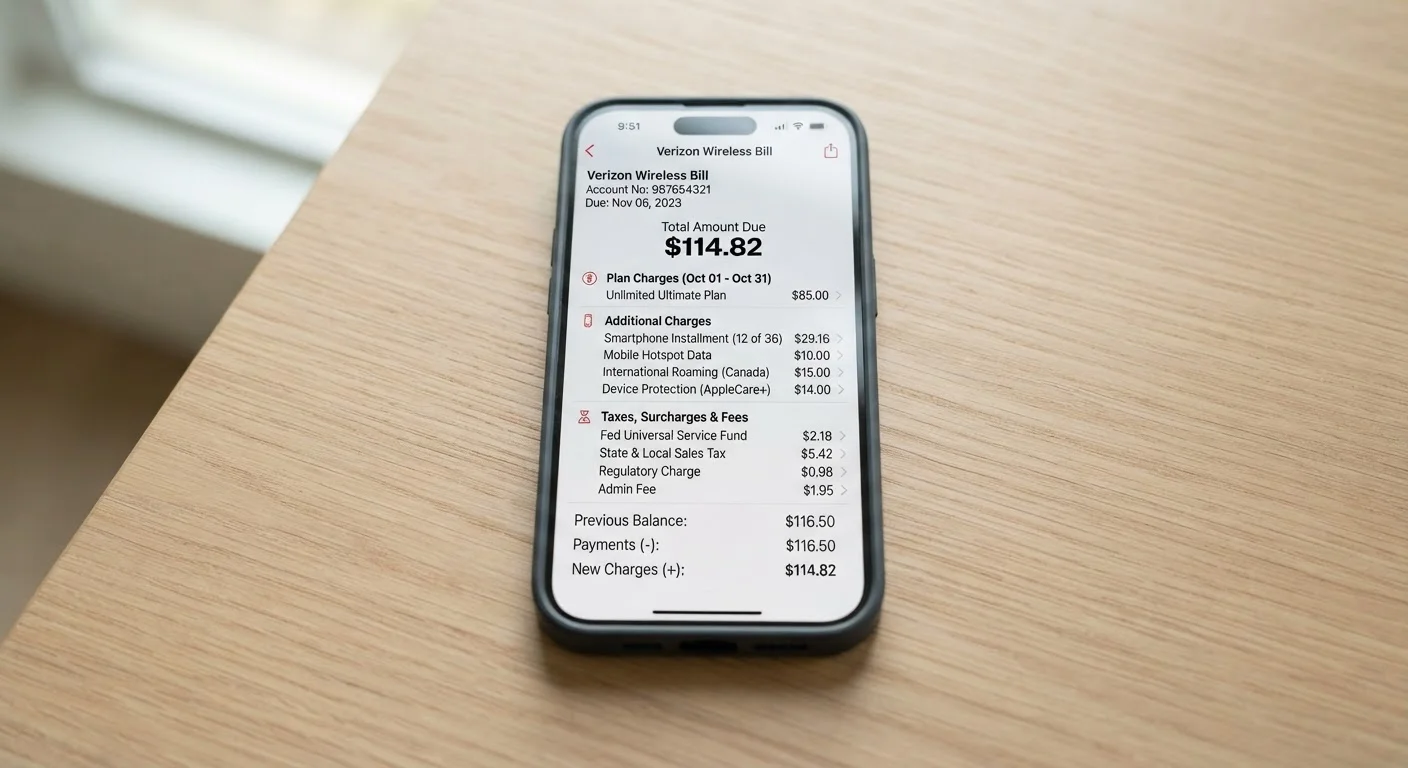
Carriers advertise a monthly rate for their plans, but that number almost never matches what actually hits your bank account. The gap between the advertised price and your real total is made up of government-mandated taxes, carrier-imposed fees, and optional add-on charges - each listed separately on your statement. Understanding what each entry represents puts you in a much stronger position to spot errors, question unnecessary charges, and make smarter plan decisions.
If you've ever wondered whether the plan you signed up for is actually the right fit, common misreads that cost people money can add up quickly before you're even aware of them.
The Core Line Items, Decoded
Most wireless bills organize charges into a few distinct categories. Here's what each typically represents:
Monthly Service Charge
This is the base cost of your plan - the advertised rate for your data, talk, and text allotment. On multi-line accounts, each line usually has its own charge listed separately, sometimes with a multi-line discount applied beneath it.
Device Payment
If you financed a phone through your carrier rather than paying upfront, a monthly installment appears here. This is a separate transaction from your service charge, though carriers bundle them on the same bill. Paying off or trading in a device eliminates this line.
Government Taxes
These are non-negotiable, mandated by federal, state, and local governments. Common examples include state sales tax on service, the Federal Excise Tax (a longstanding federal levy on local telephone service), and municipal utility taxes. The exact mix and rate depend entirely on where you live.
Universal Service Fund (USF) Fee
The USF is a federal program administered by the FCC that funds telecommunications access in rural areas, schools, libraries, and low-income households. Carriers recover their contribution to this fund by passing a percentage charge through to customers. The rate fluctuates quarterly.
Regulatory and Administrative Fees
Unlike government taxes, these fees are set and collected by the carrier itself - not a government agency - even though they often sound official. They typically recover costs associated with regulatory compliance, network maintenance, and number portability. They are legal but carrier-discretionary, meaning the carrier decides the amount. These fees are often where the biggest disconnect between advertised and actual price occurs.
911 / Emergency Service Fee
Most states and municipalities charge a small per-line fee to fund local 911 call centers and emergency dispatch infrastructure. This one is genuinely government-mandated and goes directly to public safety systems.
Surcharges and Add-Ons
International calling packages, device protection plans, premium data features, hotspot upgrades, and streaming service bundles all appear here if you've opted in - or if they were added without your explicit awareness. This section is worth reviewing regularly. See also: what fine print in wireless plans is actually telling you.
Universal Service Fund (USF)
A federal program overseen by the FCC that subsidizes telecom access for rural areas, schools, libraries, and low-income consumers. Carriers contribute to it and typically pass that cost to customers as a percentage-based line item.
Regulatory Recovery Fee
A carrier-set charge (not a government tax) that recovers costs associated with government compliance, number portability, and related regulatory obligations. The carrier controls the amount.
Device Installment
A monthly payment toward the financed purchase price of a phone or tablet. It appears on the wireless bill but is separate from the service charge and ends when the device is paid off.
E911 Fee
A per-line fee mandated by state or local governments to fund enhanced 911 (E911) emergency call infrastructure and dispatch operations.
Surcharge
An additional charge beyond the base plan price. Surcharges can be government-mandated (like the USF contribution) or carrier-imposed (like administrative fees), and the distinction matters when evaluating a bill.
Prepaid vs. Postpaid: How Bills Differ
Prepaid plans typically have simpler bills. Because you pay upfront for a set amount of service, there's no end-of-cycle invoice with itemized taxes - many prepaid carriers incorporate taxes into the advertised price or list them only minimally. Postpaid accounts, by contrast, generate detailed monthly statements because service is billed in arrears and taxes are calculated after the cycle closes.
For a full breakdown of how the two plan structures differ in cost and flexibility, prepaid vs. postpaid wireless plans covers each dimension in detail.
One practical note: if you use Wi-Fi heavily at home, your actual mobile data consumption - and any potential overage exposure - may be lower than you expect. understanding when your phone uses Wi-Fi vs. mobile data can help you right-size your plan and avoid paying for data headroom you don't need.
How to Audit Your Bill in Under Five Minutes
You don't need to be a telecom expert to catch billing errors or unnecessary charges. A quick monthly review using three questions covers most of the ground:
- Does every line on the account belong to someone in my household? Phantom lines occasionally appear after plan changes or promotions.
- Do I recognize every add-on charge? Device protection, cloud storage, and streaming bundles are frequently added during store visits or upgrade calls and forgotten.
- Has the regulatory/administrative fee amount changed significantly? Small quarterly shifts are normal; large jumps may warrant a call to customer service.
If your home broadband bill shows a similar pattern of opaque fees, decoding your ISP contract applies the same logic to internet service agreements.
This article is for general informational purposes only. Fee structures, tax rates, and regulatory charges vary by carrier, state, and municipality and are subject to change. Contact your carrier directly for a specific explanation of charges on your account.
The content on this site is provided for informational purposes only and should not be considered a substitute for professional advice. While we strive to provide accurate and up-to-date information, we make no guarantees regarding its completeness or accuracy. Always consult a qualified professional for advice specific to your circumstances before making any decisions.