

Our Verdict
Satellite internet has matured significantly, particularly with the expansion of low-Earth orbit networks that deliver usable speeds and lower latency than previous-generation systems. However, it still carries meaningful trade-offs in cost, consistency, and performance under stress that make it a secondary choice wherever terrestrial broadband is reliably available.
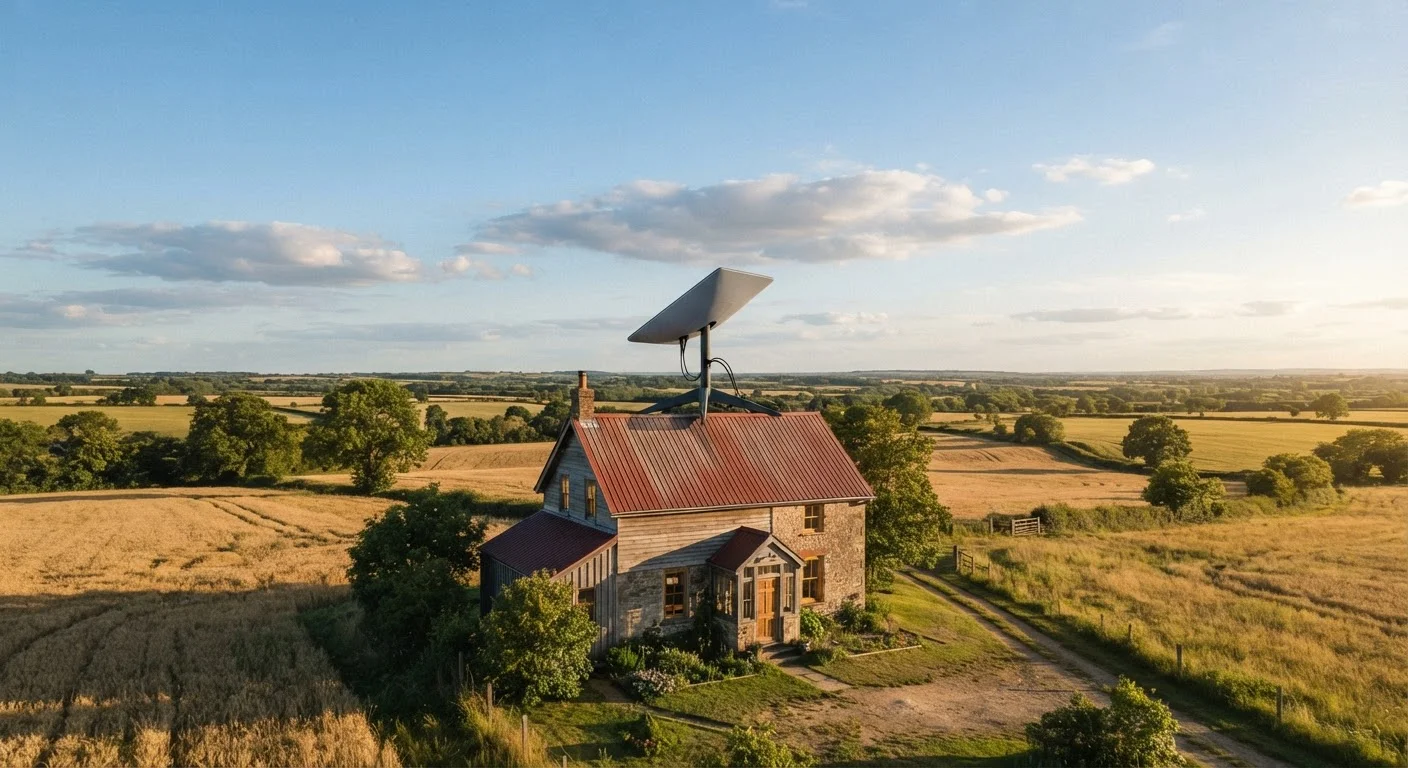
Households in rural or remote areas with no viable access to cable, fiber, DSL, or fixed wireless broadband - for whom satellite may be the only path to meaningful connectivity.
Why Satellite Internet Is Back in the Conversation
For most of the internet era, satellite service occupied a narrow niche: expensive, slow, and plagued by lag that made it frustrating for anything beyond basic email. That reputation was earned by geostationary (GEO) satellites orbiting roughly 22,000 miles above Earth, where the round-trip signal delay alone could exceed 600 milliseconds - far above the threshold for responsive browsing or video calls.
The landscape shifted with the emergence of low-Earth orbit (LEO) satellite networks, which orbit at altitudes between roughly 340 and 1,200 miles. At those distances, latency typically falls in the 20-60 millisecond range - still higher than fiber or cable, but workable for most everyday tasks. Combined with multi-hundred-megabit download speeds on better plans, LEO networks have repositioned satellite as a legitimate broadband option rather than a last resort.
For context on how satellite compares technically to other connection types, see our overview of home internet technologies.
Reaches rural and remote areas with no wired options
Satellite signal covers geography that cable, fiber, and DSL infrastructure does not reach - including remote farmland, mountain communities, and sparsely populated regions. For many rural households, it is the only path to broadband-class internet.
LEO networks deliver usable latency for everyday tasks
Modern low-Earth orbit systems typically achieve latency in the 20-60 ms range, making video calls, web browsing, and streaming functional in ways that older geostationary systems could not support.
Download speeds competitive with basic cable tiers
Many LEO satellite plans advertise download speeds in the 100-200 Mbps range under favorable conditions, sufficient for most household activities including remote work and HD streaming.
No ground-level infrastructure required
Because satellite doesn't depend on trenched fiber or telephone lines, it can be provisioned quickly - setup typically requires only dish installation and doesn't wait on local utility construction timelines.
Expanding coverage and improving capacity over time
LEO operators continue to launch additional satellites, which generally increases network capacity and may improve speed consistency as more orbital assets become active.
Where Satellite Internet Falls Short
The improvements in LEO technology are real, but they don't erase all the friction that has historically defined satellite service. Several limitations remain significant enough to affect day-to-day experience.
Higher upfront equipment costs than terrestrial services
Satellite hardware - dish and router - often costs several hundred dollars to purchase outright, a barrier that doesn't exist for cable or DSL, where providers typically supply a modem at low or no upfront cost.
Monthly pricing higher than comparable wired speeds
Satellite plans tend to cost more per month than cable or fiber plans offering similar speeds in markets where wired options are available, making cost comparisons unfavorable when alternatives exist.
Weather and obstructions can interrupt service
Heavy precipitation and physical obstructions such as trees or structures block the signal path, causing intermittent outages that are largely outside the subscriber's control.
Data caps and deprioritization policies apply
Many satellite plans include data thresholds above which speeds are reduced or traffic is deprioritized during congestion - relevant for heavy users who stream in high definition or work from home full-time.
Latency still higher than fiber or cable
Even at 20-60 ms, satellite latency exceeds what fiber delivers (often under 10 ms), which can matter for real-time gaming, financial trading platforms, or applications sensitive to network delay.
Network congestion can reduce peak-hour speeds
As subscriber counts grow within a coverage footprint, shared bandwidth can become constrained during evening peak hours, resulting in real-world speeds below advertised rates.
Geostationary vs. Low-Earth Orbit: A Key Distinction
Not all satellite internet is the same technology. Older geostationary (GEO) services orbit at roughly 22,000 miles and carry latency above 500 ms, making them poorly suited for real-time applications. Newer low-Earth orbit (LEO) networks orbit at a fraction of that altitude and deliver substantially lower latency. If you're evaluating satellite service, confirming which type of network the provider operates matters significantly for real-world performance expectations.
If you're unsure how much speed your household actually needs before evaluating satellite plans, our guide on estimating real bandwidth needs can help you set realistic expectations.
The Cost Reality for Rural Households
Satellite internet typically involves two distinct expense layers that don't apply to cable or DSL: upfront equipment costs and higher monthly service fees. Hardware - the dish and router - can run into several hundred dollars at purchase, or alternatively into a multi-year lease arrangement. Monthly pricing for LEO service tends to run meaningfully higher than comparable speeds on cable or fiber in urban areas.
For households with no wired alternative, that premium may still be worth paying. The calculation changes in areas where fixed wireless broadband is available, since fixed wireless often delivers competitive speeds at lower cost with a simpler setup. The broader picture of rural connectivity options, including how satellite fits into it, is covered in our piece on internet access in rural America.
~21 million
Rural Americans lacking broadband access
The FCC's broadband map data and independent analyses have consistently found tens of millions of Americans - concentrated in rural areas - without access to fixed broadband meeting federal speed benchmarks.
20-60 ms
Typical LEO satellite latency range
Low-Earth orbit satellite networks operate at this latency range under normal conditions, compared to 500-800 ms typical of older geostationary systems.
Before committing to any plan, it's worth asking the right questions - contracts, data limits, equipment ownership, and outage policies all vary. Our checklist of questions to ask before signing up applies to satellite providers just as much as to cable or DSL.
Practical Performance: What to Expect Daily
Under clear skies and light network load, modern LEO satellite service can deliver a genuinely capable broadband experience - streaming video, video conferencing, and remote work tasks generally function without significant disruption. The experience becomes less predictable under three specific conditions:
- Weather: Heavy rain, thick cloud cover, and snow accumulation on the dish can degrade or interrupt the signal. This is more disruptive in climates with frequent severe weather.
- Network congestion: LEO networks share capacity across all active users in a coverage area. During peak hours, speeds can drop noticeably - a pattern familiar from cable internet but potentially more pronounced in early-stage network rollouts.
- Obstructions: Satellite dishes require a clear, unobstructed view of the sky. Trees, roof overhangs, or nearby buildings can cause persistent signal problems that no amount of plan upgrading will solve.
These factors don't make satellite unusable, but they do mean that households should assess their physical installation site carefully and set realistic expectations for consistency. For a side-by-side view of how satellite stacks up against fiber and cable on reliability metrics, the fiber vs. cable comparison offers useful framing on what consistency looks like on wired networks.
The content on this site is provided for informational purposes only and should not be considered a substitute for professional advice. While we strive to provide accurate and up-to-date information, we make no guarantees regarding its completeness or accuracy. Always consult a qualified professional for advice specific to your circumstances before making any decisions.