

Our Verdict
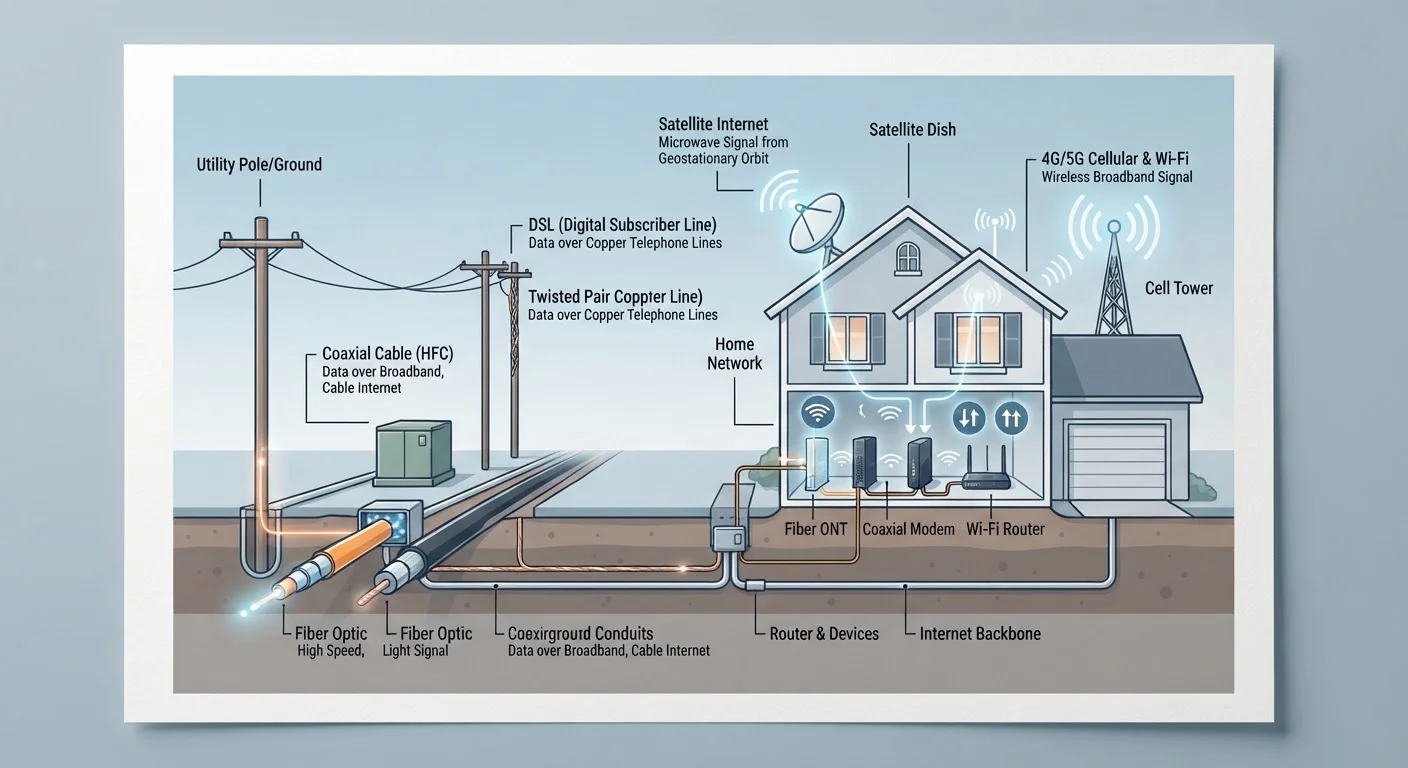
Each of the four main internet technologies has a distinct physical infrastructure, and understanding how they work explains why their real-world performance differs. Fiber delivers the most consistent and symmetrical experience, while cable remains widely available and capable for most households. DSL is increasingly limited by aging copper infrastructure, and fixed wireless fills access gaps where wired options don't reach.
| Best for | Recommended |
|---|---|
| Urban and suburban households wanting fast, symmetrical speeds | Fiber |
| Households in areas without fiber that need broad availability | Cable |
| Rural or semi-rural areas where wired broadband is unavailable | Fixed Wireless |
| Low-usage households in areas where only phone-line service exists | DSL |
How Fiber Optic Internet Actually Works
Fiber optic internet transmits data as pulses of light through thin strands of glass or plastic - the same principle used in long-distance telecommunications. Unlike electrical signals running through copper wire, light pulses are not subject to electromagnetic interference and experience far less signal degradation over distance.
The result is a connection that can deliver symmetrical speeds - meaning upload and download rates are comparable rather than mismatched - and maintains consistent performance even during high-demand periods. Because fiber lines typically run directly to individual homes (a configuration called FTTH, or Fiber to the Home), the connection is not shared with neighbors at the final leg.
The primary limitation is infrastructure: laying fiber requires significant construction investment, so deployment has concentrated in denser urban and suburban markets. Availability in rural areas remains limited, though federal broadband expansion programs are actively funding new fiber builds across underserved regions. For a broader look at the connectivity landscape outside cities, see our article on internet access in rural America.
Cable Internet: Shared Infrastructure, Broad Reach
Cable internet delivers service over the same coaxial cable network originally built for television. It uses a protocol called DOCSIS (Data Over Cable Service Interface Specification) to carry broadband signals alongside cable TV signals, or independently where cable TV has been dropped.
One key structural feature is the shared last-mile network: multiple households in a neighborhood connect through the same local cable node before traffic splits off to individual addresses. This architecture means available bandwidth is divided among active users at any given time. During peak hours - typically evenings when many households are streaming simultaneously - users on the same node may notice slower speeds than they see at off-peak times.
Speeds on cable are generally asymmetrical by design: download speeds are significantly faster than upload speeds, which is a practical limitation for video conferencing, large file uploads, or remote work scenarios. Newer DOCSIS 3.1 deployments narrow that gap somewhat, and some providers have begun rolling out multi-gigabit tiers. Cable remains among the most widely available broadband technologies in the U.S., covering most suburban and many urban areas.
| Fiber | Cable | DSL | Fixed Wireless | |
|---|---|---|---|---|
| Physical medium | Glass or plastic strands (light) | Coaxial copper cable | Copper telephone wire | Radio frequency (air) |
| Typical download speeds | 200 Mbps - 5+ Gbps | 100 Mbps - 1.2 Gbps | 1 - 100 Mbps | 25 - 300 Mbps |
| Upload speed parity | Symmetrical | Asymmetrical (much slower) | Asymmetrical (much slower) | Varies; often asymmetrical |
| Shared last-mile network | Generally no | Yes (neighborhood node) | No | Shared tower capacity |
| Distance sensitivity | Minimal | Low | High (degrades with distance) | High (line-of-sight dependent) |
| Availability | Growing; urban/suburban focus | Broad suburban/urban coverage | Wide but declining investment | Rural and underserved areas |
| Typical latency | Very low | Low to moderate | Moderate | Moderate (higher in some configs) |
DSL: The Phone-Line Connection and Its Constraints
DSL - Digital Subscriber Line - carries broadband data over the copper telephone lines already present in most U.S. homes. Because the copper network is mature and widespread, DSL reaches many areas that cable and fiber have not yet served. However, the physics of copper wire impose hard limits on what DSL can deliver.
The most significant constraint is distance attenuation: DSL speeds degrade as the length of the copper loop between a home and the provider's central office (or remote terminal) increases. A household a short distance from the node may receive adequate speeds; one several miles away may experience speeds that fall well below advertised rates. DSL is also asymmetrical, with downloads substantially faster than uploads.
Advertised DSL Speeds May Not Reflect Reality
ISPs often advertise DSL speeds based on the best-case scenario at minimum distance from the network hub. If your home is farther along the copper loop, actual speeds can be a fraction of what was marketed. Before committing to a DSL plan, ask the provider for an estimated speed at your specific address - not a general range - and clarify whether there is any speed guarantee in the contract.
Providers have introduced faster DSL variants - including VDSL2 and G.fast - that achieve higher speeds over shorter copper loops, sometimes by running fiber closer to neighborhoods and only using copper for the final short connection. Still, in most configurations, DSL is increasingly outpaced by cable and fiber and is best understood as a legacy technology filling gaps rather than a long-term investment by most ISPs.
Fixed Wireless: Over-the-Air Broadband
Fixed wireless internet uses radio frequency signals transmitted between a provider's tower and a receiver antenna mounted at a customer's home. Unlike mobile wireless (the cellular data on a smartphone), fixed wireless is designed for stationary use at a specific address, with the receiving equipment aimed and installed at installation time.
Performance depends heavily on two factors: line of sight between the tower and the home antenna, and the distance involved. Obstructions like hills, dense tree coverage, or large buildings can degrade signal quality. When conditions are favorable, modern fixed wireless technology - particularly systems using LTE or 5G frequencies - can deliver speeds comparable to lower-tier cable plans, making it a viable option in areas where running physical cables is cost-prohibitive.
Fixed wireless is a primary broadband option in many rural and semi-rural communities. It is also distinct from satellite internet, which transmits signals from orbit and involves different latency characteristics. To understand how cellular spectrum affects wireless performance more broadly, see our explainer on how carriers divide up U.S. spectrum.
Before settling on any connection type, it helps to know which questions to ask your provider about actual speeds, contract terms, and service guarantees. Our guide on questions to ask before signing up for a home internet plan walks through the key considerations.
The content on this site is provided for informational purposes only and should not be considered a substitute for professional advice. While we strive to provide accurate and up-to-date information, we make no guarantees regarding its completeness or accuracy. Always consult a qualified professional for advice specific to your circumstances before making any decisions.