

Option A
Fiber Internet
The high-performance, symmetrical standard for home broadband.
Best for: Households with heavy simultaneous usage, remote workers, and anyone who needs consistent upload and download speeds.
Option B
Cable Internet
The widely available, proven option built on existing coaxial infrastructure.
Best for: Households in areas without fiber access, or those who want reliable speeds for everyday streaming, browsing, and moderate remote work.
How Each Technology Actually Works
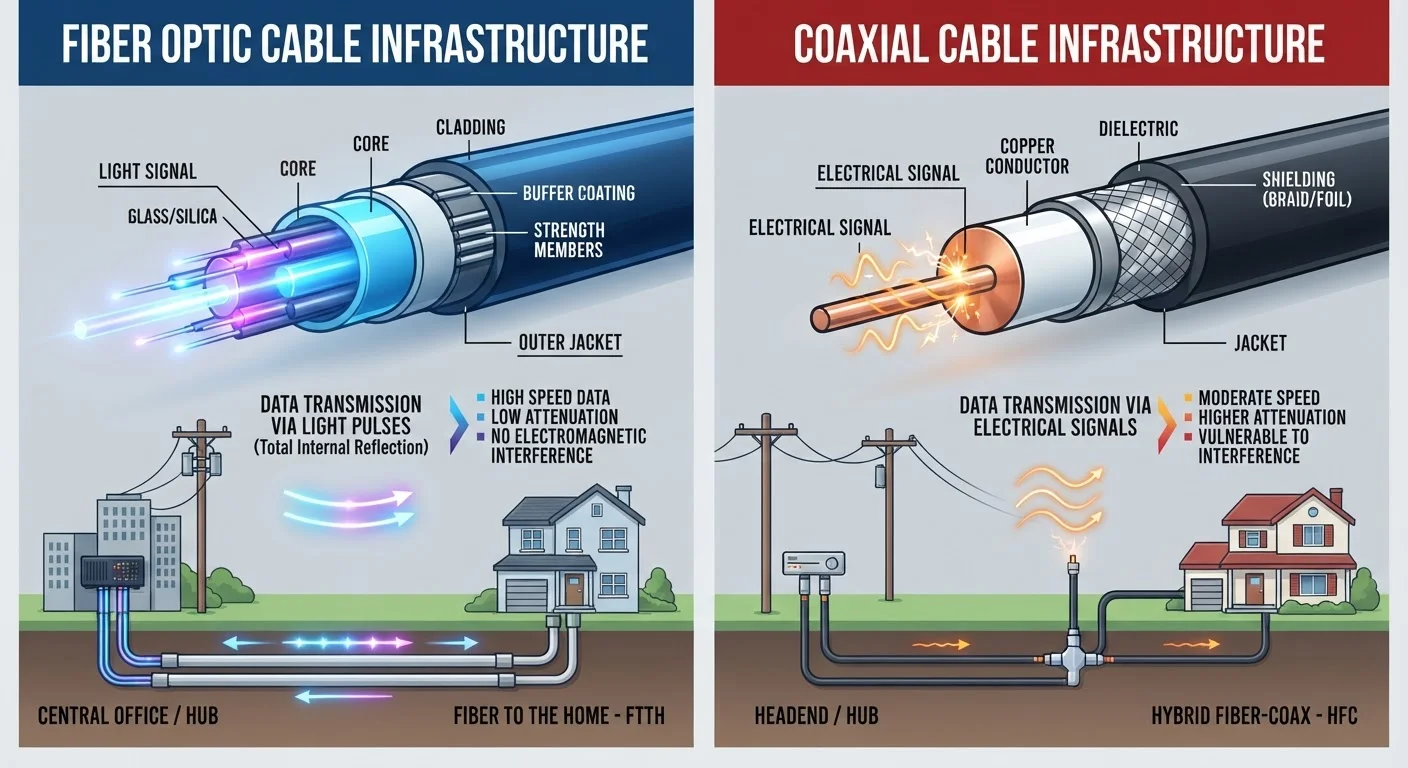
Understanding the difference between fiber and cable starts with the physical medium each one uses. Fiber optic internet transmits data as pulses of light through thin glass or plastic strands. Cable internet, by contrast, carries data as electrical signals over coaxial copper cable - the same infrastructure originally built to deliver television signals.
This distinction matters because light travels faster and degrades less over distance than electrical signals do. Fiber lines also aren't susceptible to electromagnetic interference, which can affect signal quality on copper-based systems. For a deeper look at how each technology delivers the signal from the network to your wall, see our overview of home internet delivery technologies.
| Criterion | Fiber Internet | Cable Internet |
|---|---|---|
| Signal medium | Light through glass/plastic fiber | Electrical signal over coaxial copper |
| Download speeds | Up to 1-10 Gbps | Up to 1-2 Gbps (DOCSIS 3.1) |
| Upload speeds | Symmetrical (matches download) | Asymmetrical (significantly lower) |
| Typical latency | 5-10 ms | 15-30 ms |
| Peak-hour congestion | Minimal - dedicated signal path | Possible - shared neighborhood node |
| U.S. household availability | ~45-50% of locations | ~88% of locations |
| Infrastructure age | Newer build-out required | Existing coaxial cable repurposed |
Speed, Latency, and Real-World Performance
On paper, both fiber and modern cable can advertise gigabit download speeds. The more telling difference lies in upload speed and consistency. Cable networks use a standard called DOCSIS, which allocates far more bandwidth to downloads than uploads - a design assumption from the era when consumers mostly received content rather than sending it. Fiber connections are symmetrical by design, meaning upload speeds match download speeds.
Latency - the time it takes a data packet to travel from your device to a server and back - is another area where fiber typically has an edge. Fiber connections commonly measure latency in the 5-10 millisecond range, while cable often lands between 15-30 ms under normal conditions. For most browsing and streaming, this difference is imperceptible. For video calls, cloud gaming, or financial applications where real-time responsiveness matters, lower latency has a tangible effect.
~88%
U.S. households with cable broadband access
FCC broadband deployment data indicates cable internet reaches the vast majority of U.S. fixed locations.
5-10 ms
Typical fiber latency
Independent broadband measurement studies consistently show fiber connections deliver lower round-trip latency than cable under comparable conditions.
10x+
Upload speed advantage of fiber over cable
Cable's DOCSIS standard allocates significantly more bandwidth to downloads; fiber's symmetrical design eliminates this disparity entirely.
Cable networks operate on a shared-node model: multiple homes in a neighborhood connect through the same segment of infrastructure. During peak evening hours, this can create congestion that slows speeds noticeably. Fiber's point-to-point or point-to-multipoint architecture largely eliminates this shared-bandwidth problem. If your connection regularly underperforms relative to your plan, our guide on why home internet feels slow even on fast plans breaks down the most common causes.
Availability and Practical Considerations
For many households, the fiber-versus-cable decision isn't a choice at all - it's determined by what's wired to their neighborhood. According to FCC broadband data, cable internet reaches approximately 88% of U.S. locations, while fiber availability sits considerably lower, with meaningful gaps in rural and some suburban areas. Expanding fiber infrastructure requires significant investment in new physical lines, which is why buildout has been concentrated in denser urban and suburban markets.
If you're evaluating a new plan, the questions worth asking go beyond raw speed tiers. Contract length, equipment rental fees, data caps, and what happens when service goes out are all critical factors. Our article on questions to ask before signing a home internet plan provides a practical checklist before you commit.
Data Caps: Check the Fine Print
Some cable internet plans include monthly data caps - thresholds beyond which speeds may be throttled or overage fees applied. Fiber plans more commonly offer unlimited data, though this varies by provider and market. Before selecting a plan, confirm whether a data cap applies and how it compares to your household's typical monthly usage. Streaming video, video conferencing, and cloud backups can consume data faster than most households expect.
Households in rural areas often face a different set of options entirely, with cable and fiber both unavailable. Fixed wireless and satellite internet serve as alternatives in those markets, each with their own trade-offs. To understand what's realistic for low-density areas, see our piece on internet access in rural America.
Once you know which technology is available to you, the next step is matching a speed tier to your household's actual usage. Our guide on how much internet speed your household actually needs can help you think through that without defaulting to the highest-priced plan.
The content on this site is provided for informational purposes only and should not be considered a substitute for professional advice. While we strive to provide accurate and up-to-date information, we make no guarantees regarding its completeness or accuracy. Always consult a qualified professional for advice specific to your circumstances before making any decisions.