

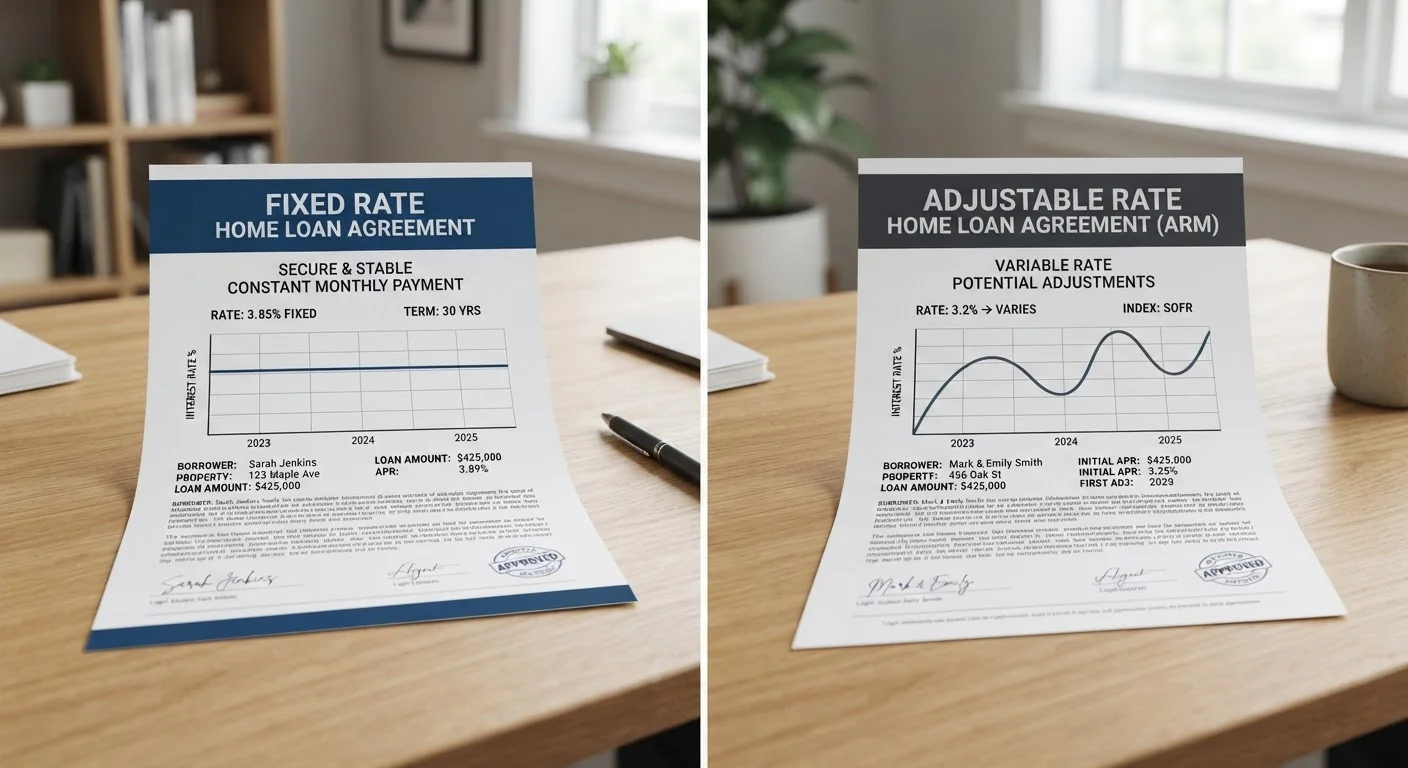
Option A
Fixed-Rate Mortgage
The predictable, stability-first choice for long-term homeowners.
Best for: Buyers who plan to stay in a home long-term and want consistent monthly payments regardless of market shifts.
Option B
Adjustable-Rate Mortgage (ARM)
The flexible, lower-entry-cost option for shorter-horizon buyers.
Best for: Buyers who expect to sell or refinance within a defined period and want to take advantage of lower initial rates.
How Each Structure Works
A fixed-rate mortgage charges the same interest rate for the entire loan term - typically 15 or 30 years. Your principal and interest payment never changes, regardless of what happens to broader interest rates. What you agree to at closing is what you pay through the final month.
An adjustable-rate mortgage (ARM) begins with a fixed introductory period - commonly 5, 7, or 10 years - during which the rate is set and static. After that window closes, the rate adjusts periodically (often annually) based on a reference benchmark, such as the Secured Overnight Financing Rate (SOFR), plus a lender-set margin. A 5/1 ARM, for example, holds its initial rate for five years, then adjusts once per year thereafter.
ARMs include rate caps to limit adjustment volatility. A typical cap structure might be expressed as 2/2/5: the rate cannot rise more than 2 percentage points at the first adjustment, no more than 2 points at any subsequent adjustment, and no more than 5 points above the initial rate over the life of the loan. Understanding these caps is essential for evaluating worst-case payment scenarios.
| Criterion | Fixed-Rate Mortgage | Adjustable-Rate Mortgage (ARM) |
|---|---|---|
| Interest Rate | Locked for entire loan term | Fixed initially, then adjusts periodically |
| Initial Rate Level | Typically higher than ARM | Typically lower than fixed |
| Payment Predictability | Completely stable P&I payment | May change after introductory period |
| Interest Rate Risk | Lender bears long-term rate risk | Borrower bears risk after fixed period |
| Rate Caps | Not applicable | Caps limit per-period and lifetime increases |
| Best Horizon Fit | Long-term ownership (7+ years) | Shorter-term ownership (≤ fixed period) |
| Complexity | Straightforward to understand | Requires understanding of index, margin, caps |
| Refinancing Incentive | If rates fall significantly | Before adjustment period begins |
Costs, Risk, and the Interest Rate Environment
Fixed-rate mortgages generally carry slightly higher starting rates than ARMs because lenders assume the long-term risk of rate movement. When market rates rise well above your locked rate, you benefit; when rates fall, you may want to refinance - which involves closing costs and qualification requirements.
ARMs pass interest rate risk to the borrower after the initial period ends. In a rising-rate environment, this can meaningfully increase monthly payments. In a stable or declining rate environment, borrowers may see little or no increase - and could even see their rate decrease. For a deeper look at how broader rate trends interact with home values, see how mortgage rates and home prices interact.
Buyers who plan to remain in a home through potential market cycles benefit from the certainty of a fixed rate. Those who anticipate a defined exit window - a relocation, an upgrade - may find the ARM's lower initial rate saves meaningful money before any adjustment kicks in. This decision also connects to your broader financial picture; a stable housing cost can make budgeting for savings and debt repayment more manageable.
30 years
Most common fixed-rate mortgage term in the US
The 30-year fixed-rate mortgage has historically been the most widely used home loan structure among American borrowers, according to Freddie Mac survey data.
5/1
Most common ARM structure chosen by buyers
The 5/1 ARM - five years fixed, then annual adjustments - is among the most frequently selected adjustable structures when ARMs represent a meaningful share of originations, per Mortgage Bankers Association reporting.
2/2/5
Typical ARM rate cap structure
A 2/2/5 cap structure limits the first adjustment to 2 points, subsequent adjustments to 2 points each, and the total lifetime increase to 5 points above the start rate, a common industry standard.
Choosing Based on Your Actual Situation
Time horizon is arguably the clearest decision driver. If you plan to own the home for longer than the ARM's fixed period, you will eventually face rate adjustments - and must be financially prepared for that possibility. If your timeline is shorter, locking a 30-year fixed rate means paying a premium for security you may never need.
Income stability matters too. Borrowers with variable income or limited financial cushion generally benefit from payment certainty. Those with strong, growing incomes and liquid savings are better positioned to absorb an upward adjustment. Consider also whether you might refinance: if rates drop significantly, a fixed-rate borrower can refinance, though that process involves fees and a new qualification process.
The choice between renting and owning at various market stages also shapes this calculus - renting vs. owning across market cycles explores how housing conditions affect that decision more broadly. Similarly, the flexibility versus commitment tradeoff echoes themes in month-to-month vs. fixed-term leases.
This article is for general informational and educational purposes only and does not constitute personalized financial, mortgage, or legal advice. Consult a licensed mortgage professional or financial adviser for guidance specific to your circumstances.
The content on this site is provided for informational purposes only and should not be considered a substitute for professional advice. While we strive to provide accurate and up-to-date information, we make no guarantees regarding its completeness or accuracy. Always consult a qualified professional for advice specific to your circumstances before making any decisions.