

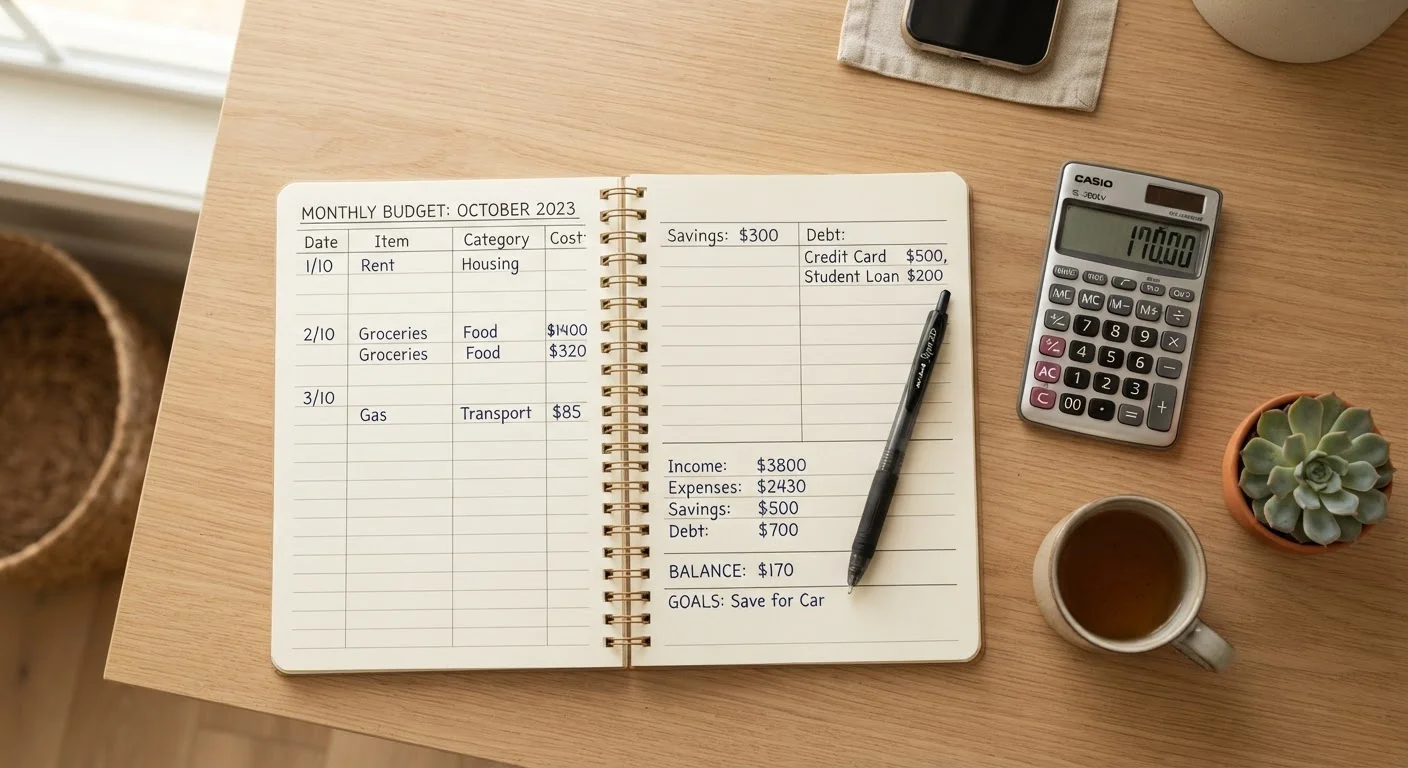
Why Savings and Debt Repayment Belong in the Same Budget
Most people approach debt and savings as a binary choice: pay off what you owe first, then start building wealth - or save aggressively now and deal with debt later. In practice, neither extreme tends to work well. A budget that ignores savings leaves you financially fragile; one that ignores debt lets compounding interest quietly work against you. The goal of a well-structured monthly budget is to make both goals visible and funded, even if the proportions shift over time.
The framework in this article treats savings and debt repayment not as competing priorities but as parallel line items - each assigned a dollar amount every month, each automated where possible, and each reviewed regularly. If you have never built a budget before, Personal Budgeting from the Ground Up covers the foundational concepts you will need before working through the steps below.
What you will need
What You Need Before You Begin
Having the right information on hand makes the budgeting process significantly faster and more accurate. Gather the documents and tools listed below before working through the steps. If you are sharing finances with a partner, both of you should participate in this process from the start - Budgeting as a Couple addresses the additional complexity that shared finances introduce.
Spreadsheet or Budgeting App
Records income, categorizes expenses, and tracks allocations for debt and savings each month.
Debt Payoff Worksheet or Calculator
Organizes debts by balance and interest rate so you can prioritize extra payments strategically.
High-Yield Savings Account
Keeps your emergency fund and savings goals separate from spending money and earns a higher return than a standard checking account.
Automatic Transfer Setup (via your bank or credit union)
Automates contributions to savings and extra debt payments so they happen without manual action each pay period.
Step-by-Step: Building the Budget
The six steps below move from establishing your income baseline through automating your system. Work through them in order - each step builds on the previous one. Skipping steps, particularly the debt inventory in Step 2 or the emergency reserve in Step 3, commonly leads to a budget that looks balanced on paper but breaks down at the first unexpected expense.
Calculate Your True Monthly Take-Home Income
Start with what actually lands in your bank account after taxes, health insurance premiums, and any retirement contributions already deducted by your employer. If your income varies month to month, use a conservatively low estimate - perhaps the average of your three lowest recent paychecks. Building a budget on an income ceiling you rarely hit is a reliable way to run short. For more detail on this foundational step, see Personal Budgeting from the Ground Up.
List Every Debt With Its Minimum Payment and Interest Rate
Before assigning a single dollar to savings, you need a complete inventory of what you owe. For each debt - credit cards, student loans, auto loans, personal loans, medical debt - record the current balance, the required minimum monthly payment, and the annual percentage rate (APR). This list does two things: it shows you the floor of what debt repayment costs you every month, and it reveals which balances are most expensive to carry. High-APR debt, such as credit card balances, typically warrants more aggressive repayment than low-interest debt. A full walkthrough of how to organize this list is available in Building a Debt Payoff Plan.
Establish a Starter Emergency Fund Before Adding Extra Debt Payments
Financial educators broadly recommend having at least a small cash cushion - commonly cited as $500 to $1,000, though the right amount varies by individual circumstance - before directing surplus income aggressively toward debt. Without any reserve, a single unexpected expense like a car repair or medical copay forces you back into high-interest borrowing, erasing debt-repayment progress. Once your starter fund is in place, you can shift focus. For a deeper look at when saving alongside debt makes rational sense, see Saving Money While in Debt.
Assign Every Dollar a Category Using a Proven Framework
With income and obligations mapped out, divide your take-home pay into four buckets: Needs (housing, utilities, minimum debt payments, groceries, insurance), Debt Acceleration (extra payments above the minimum), Savings Goals (emergency fund growth, retirement, specific goals), and Wants (dining out, entertainment, subscriptions beyond essentials). A commonly referenced starting point is the 50/30/20 rule - roughly 50% to needs, 30% to wants, and 20% split between savings and debt acceleration - but this is a template, not a rule. Adjust the percentages to match your actual interest rates and goals. For a side-by-side comparison of popular frameworks, see The 50/30/20 Rule vs. Zero-Based Budgeting.
Decide How to Split Surplus Between Savings and Debt Acceleration
Once needs are covered and a starter emergency fund exists, you face the central question: how much extra goes to debt versus savings? The interest rate comparison is the most objective guide. If a debt carries an interest rate higher than what a savings vehicle is likely to earn, paying it down faster has a measurable mathematical advantage. If the debt rate is low (for example, a fixed-rate mortgage or federal student loan at a rate well below market savings rates), contributing to long-term savings simultaneously can make sense. Neither approach is universally correct - it depends on your specific rates and goals. Paying Off Debt vs. Building Savings explores this trade-off in depth.
Automate, Then Review Monthly
Set up automatic transfers on or immediately after each payday: one to your savings account, one as an extra payment to your highest-priority debt. Automation removes friction and prevents the surplus from being absorbed into daily spending. Then, once a month, compare your actual spending to your plan. Adjust category allocations when circumstances change - a raise, a paid-off debt, or a new expense each creates an opportunity to rebalance. Principles That Hold Up Across Every Stage outlines the habits that make this kind of system durable over time.
Skipping Minimum Payments Has Serious Consequences
Never redirect minimum debt payments toward savings. Missing minimums triggers late fees, penalty interest rates, and credit score damage that can cost far more than any savings gain. Always cover every minimum payment before allocating surplus funds anywhere else.
Automate Both Savings and Debt Payments
Setting up automatic transfers on payday - before you see the money in your checking account - removes the decision entirely. Automation is one of the most reliable strategies for staying consistent with both savings contributions and extra debt payments month after month.
Troubleshooting: When the Numbers Don't Fit
After completing the steps, many people find that their expenses and debt obligations consume most or all of their take-home pay, leaving little room for savings or acceleration. If that is your situation, there are two levers: reduce spending or increase income - usually some combination of both. Start by auditing the Wants bucket for items that can be trimmed temporarily. Even redirecting $50 to $100 per month toward high-interest debt can shorten repayment timelines meaningfully, thanks to how compound interest works on the lender's side.
If your income is variable or project-based, a static monthly budget may not be the right structure. Building a Budget Around Irregular Income offers a framework specifically designed for unpredictable earnings. For those dealing with damaged credit as a result of past debt struggles, Rebuilding Credit After Financial Setbacks provides a practical recovery roadmap alongside the budgeting work.
Finally, remember that a budget is a living document. The proportions that made sense when you had three open credit cards will look different once two are paid off. Review and revise at least quarterly, or whenever your financial picture changes meaningfully.
This article is for general informational and educational purposes only and does not constitute personalized financial, investment, tax, or legal advice. Consult a qualified financial professional before making decisions about your specific financial situation.
This Is General Education, Not Personalized Advice
The frameworks in this article are intended as general financial education for a broad US audience. They are not a substitute for personalized financial, tax, or legal advice. Your income, debts, family situation, and goals are unique - consult a qualified financial professional before making significant changes to your financial plan.
The content on this site is provided for informational purposes only and should not be considered a substitute for professional advice. While we strive to provide accurate and up-to-date information, we make no guarantees regarding its completeness or accuracy. Always consult a qualified professional for advice specific to your circumstances before making any decisions.