

Why the Textbook Relationship Breaks Down
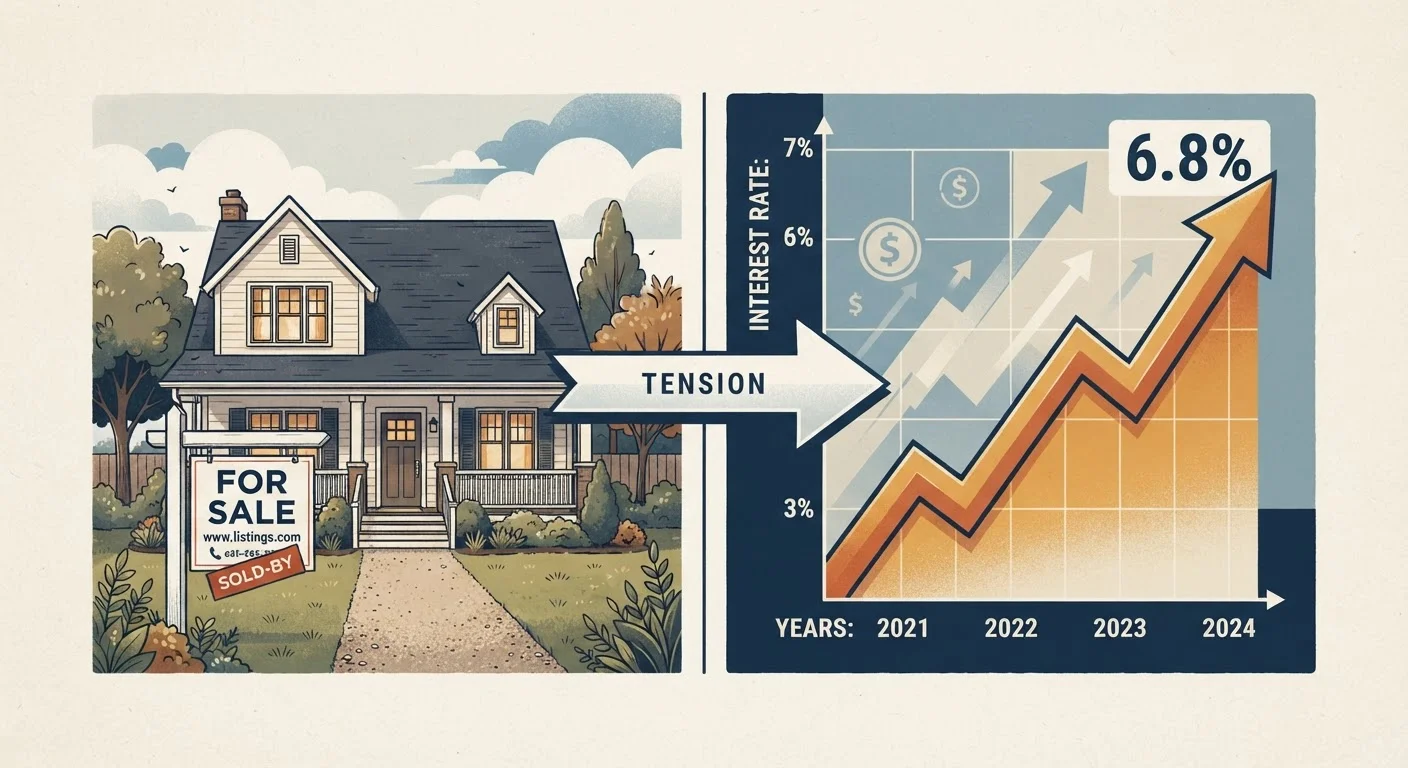
The intuitive logic is straightforward: when mortgage rates go up, monthly payments rise, fewer people can afford to buy, demand falls, and prices follow. When rates drop, the reverse happens. But real housing markets don't move like econ textbook diagrams, and that gap between theory and reality trips up a lot of buyers and sellers.
A key reason is that housing supply doesn't adjust quickly. Builders can't flip a switch to add inventory, and existing homeowners often won't sell at a loss - or even at a price that feels low relative to what their neighbors got a year earlier. This is explored further in why home prices don't fall as fast as they rise. The result is that rate increases frequently produce a market freeze rather than a price correction: transaction volume drops sharply, but list prices hold firm.
Understanding what drives home prices up and down - including employment, local zoning, and migration patterns - helps clarify why rates are only one piece of the puzzle.
Local Markets Vary Significantly
National averages for mortgage rates and home prices can obscure wide regional differences. A rate environment that freezes activity in a high-cost coastal city may have little effect on a smaller market with more affordable inventory and steady local job growth. Always evaluate rate and price dynamics in the context of a specific local market rather than national headlines alone.
The Low-Rate Paradox: More Buying Power, Less Affordability
The period following the 2008 financial crisis and through much of the 2010s illustrated a paradox that many buyers still find surprising: sustained low interest rates can make homes less affordable, not more. Here's why.
When rates fall, the monthly payment on any given loan amount decreases. Buyers respond by qualifying for larger loans or stretching their budgets toward higher-priced homes. Sellers, aware of this expanded purchasing power, raise asking prices - or receive multiple competing offers that push final sale prices above list. The net effect is that price appreciation can outpace the affordability gains from lower rates, leaving many buyers no better off than before.
This dynamic is one of the most common things people get wrong about rising home prices. The assumption that cheap money makes homes more accessible ignores how quickly prices absorb that cheap money.
~$300+
Monthly payment increase per $100K borrowed at 7% vs. 3%
Based on standard 30-year fixed-rate amortization calculations; actual payments vary by loan terms and other factors.
~25-30%
Decline in existing home sales volume in 2022-2023
National Association of Realtors data reflected significant transaction volume drops as rates rose sharply, while median prices remained elevated.
Millions
U.S. homeowners estimated to hold sub-4% mortgage rates
Industry analyses following the 2022-2023 rate environment estimated a large share of outstanding mortgages carried rates well below prevailing market levels, reinforcing the lock-in effect.
What Rate Increases Actually Do to a Housing Market
When rates climb sharply - as they did in 2022 and 2023 - the effects are immediate and measurable on the demand side. Monthly payments on a median-priced home can increase by hundreds of dollars, pricing out a significant share of potential buyers who were on the edge of qualifying. Mortgage application volume tends to decline quickly.
But sellers face their own arithmetic. Homeowners who locked in a low rate several years earlier are reluctant to sell and take on a new mortgage at a higher rate for their next home. This phenomenon - sometimes called the rate lock-in effect - constrains inventory at exactly the moment when analysts might expect supply to improve prices for buyers. Instead, fewer homes come to market, which provides a floor under prices even as demand weakens.
The result is a market that is simultaneously slow and expensive - high prices, low transaction volume, and frustrated buyers and sellers alike. For buyers navigating this environment, understanding the financing structure matters: see the comparison of fixed-rate vs. adjustable-rate mortgages for how each type performs in different rate environments.
Thinking About Affordability More Completely
Affordability is not just a price number or a rate number - it's the interaction of both, combined with income, down payment, property taxes, insurance, and maintenance costs. A home that appears affordable by price can become a stretch when rates are high; a home that appears overpriced at first glance can pencil out when rates are low and local incomes are strong.
First-time buyers in particular tend to anchor on one variable at a time. The homebuying myths that trip up first-timers often include the idea that a falling rate environment automatically produces buying opportunities, or that a rising rate environment should be avoided at all costs. Neither is universally true.
Buyers who focus on what a home costs in total - purchase price plus financing cost over their expected holding period - are better positioned than those timing the market on either variable alone. A licensed financial adviser or HUD-approved housing counselor can help translate these variables into a picture that fits your specific financial circumstances. This article provides general educational context and is not a substitute for personalized financial or real estate advice.
This article is for informational and educational purposes only and does not constitute financial, mortgage, or real estate advice. Consult a qualified professional before making housing or financing decisions.
Frequently Asked Questions
Not automatically. Higher rates reduce buyer demand, but sellers often choose to stay put rather than accept lower offers - a pattern called nominal rigidity. Prices may stagnate or grow more slowly, but outright declines require sustained, significant demand drops alongside adequate housing supply.
Low rates expanded how much buyers could borrow without increasing their monthly payment. With more purchasing power competing for a limited supply of homes, prices were bid up. Affordability improved on the rate side but worsened on the price side.
In theory, yes - as rates rise, prices should soften, and vice versa. In practice, the relationship is inconsistent and depends heavily on inventory levels, local economic conditions, and how quickly buyers and sellers adjust their expectations.
Both determine your total cost of ownership, but the rate has an outsized effect on monthly payments in the short run. A small rate difference on a large loan can mean tens of thousands of dollars over the life of the mortgage. Neither factor should be evaluated in isolation.
Timing the market is difficult and carries real risk. If rates fall widely, demand typically surges and prices rise, potentially offsetting any payment savings. Your readiness - financial stability, time horizon, and local market conditions - matters more than trying to catch a rate cycle. This is general educational information, not personal financial advice; consult a qualified adviser for your situation.
The content on this site is provided for informational purposes only and should not be considered a substitute for professional advice. While we strive to provide accurate and up-to-date information, we make no guarantees regarding its completeness or accuracy. Always consult a qualified professional for advice specific to your circumstances before making any decisions.