

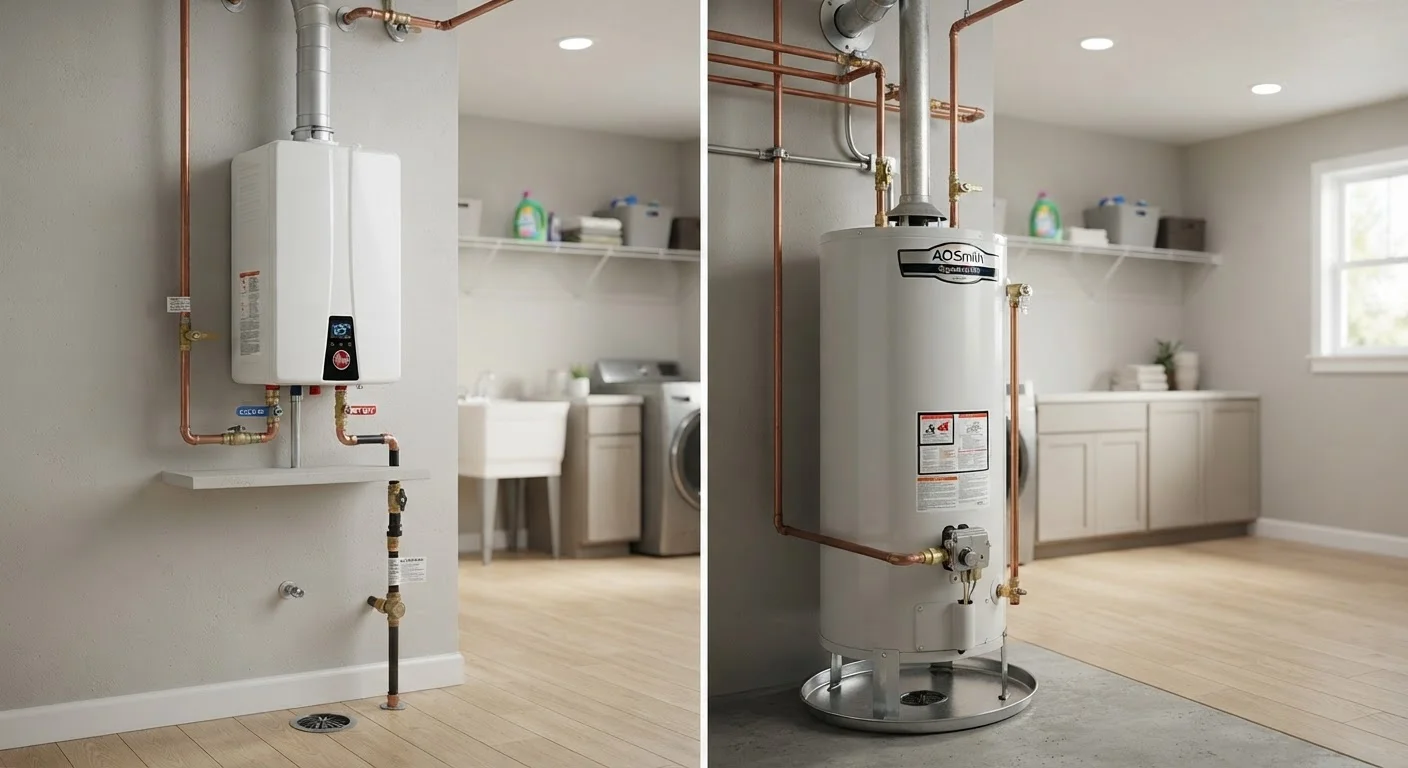
Option A
Tankless Water Heater
The on-demand, energy-efficient upgrade.
Best for: Best for smaller households or those prioritizing long-term energy savings and space efficiency.
Option B
Traditional (Storage Tank) Water Heater
The reliable, lower-upfront-cost workhorse.
Best for: Best for larger households with high simultaneous hot water demand and budget-conscious upfront needs.
How Each System Works
Understanding the fundamental difference between these two systems helps clarify every other trade-off. A traditional storage tank water heater holds a reservoir of water - commonly 30 to 80 gallons - and keeps it heated continuously. Whenever you draw hot water, pre-heated water flows from the tank and cold water refills it. The heater then cycles on to bring the new water back up to temperature.
A tankless water heater (also called an on-demand or instantaneous heater) has no reservoir. When you turn on a hot tap, cold water travels through the unit and a high-powered burner or electric element heats it in real time. Hot water flows only as long as the tap is open, and the unit shuts off completely when demand stops.
For a deeper look at how water moves through your home's system overall, see our home plumbing basics guide.
| Criterion | Tankless Water Heater | Traditional Storage Tank |
|---|---|---|
| Upfront cost | Higher (unit + installation) | Lower (unit + installation) |
| Energy efficiency | Higher (no standby loss) | Moderate (standby heat loss) |
| Lifespan | 20+ years | 10-15 years |
| Hot water supply | Continuous (flow-rate limited) | Limited by tank capacity |
| Space required | Minimal (wall-mounted) | Significant floor space |
| Installation complexity | Higher (may need upgrades) | Lower (standard connections) |
| Maintenance | Annual descaling | Annual flush + anode rod check |
Upfront Costs and Installation
Upfront cost is one of the starkest differences between these two technologies. Storage tank heaters are relatively inexpensive to purchase, and most homes already have the gas lines or electrical connections they require. Professional installation is typically straightforward and completed in a few hours.
Tankless units carry a noticeably higher purchase price. Gas-powered tankless heaters often also require upgrading the gas line to accommodate higher BTU demands, and electric models may need a panel upgrade to supply adequate amperage. Installation labor tends to run higher as well. Permits are commonly required for either type of replacement - always verify local code requirements with your municipality before work begins.
24-34%
Energy savings for moderate hot water users
According to the U.S. Department of Energy, tankless heaters achieve this efficiency advantage for households using 41 gallons or less per day.
10-15 yrs
Average lifespan of a storage tank heater
Industry estimates place traditional tank water heater replacement intervals between 10 and 15 years depending on maintenance and water quality.
20+ yrs
Typical lifespan of a well-maintained tankless unit
Tankless manufacturers and plumbing professionals commonly cite a 20-year or longer service life with proper annual maintenance.
Energy Efficiency and Operating Costs
The core efficiency advantage of tankless heaters comes from eliminating standby heat loss - the energy consumed by a storage tank to keep water hot around the clock, whether you use it or not. According to the U.S. Department of Energy, tankless water heaters can be 24-34% more energy efficient than storage models for homes that use 41 gallons or less of hot water daily. For heavier users, the gap narrows, though savings remain measurable.
That said, efficiency on paper doesn't always translate directly to savings on your bill. Climate, fuel type (gas vs. electric), local utility rates, and household habits all influence real-world results. Running a tankless unit hard - multiple simultaneous demands - can also reduce efficiency gains if the unit struggles to keep up with flow rate.
Traditional tanks have improved meaningfully in efficiency over the past decade with better insulation and heat traps, making modern models noticeably more efficient than older units you may be replacing.
Lifespan, Maintenance, and Reliability
Lifespan is a genuine advantage for tankless systems. Well-maintained tankless heaters commonly last 20 years or more. Traditional storage tanks typically require replacement every 10-15 years, though this varies with water quality and maintenance habits.
Both systems benefit from annual maintenance, but the tasks differ. Storage tanks should be flushed yearly to remove sediment buildup that reduces efficiency and accelerates corrosion. The anode rod - a sacrificial metal rod that prevents tank corrosion - should be inspected every few years and replaced as needed.
Tankless units in hard-water areas require periodic descaling to remove mineral deposits from the heat exchanger. Neglecting this shortens lifespan and reduces performance. Many homeowners in mineral-heavy regions add a water softener upstream of the unit. Either system can be prone to issues if installation is done incorrectly, which is why using a licensed plumber is strongly advisable for any water heater work.
When comparing major home investments like this one, the same long-term cost-versus-upfront-cost thinking applies in other categories too - much like the analysis in our new vs. used car comparison.
When Permits and Professionals Are Required
Replacing a water heater - regardless of type - typically requires a permit in most U.S. jurisdictions. Some localities also mandate that the work be performed by a licensed plumber or contractor. Skipping permits can create problems during home sales or insurance claims. Always check with your local building department before starting any water heater installation or replacement project.
The content on this site is provided for informational purposes only and should not be considered a substitute for professional advice. While we strive to provide accurate and up-to-date information, we make no guarantees regarding its completeness or accuracy. Always consult a qualified professional for advice specific to your circumstances before making any decisions.