

Why HVAC Filter Myths Persist
HVAC filter advice spreads easily because it feels intuitive - cleaner air sounds better, newer is always better, and rules like "change it monthly" are simple to remember. The problem is that simple rules don't account for the variety of home sizes, system designs, and household conditions that actually determine what a filter needs to do. Acting on outdated or oversimplified advice can mean spending money you don't need to spend, or worse, inadvertently damaging the system you're trying to maintain.
Much of the confusion parallels other home maintenance areas. Just as drivers sometimes follow car care habits that don't hold up to scrutiny - see our look at car maintenance myths that quietly drain your wallet - homeowners often follow HVAC filter habits inherited from habit rather than evidence.
Myth
You should replace your HVAC filter every month, no matter what.
Fact
Replacement frequency depends on your specific household - most homes need a new filter every 60 to 90 days.
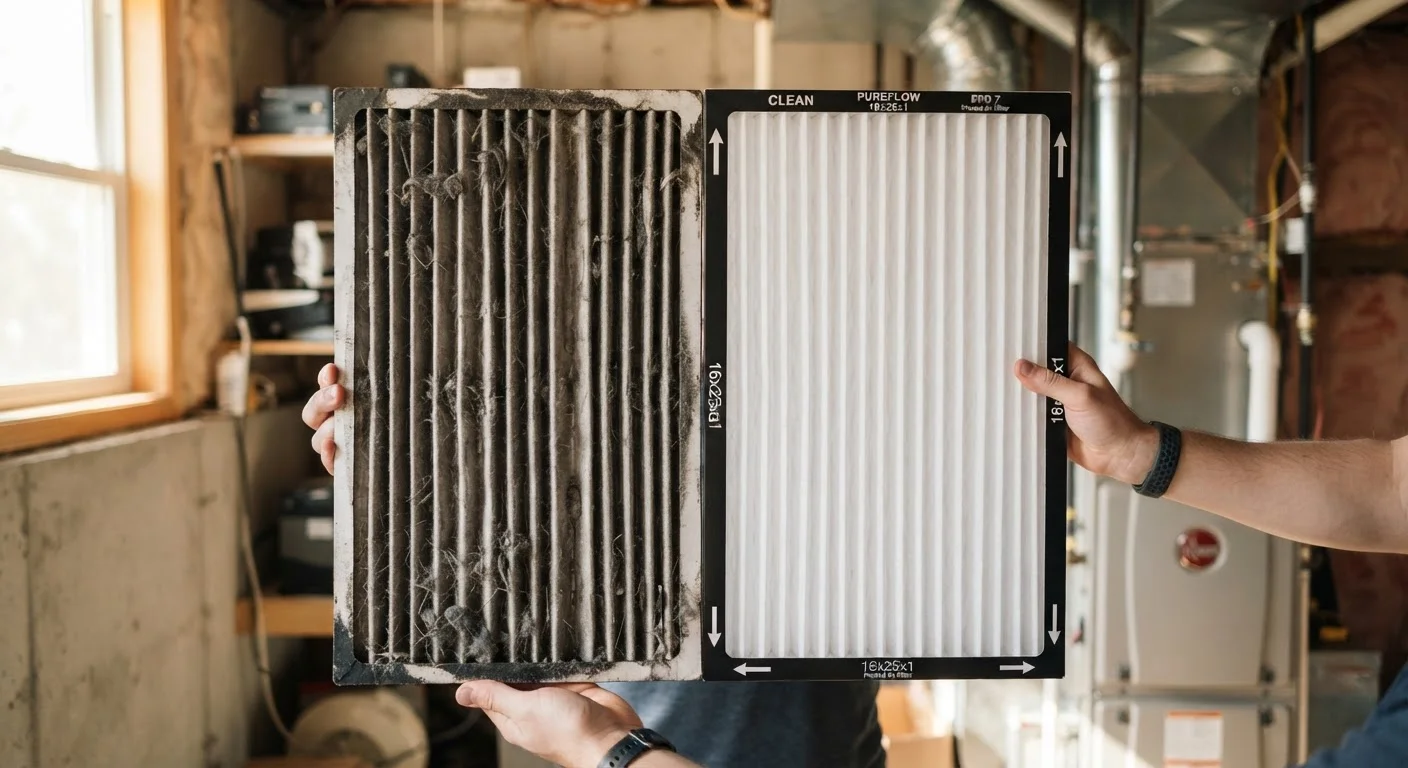
The every-30-days rule is a broad generalization that doesn't apply equally to everyone. A single-person home with no pets and low dust levels may get three months of effective use from a quality filter. Meanwhile, a household with multiple dogs, heavy foot traffic, or a resident with respiratory sensitivities may genuinely need monthly changes. The right approach is to pull the filter and inspect it visually - if it's gray, packed with debris, or noticeably restricting light, it's time to replace it regardless of the calendar.
Myth
The highest MERV rating available is always the best choice for your home.
Fact
Filters with very high MERV ratings (above 13) can restrict airflow in residential systems not designed to handle them.
MERV (Minimum Efficiency Reporting Value) measures a filter's ability to capture particles of various sizes. Higher numbers capture finer particles - but residential HVAC systems are engineered with specific static pressure tolerances. Forcing air through a dense MERV-16 filter in a system designed for a MERV-8 can reduce airflow, cause the blower to labor harder, and lead to premature wear. Most residential systems perform well with MERV 8 to 13. Check your system's documentation or consult an HVAC technician before stepping up significantly in MERV rating.
Myth
Cheap fiberglass filters work just as well as pleated filters.
Fact
Fiberglass filters capture far fewer airborne particles and generally offer minimal protection for indoor air quality.
Basic fiberglass filters are primarily designed to protect the HVAC equipment itself from large debris - not to meaningfully clean your indoor air. They typically have MERV ratings of 1 to 4 and allow a wide range of fine particles, including dust mite debris and mold spores, to pass through freely. Pleated filters, by contrast, have a much larger surface area and are available in MERV ratings that provide real air-quality benefits. The cost difference between fiberglass and a mid-range pleated filter is modest, while the performance gap is substantial.
Myth
Running your system without a filter for a short time won't cause any harm.
Fact
Even brief operation without a filter allows dust, debris, and biological material to accumulate directly on your system's internal components.
Your evaporator coil, blower wheel, and ductwork are designed to operate with filtered air. Without a filter in place, dust binds to the moist surface of the evaporator coil within hours, creating a layer that reduces heat transfer efficiency and can become a breeding ground for mold. Cleaning a contaminated coil is significantly more time-consuming and costly than simply keeping a filter installed at all times. If you need to swap filters, do so quickly and keep the system off during the brief changeover.
Myth
A thicker filter always clogs faster and needs more frequent replacement.
Fact
Thicker filters typically have more media surface area, meaning they can hold more debris and often last longer than thin filters of similar MERV ratings.
A 4- or 5-inch deep filter contains substantially more filter media folded into pleats compared to a 1-inch filter of the same face dimensions. This extra media means there is more surface area to capture particles before the filter becomes restrictive. Many homeowners using deep media filters find they can extend replacement intervals to four to six months without sacrificing air quality or system performance. However, this advantage only applies if your system's filter cabinet is sized to accommodate the deeper filter - forcing a thicker filter into an undersized slot can cause bypassing around the edges.
What Your Filter Schedule Should Actually Look Like
Rather than following a fixed calendar, build your filter maintenance around a monthly visual check. Pull the filter out, hold it up to a light source, and assess how much airflow it still allows. A filter that's only lightly coated with a thin layer of dust may actually be working at its peak - a small layer of captured debris helps trap additional fine particles. A filter that's visibly packed and gray throughout needs to come out.
A Clogged Filter Is Never Harmless
Leaving a heavily loaded filter in place doesn't just reduce air quality - it forces your blower motor to work against restricted airflow, which can overheat components and lead to expensive repairs. In severe cases, a blocked filter is a contributing factor in evaporator coil freeze-ups. Check your filter at least once a month, even if you don't replace it that often.
Your household profile matters most. Homes with multiple pets, anyone with asthma or allergies, recent renovation work, or a wood-burning fireplace will accumulate particulates faster and need more frequent attention. Sealing air leaks around windows and doors is another overlooked factor - drafty homes pull in more outdoor dust and pollen, loading filters faster. Our guide to sealing air leaks around windows and doors covers that piece of the puzzle.
MERV 8-13
Recommended filter range for most homes
The U.S. Department of Energy and HVAC industry guidance generally point to this range as the practical sweet spot for residential air quality and system compatibility.
5-15%
Potential energy waste from a clogged filter
The U.S. Department of Energy has noted that a dirty or clogged air filter can increase a system's energy consumption by this range, as the motor compensates for restricted airflow.
Finally, note that HVAC filters are specific to your home's air handling system - a different maintenance category entirely from the cabin air filter or engine air filter in your vehicle. If you're curious about those, cabin and engine air filter replacement guidance covers that topic separately.
The content on this site is provided for informational purposes only and should not be considered a substitute for professional advice. While we strive to provide accurate and up-to-date information, we make no guarantees regarding its completeness or accuracy. Always consult a qualified professional for advice specific to your circumstances before making any decisions.