

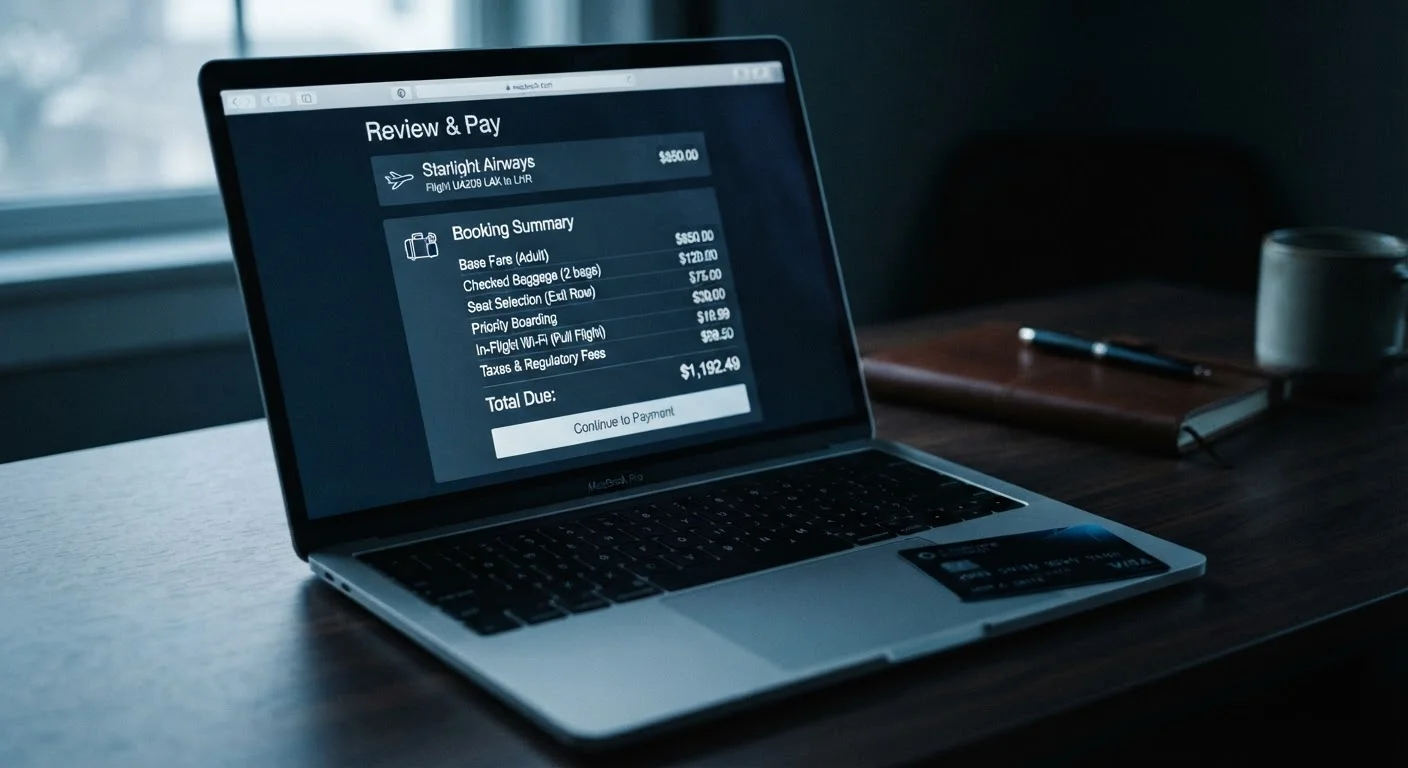
Why the Base Fare Is Just the Starting Point
When you search for a flight and see a $79 fare, that number represents the seat on the plane - nothing more. Airlines have systematically unbundled what was once an all-inclusive ticket into a base product plus a menu of paid add-ons. This shift has accelerated over the past 15 years, particularly among budget and ultra-low-cost carriers, but legacy airlines have followed suit with restricted fare classes.
The result: the final price you pay can be significantly higher than what drew you to click in the first place. For anyone building a realistic travel budget, the base fare is where the calculation starts - not ends.
$7.0B+
U.S. airline baggage fee revenue in a recent year
U.S. Bureau of Transportation Statistics data shows domestic carriers collected billions annually in baggage fees, underscoring how central ancillary revenue has become to airline business models.
$3.8B+
U.S. airline reservation change and cancellation fees in one year
BTS data highlights that change and cancellation fees represent another major ancillary revenue stream, though some carriers reduced or eliminated these fees following the pandemic period.
~40%
Share of some ultra-low-cost carrier revenue from ancillary fees
Industry analyst reports have noted that for some ultra-low-cost carriers, ancillary charges can account for roughly 40% or more of total revenue, illustrating how fee-dependent their model is.
The Most Common Fees Travelers Encounter
While fee structures vary by airline and fare class, a few categories account for the bulk of ancillary charges most passengers face:
- Checked baggage: Typically $30-$40 per bag each way on domestic routes. Fees vary by airline, route, and how many bags you check.
- Carry-on bags: Ultra-low-cost carriers may charge $25-$75 or more for a carry-on that won't fit under the seat.
- Seat selection: Standard economy seats in desirable locations - aisle, window, front of cabin - often carry fees of $10-$50 per segment.
- Flight changes and cancellations: Many basic economy fares are non-refundable and non-changeable, or charge fees of $50 or more to modify.
- Priority boarding: Often sold as a standalone add-on, ranging from $8 to $30 or more depending on the carrier.
- In-flight meals and Wi-Fi: Increasingly charged separately, especially on domestic routes where complimentary service has been reduced.
The pattern is consistent: the lower the base fare, the more likely meaningful services have been stripped out and repriced. This is the same dynamic seen when examining total cost versus sticker price in other purchase decisions.
Build Your Own Full-Cost Comparison
Before booking, write down every service you'll actually need: bags, seat, Wi-Fi, meals. Then look up the fee for each on every carrier you're comparing and add it to the base fare. This takes five extra minutes and gives you a far more accurate picture of which flight is actually less expensive.
How to Get an Accurate Total Before You Book
Comparing flights fairly requires factoring in every fee that applies to your travel needs. A practical approach:
- Define your actual needs first. Will you check a bag? Do you need a specific seat? Knowing this before searching lets you apply fees consistently across options.
- Check airline fee schedules directly. Most carriers publish their full fee schedules on their websites. Checking before you search - rather than during checkout - prevents surprises.
- Apply fees uniformly when comparing. If Carrier A's base fare is $30 cheaper but charges $45 for a carry-on you'd need, Carrier A is actually more expensive.
- Read the fare class rules. "Basic Economy" on one airline may allow a carry-on; on another, it may not. The fare name doesn't standardize what's included.
This kind of total-cost thinking applies well beyond airfare. The same discipline helps when comparing the true costs of car ownership or evaluating any large financial commitment.
It's also worth being skeptical of assumptions that can inflate or deflate perceived savings. The common myths around cheap flights - like incognito browsing lowering prices - often distract from the more straightforward work of calculating real total cost.
A traveler books a $99 base fare on an ultra-low-cost carrier for a weekend trip, then adds a carry-on bag ($55), a seat selection ($20), and checks in at the airport instead of online, triggering a $10 fee.
A family of four books flights for a holiday trip, each checking one bag at $40 each way.
A business traveler holds mid-tier status with a major airline, which includes one free checked bag and complimentary seat selection.
When Fees Can Be Reduced or Avoided
Some ancillary fees are avoidable with planning; others are simply part of flying a particular carrier. A few genuine levers worth knowing:
- Airline co-branded credit cards often include one free checked bag per person on that carrier's flights - a benefit that can offset an annual fee on its own if you fly that airline regularly.
- Frequent flyer status typically includes waived bag fees and complimentary seat selection, though the fee structures and thresholds vary by program.
- Packing light - fitting everything into a personal item - eliminates checked bag and carry-on fees entirely and is often the most reliable strategy for short trips.
- Skipping seat selection and accepting an auto-assigned seat is free, though you give up control over placement. This is a reasonable trade-off for budget-focused travelers on shorter flights.
None of these are guaranteed savings, and what works depends entirely on your specific airline, route, and travel needs. The goal is to make an informed decision with the full cost picture in view - not to chase the lowest headline number.
Frequently Asked Questions
On most U.S. airlines, checked baggage fees are not included in the base fare and are charged separately. A handful of fare classes or loyalty programs may include a free checked bag, but this is not the default for most economy tickets. Always check the specific fare rules before booking.
U.S. Department of Transportation rules require airlines to disclose certain fees, such as baggage charges, but the timing and prominence of those disclosures can vary. Many fees don't appear until deeper in the checkout process. Checking an airline's fee schedule directly - before searching - is the most reliable approach.
Not always. Many airlines assign a seat automatically at no charge if you don't select one, but the assigned seat may be a middle seat or near the back. Preferred seats - including exit rows, bulkheads, or seats toward the front - typically carry an additional fee.
It varies widely by airline, route, and how many services you use. A round trip with one checked bag, seat selection, and a carry-on on an ultra-low-cost carrier can add $80 to $200 or more to the base fare. This is why comparing total cost matters more than comparing base fares alone.
Some travel credit cards include airline fee credits, free checked bags on specific carriers, or priority boarding as a benefit. These perks can offset certain fees, but only if the card's benefits align with the airline you're flying. Check your card's terms before assuming coverage.
Not anymore. Ultra-low-cost carriers often charge for carry-on bags that don't fit under the seat in front of you. Basic Economy fares on legacy carriers may also restrict carry-on privileges. Reading the fare rules - not just the price - is essential before booking.
The content on this site is provided for informational purposes only and should not be considered a substitute for professional advice. While we strive to provide accurate and up-to-date information, we make no guarantees regarding its completeness or accuracy. Always consult a qualified professional for advice specific to your circumstances before making any decisions.