

Why Carry-On Only Still Works for Long US Trips
The assumption that longer trips require checked baggage is one of the most common packing myths. In reality, the number of days you're traveling matters far less than how strategically you pack. A well-organized carry-on - typically one that fits in the overhead bin, usually up to 22 x 14 x 9 inches, though airline rules vary - can realistically support a two-week domestic trip with minimal sacrifice.
Flying carry-on only means no checked bag fees, no waiting at baggage claim, and no risk of your luggage arriving somewhere other than you. For domestic travel especially, those advantages compound quickly. If you're weighing your overall trip approach, our end-to-end US travel planning guide covers how packing decisions fit into the broader logistics picture.
Before you start filling a bag, confirm your airline's carry-on size and weight limits. Budget carriers in particular enforce these more strictly than major airlines, and the limits can differ even between fare classes on the same airline.
Building a Capsule Wardrobe That Travels Far
The capsule approach means selecting a small number of versatile pieces that mix and match across multiple outfits rather than packing a distinct outfit for every day. In practice, five to seven clothing items - a couple of neutral bottoms, three or four tops, one layer, and one pair of shoes beyond what you wear to the airport - can cover eight to twelve days of varied activities with thoughtful combinations.
Start with a packing list built around activities, not days.
Listing what you'll actually be doing - hiking, a dinner out, a business meeting - reveals what clothing you genuinely need rather than prompting you to pack for every possible scenario. This prevents the common mistake of overpacking 'just in case' items that never get used.
Choose a color palette before selecting individual items.
When every piece in your bag works with every other piece, you multiply outfit combinations without adding items. A palette of two neutrals plus one accent color is a common starting point that most travelers find flexible enough for varied activities.
Wear your bulkiest items on travel days.
Shoes, heavy jackets, and thick sweaters take up disproportionate bag space. Wearing these items during transit frees up significant volume inside the carry-on without adding to your bag's weight limit.
Limit yourself to one pair of shoes beyond what you're wearing.
Shoes are among the heaviest and most voluminous items in any bag. Most US trips can be managed with two pairs total: one comfortable walking shoe worn during travel and one versatile alternative packed. Trying to pack for every shoe occasion is one of the fastest ways to exceed carry-on limits.
Audit your 'just in case' items before you zip the bag.
Most overpacked bags contain items added for unlikely scenarios - a fourth pair of pants in case of spills, a formal outfit for an event that may not happen. Identifying these items and asking whether the consequence of not having them is actually manageable frees up space reliably.
Fabric choice matters as much as item count. Merino wool and synthetic blends resist odor better than cotton, dry faster, and wrinkle less - all of which matter when you're repacking frequently or wearing something two days in a row. Dark neutrals hide wear between washes and pair easily.
For destination-specific gear - hiking boots for a national park trip, formal wear for an event - evaluate honestly whether you can rent, borrow, or buy inexpensively at your destination rather than dedicating bag space to bulky items you'll use once.
Toiletries, Liquids, and TSA Rules
The TSA's 3-1-1 rule applies to all carry-on bags: liquids, gels, aerosols, creams, and pastes must be in containers of 3.4 ounces (100 ml) or less, all fitting in a single quart-sized clear bag, one bag per traveler. This is a hard constraint, not a guideline - plan your toiletry kit around it from the outset rather than editing it at the security lane.
Solid Toiletries Simplify Security Every Time
Shampoo bars, conditioner bars, and toothpaste tablets have improved significantly in quality and are now widely available at major drugstores and outdoor retailers. Switching to solids eliminates the quart-bag step at security entirely and removes the risk of liquids leaking in your bag. If you're traveling frequently, making this swap once means you never have to think about the 3-1-1 rule again.
Solid alternatives - shampoo bars, solid conditioner, toothpaste tablets, solid sunscreen - sidestep the liquid limit entirely and are increasingly available at drugstores. They also tend to be lighter and less likely to leak. If you do rely on liquids, purchase travel-size versions or transfer products into reusable silicone bottles labeled clearly.
For longer trips, plan to restock basics at your destination. Most US cities have pharmacies and grocery stores where you can pick up shampoo, conditioner, or sunscreen without significant effort. Checking airport layover logistics can also help you factor in whether a connection gives you time to pick up items airside.
Packing Organization That Actually Saves Space
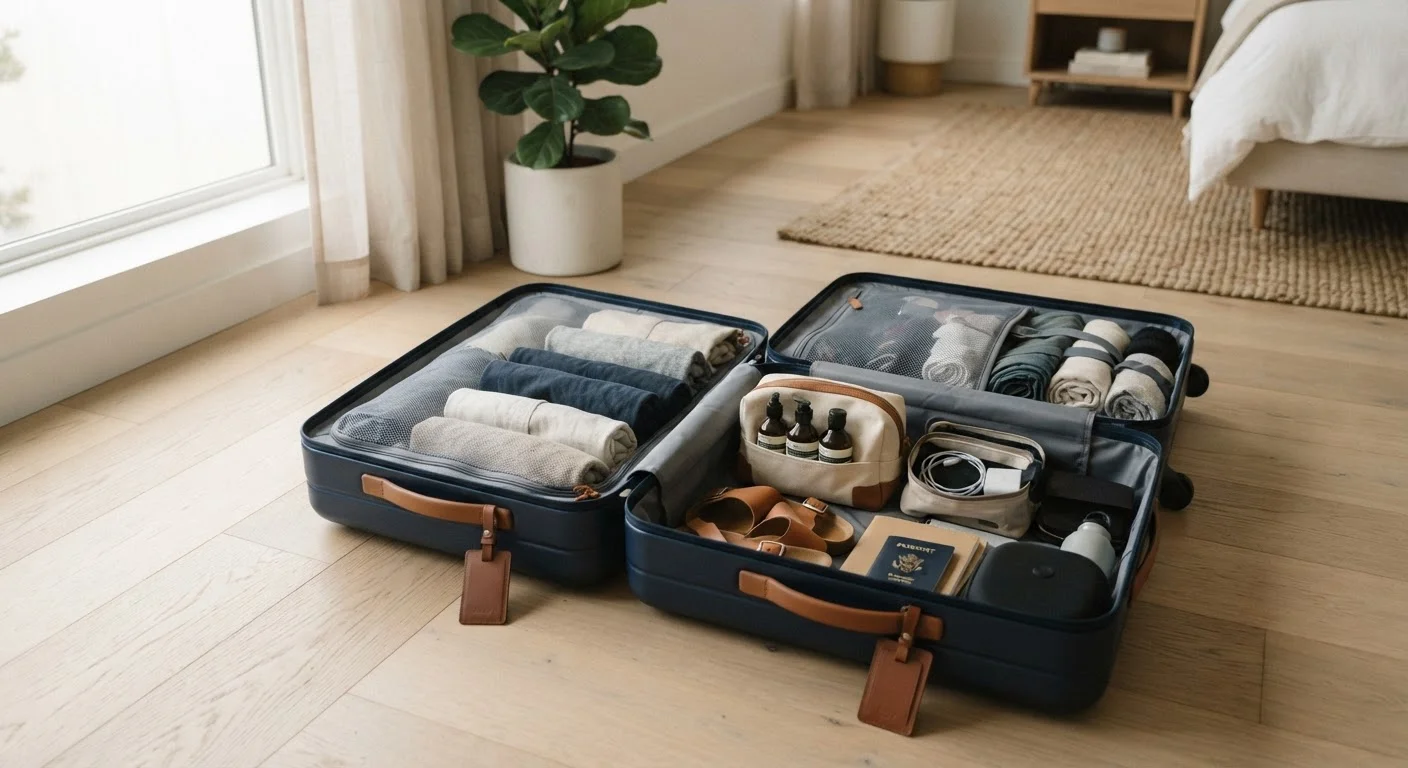
Packing cubes - lightweight fabric organizers in different sizes - are the single most effective tool for carry-on travel. They compress clothing, separate categories (tops, bottoms, undergarments), and make repacking fast when you're moving between multiple stops. Compression cubes go further by removing air from soft items, useful for bulkier garments like fleece or denim.
Rolling clothes rather than folding reduces wrinkles and uses vertical space more efficiently in most bags. Bundle wrapping - wrapping garments around a core item - can further reduce creasing for items like blazers or dress shirts, though it takes more practice.
Distribute weight low and centered in the bag to make it easier to maneuver in tight overhead bins. Shoes, which are heavy, go at the bottom near the wheels. Pack items you'll need during the flight - headphones, snacks, a charger - in the top layer or a front pocket so you're not unpacking the entire bag mid-flight.
If you're traveling by car rather than plane, the carry-on-only discipline still applies - it just simplifies loading and unpacking. Our breakdown of road trips versus flying can help you decide which mode fits your trip best.
Mid-Trip Laundry: The Strategy That Unlocks Any Length
Doing laundry once during a trip transforms how much you need to pack. Most hotels offer in-room laundry bags with next-day service, though this costs more than self-service. Laundromats near tourist areas are widely available in US cities, and many Airbnbs include washer-dryer access. A single wash cycle mid-trip effectively resets your entire clothing inventory.
If you're staying somewhere without easy laundry access, a small packet of travel laundry soap and a sink works for underwear, socks, and lightweight tops - items that dry overnight when hung up. Quick-dry fabrics designed for travel dry significantly faster than cotton, which can take 12 or more hours.
Planning a laundry day also means you can pack lighter on the front end without anxiety about running out of clean clothes. For trips to outdoor destinations, our guide on national park visit planning addresses practical logistics including what facilities are realistically available in and near park areas.
Airline carry-on size and weight policies vary by carrier and fare class. Always verify current requirements directly with your airline before traveling.
The content on this site is provided for informational purposes only and should not be considered a substitute for professional advice. While we strive to provide accurate and up-to-date information, we make no guarantees regarding its completeness or accuracy. Always consult a qualified professional for advice specific to your circumstances before making any decisions.