

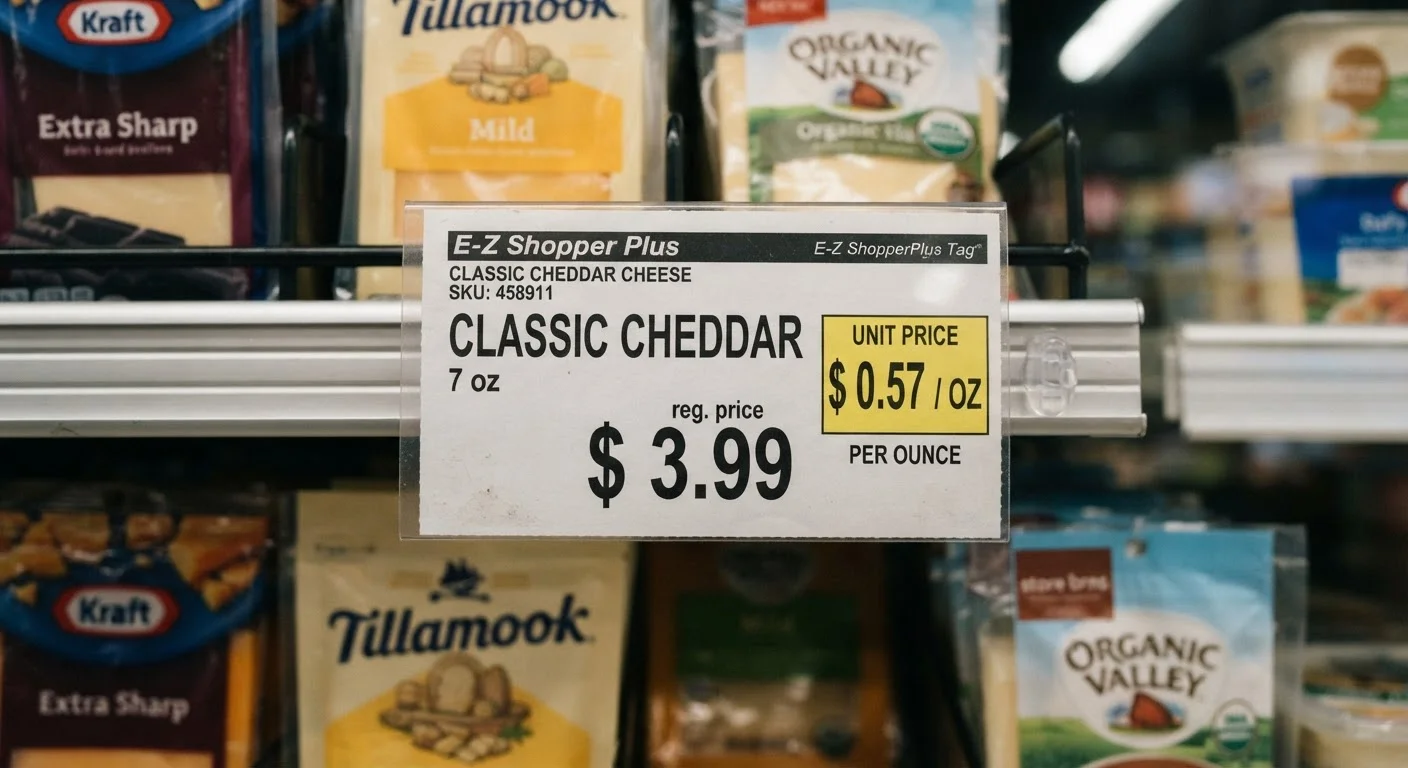
What Unit Price Actually Tells You
The sticker price on a product answers one question: what does this cost me today? Unit price answers a different, more useful question: what am I getting for each dollar I spend?
When a 32-oz bottle of olive oil costs $7.99 and a 16-oz bottle costs $4.49, the larger bottle looks like the obvious buy. But $7.99 ÷ 32 = $0.25/oz, while $4.49 ÷ 16 = $0.28/oz. The larger bottle wins - but only by doing the math. Unit price does that division for you and prints it right on the shelf.
This matters more than most shoppers realize. Package sizes in grocery stores are not standardized. Manufacturers routinely change fill weights - sometimes reducing contents while keeping the package size visually similar. Unit price cuts through that ambiguity by anchoring every product to the same measuring stick.
For a broader look at how pricing signals can mislead, see our guide to smart shopping from the ground up.
How to Read a Shelf Tag Correctly
Most shelf tags follow a predictable layout. The large number is the total price. The unit price - smaller, often in a corner - shows cost relative to a standard measure. That measure might be per ounce, per fluid ounce, per count, per square foot, or per 100 units, depending on the product category.
The catch: not all tags use the same base unit, even for similar products. One brand of pasta might display price per pound; another might show price per ounce. Before drawing any comparison, confirm both tags are measuring the same thing. If they aren't, a quick conversion on your phone resolves it.
32
U.S. states with unit pricing requirements or guidelines
Requirements vary significantly - some apply only to specific store sizes or product categories, according to consumer advocacy research on pricing transparency.
~10-15%
Estimated grocery savings from consistent unit price comparison
Consumer research organizations have suggested disciplined unit-price shopping can reduce grocery spend meaningfully over time, though results vary by shopping habits and store.
Store-brand and national-brand products sometimes appear side by side using different units deliberately or by convention - the result is that a comparison that looks straightforward isn't. Taking two seconds to verify the unit label is the entire skill.
When the Bigger Size Isn't the Better Deal
The widespread assumption that bulk always wins is worth questioning. There are predictable situations where a smaller package carries a lower unit price:
- Store-brand smaller sizes: A private-label 12-oz product may undercut a national-brand 32-oz on a per-ounce basis.
- Competing promotions: A smaller size on sale this week may temporarily beat the bulk price of the same brand.
- Warehouse clubs: Per-unit pricing at warehouse retailers is often competitive, but not automatically superior to a supermarket sale price on a standard size.
Unit price makes these comparisons instant. Without it, shoppers often default to size as a proxy for value - which is exactly the assumption that can cost more over hundreds of shopping trips.
A shopper comparing two sizes of shampoo: a 12-oz bottle for $4.29 and a 28-oz bottle for $8.99.
A paper towel display shows a 6-roll pack for $5.49 and a 12-roll pack for $9.99, both displaying price per sheet on the tag.
A store-brand canned tomato sauce (15 oz, $0.89) sits next to a national brand on sale (28 oz, $2.49, marked '20% off').
At a warehouse club, a 5-lb bag of almonds is priced at $18.99, while a standard grocery store sells a 1-lb bag for $6.49 on promotion.
It's also worth noting that buying more than you'll use before a product expires or goes stale negates any per-unit savings. The lowest unit price is only a genuine savings if you use what you buy.
Unit Price vs. Sale Price: Don't Conflate Them
A promotional tag and a unit price are answering different questions, and conflating them is one of the most common errors at the shelf. A sale badge tells you a product is cheaper than it was. Unit price tells you whether it's cheaper than its alternatives right now.
Consider: a name-brand cereal marked 20% off may still carry a higher unit price than the store brand at full price. The discount is real; the value comparison depends entirely on the unit price, not the percentage markdown.
Understanding how retailers frame promotional pricing - and why discounts feel more compelling than they sometimes are - is covered in our piece on anchoring and reference pricing. For specifics on how sale and markdown language works, see sale price vs. markdown explained.
The habit of checking unit price before responding to a sale tag is a straightforward way to verify whether a deal is genuinely competitive.
Make Unit Price Your First Look, Not Your Last
Before you reach for the larger size or the item with the sale tag, glance at the unit price field on both shelf tags. It takes under five seconds and gives you the comparison that total price alone can't. If the tags use different units, a quick phone calculation closes the gap.
Frequently Asked Questions
It's usually displayed in smaller text near the top or bottom of the shelf label, separate from the larger total price. It's often formatted as a dollar amount followed by the measurement unit, such as '$0.18/oz' or '$1.42/100ct'.
Not always. Bulk sizes are often cheaper per unit, but that's not a universal rule. Promotions, store-brand pricing, or packaging changes can make a smaller size the better value on a given day. Always verify with the unit price rather than assuming.
You'll need to convert before comparing. For example, if one product lists price per ounce and another lists price per pound, divide the per-pound price by 16 to get the per-ounce equivalent. Most smartphones have a calculator for this.
Not universally. Requirements depend on state law and sometimes store size. If a store doesn't display unit prices, you can calculate it yourself by dividing the total price by the number of units (ounces, count, etc.) shown on the packaging.
Yes. Unit pricing is common for household supplies like paper towels (per sheet), laundry detergent (per load or per ounce), and cleaning products. The same comparison logic applies across any category where multiple sizes are sold.
Yes. A product may be on sale yet still have a higher unit price than a non-sale alternative on the same shelf. Checking unit price alongside any promotional tag gives you the full picture. Our article on <a href="/travel-shopping/savvy-shopping/sale-price-vs-markdown-what-retailers-actually-mean">sale price vs. markdown</a> explains how promotional labels can mislead.
The content on this site is provided for informational purposes only and should not be considered a substitute for professional advice. While we strive to provide accurate and up-to-date information, we make no guarantees regarding its completeness or accuracy. Always consult a qualified professional for advice specific to your circumstances before making any decisions.