

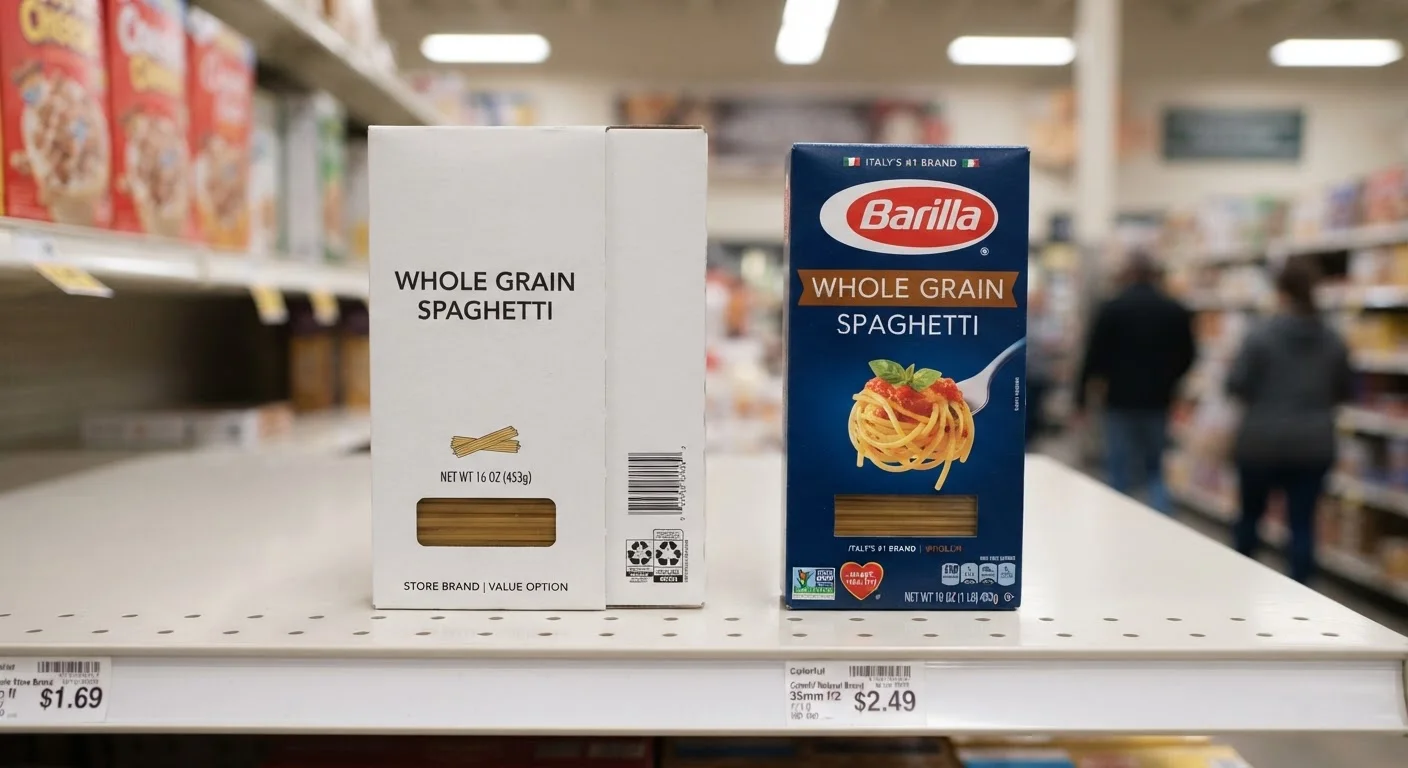
Option A
Store Brands (Private Label)
The retailer-owned, often lower-priced alternative.
Best for: Budget-conscious shoppers who prioritize value in commodity and everyday-use categories.
Option B
Name Brands (National Brands)
The established, heavily marketed household names.
Best for: Shoppers who prioritize consistency, specific formulations, or performance in specialized categories.
Where the Price Difference Actually Comes From
The price gap between a store brand and its name brand equivalent typically has less to do with what's inside the package and more to do with what happens outside of it. National brands spend heavily on national advertising, celebrity endorsements, slotting fees to secure premium shelf placement, and packaging design. These costs get built into the retail price consumers pay.
Store brands - also called private label products - eliminate most of those layers. The retailer contracts directly with a manufacturer, markets the product under its own label, and captures more margin by cutting out the brand overhead. The result is a lower shelf price, not necessarily a lower-quality product.
This structure is well-established in the grocery industry. Multiple independent industry analyses have documented that a significant share of store brand products are manufactured in the same facilities as their name brand counterparts, sometimes on the same production lines. The manufacturer sells to both the national brand and the retailer - just under different labels.
| Criterion | Store Brands | Name Brands |
|---|---|---|
| Typical price point | 20-40% lower on average | Higher; reflects marketing overhead |
| Manufacturing source | Often same facilities as name brands | Proprietary or contracted facilities |
| Marketing investment | Minimal; retailer-level only | Heavy national advertising spend |
| Ingredient transparency | Panel-based; varies by retailer | Panel-based; same regulatory standard |
| OTC drug equivalence | FDA-mandated same active ingredients | Brand-name formulation |
| Return/satisfaction policy | Usually retailer-backed guarantee | Varies by brand and retailer |
| Specialized formulations | Limited in complex categories | Often proprietary; can differ meaningfully |
When Store Brands Genuinely Compete - and When They Don't
The honest answer is that category matters enormously. In commodity-heavy categories - canned goods, pantry staples, over-the-counter medications, household cleaning products, and basic paper goods - the store brand typically performs comparably. For OTC drugs specifically, FDA regulations require generic products to contain the same active ingredients at the same strength as their branded equivalents, which makes the choice fairly straightforward.
Where name brands hold more defensible ground is in categories where proprietary formulations, complex manufacturing processes, or deep product engineering genuinely create differentiation. A specialized adhesive, a specific laundry detergent formula designed for a unique problem, or a premium food product with a distinct preparation method can represent real differences - not just marketing.
~25%
Average price difference, store vs. name brand
Industry estimates from trade research have consistently placed the average store brand price advantage in the 20-30% range across grocery categories.
~40%
U.S. grocery sales accounted for by private label
Private label market share in U.S. food retail has grown steadily, with trade analysts tracking it near or above 40% of unit volume in some channels.
The most reliable approach any consumer can take is to compare ingredient panels and product specifications directly, rather than relying on packaging cues or price assumptions. A higher price does not automatically mean better ingredients, and a lower price does not automatically mean cut corners. For a broader look at how pricing signals can mislead, see our piece on shopping myths that cost Americans money.
How to Make the Call for Your Household
A practical starting point: treat the switch as a trial, not a permanent commitment. Most store brand items carry the retailer's satisfaction guarantee. Buy one, compare it against your usual product, and evaluate on your own terms - taste, texture, performance, or whatever dimension matters to you.
Apply more scrutiny in categories where you have specific needs or past experiences with product failures. A store brand trash bag that splits open isn't a bargain. A store brand all-purpose flour that performs identically in your recipes almost certainly is.
It's also worth noting that brand loyalty itself is a marketing outcome. Decades of advertising investment are designed to create an emotional preference that persists even when product differences don't justify it. That doesn't mean preferences aren't real - it means they're worth examining. Where you buy also shapes the options available to you; this decision intersects with the broader question of where to buy based on what you're purchasing, since online channels often surface a wider range of private label options than a physical shelf.
A Note on Store Brand Quality Variation
Not all retailers invest equally in their private label programs. Some chains maintain rigorous quality standards and conduct ongoing product testing; others prioritize price minimization above all else. A store brand from a retailer with a strong quality-control reputation may outperform one from a chain that treats private label as a pure cost-cutting vehicle. When in doubt, the satisfaction guarantee is your safety net.
The bottom line: neither store brands nor name brands win categorically. The differences come down to specific products, specific categories, and your own informed assessment - not the label on the front of the package.
The content on this site is provided for informational purposes only and should not be considered a substitute for professional advice. While we strive to provide accurate and up-to-date information, we make no guarantees regarding its completeness or accuracy. Always consult a qualified professional for advice specific to your circumstances before making any decisions.