

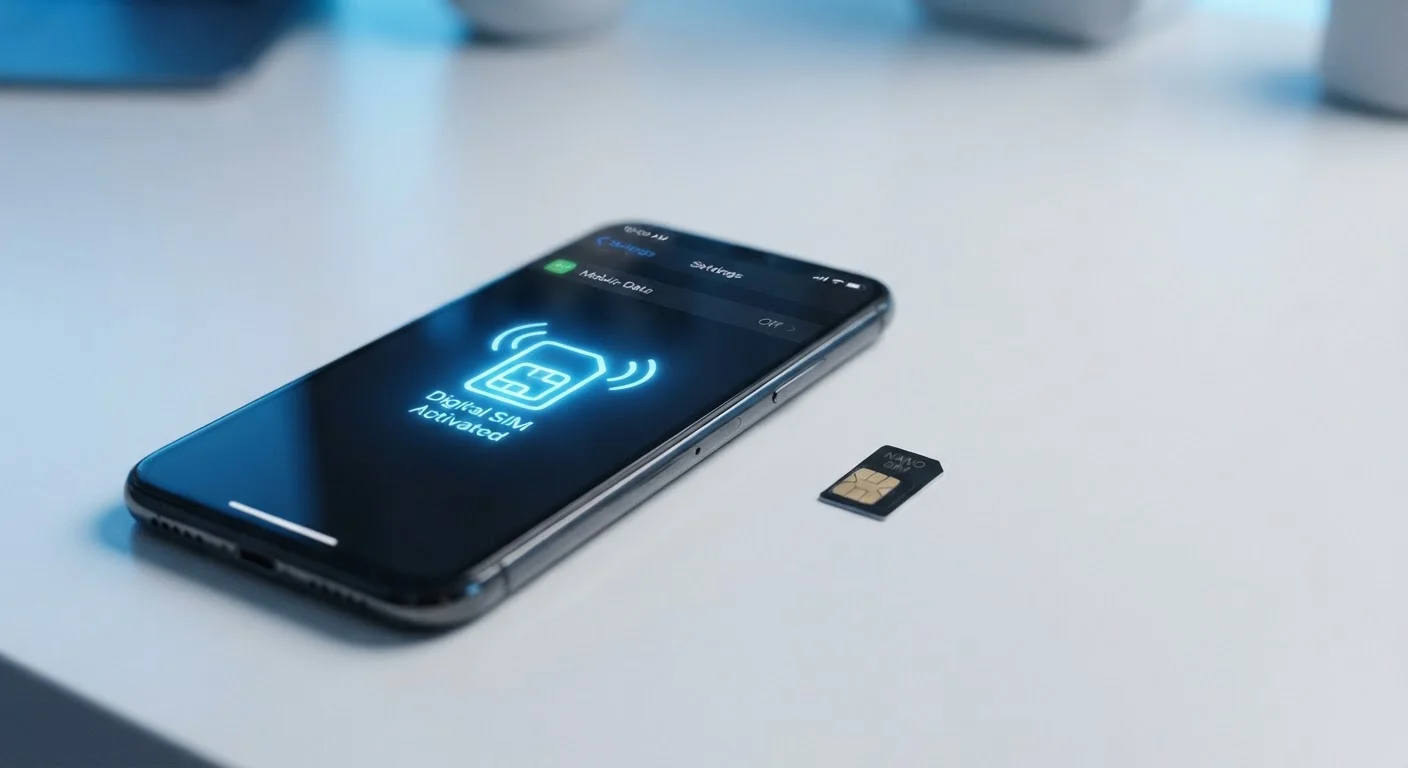
Option A
eSIM
The built-in, software-based alternative to a physical card.
Best for: Travelers, frequent carrier-switchers, and anyone who wants a streamlined setup without handling a physical card.
Option B
Physical SIM
The removable card that has connected phones to networks for decades.
Best for: Anyone needing broad device compatibility, easy SIM swapping between phones, or access to carriers with limited eSIM support.
What Each SIM Actually Does
A SIM - SIM - is what ties your phone to a carrier's network. It stores your account credentials and tells the network who you are, so calls, texts, and data can be routed to your number.
A physical SIM is a small removable card - most modern phones use the nano-SIM format - that slots into a tray on the side of your device. Swap the card, and you've effectively moved your account to that phone. Carriers have distributed physical SIMs for decades, and virtually every mobile network in the world supports them.
An eSIM (embedded SIM) is a chip permanently soldered into the phone's hardware. Instead of inserting a card, you download a carrier profile digitally - typically by scanning a QR code, using a carrier app, or activating through your phone's settings. The underlying job is identical: authenticate your identity with the network and enable service.
| Criterion | eSIM | Physical SIM |
|---|---|---|
| Form factor | Embedded chip, no card needed | Removable nano-SIM card |
| Carrier activation | QR code, app, or settings | Insert card, activate account |
| Switching carriers | Digital, often within minutes | Requires new physical card |
| Moving to another phone | Requires digital re-activation | Physically move the card |
| Dual-SIM capability | Yes, on supported devices | Only with dual-tray hardware |
| Device compatibility | Flagship phones; not universal | Broad - most phones worldwide |
| International use | Add local plan digitally | Swap to local carrier card |
| Risk of loss or damage | None - internal component | Small card can be lost |
Key Practical Differences
The most significant day-to-day difference is how you switch carriers or plans. With a physical SIM, you need a new card - either mailed to you or picked up at a store. With an eSIM, the switch is largely software-driven and can happen in minutes, assuming your phone and the carrier both support it.
eSIMs also enable dual-SIM functionality on many devices. An iPhone, for example, can hold one physical SIM and one eSIM (or in some US models, two eSIM profiles), letting you maintain a personal and work number on one handset, or keep a home plan active while adding a travel plan abroad.
Physical SIMs, however, offer something eSIMs cannot: straightforward portability across devices without any digital handshake. If your phone dies and you have a spare, the physical SIM moves with you in seconds. That simplicity matters in low-connectivity situations or when dealing with carriers that haven't yet rolled out eSIM support.
eSIM Profiles Are Not Always Transferable
When you activate an eSIM, the carrier profile is tied to that specific device. If you get a new phone, you typically need to re-activate with your carrier rather than simply moving a profile over. Some carriers allow profile transfers through their app or customer service, but the process varies. Confirm your carrier's policy before upgrading devices, especially if you rely on an eSIM-only setup.
For travelers specifically, the calculus is worth thinking through. Our guide on choosing a phone plan when you travel internationally breaks down how local SIMs, travel day passes, and roaming plans each compare.
Compatibility and Carrier Support
eSIM support has grown substantially among US carriers and flagship devices, but it is not universal. Most current-generation iPhones and flagship Android phones sold in the US include eSIM capability. Budget and mid-range Android devices vary widely - some support eSIM, many do not.
Carrier support also matters. The major US networks - AT&T, T-Mobile, and Verizon - support eSIM broadly, and many MVNOs (mobile virtual network operators) that ride on those networks have added eSIM activation as well. Still, not every MVNO has caught up, and international carriers vary considerably.
One more consideration: if you purchase an unlocked phone from a third-party retailer or internationally, confirm whether its eSIM functionality is active in the US. Some devices are sold with eSIM disabled in certain regions.
~50%
Global smartphones with eSIM by 2023
Industry analyst estimates suggest roughly half of smartphones shipped globally in 2023 included eSIM capability, with the share growing each year.
2
Active lines supported simultaneously on many flagship phones
Many current iPhones and select Android flagships allow two active numbers - via eSIM, physical SIM, or a combination - without carrying a second device.
Which Makes More Sense for You?
For most people buying a current flagship phone from a major US carrier, eSIM is increasingly the default - and for good reason. The convenience of instant activation, dual-number support, and no physical card to lose are genuine advantages for everyday use.
That said, physical SIMs aren't obsolete. If you share phones regularly, use a device purchased abroad, or rely on a carrier or MVNO that hasn't fully implemented eSIM, a physical card remains the simpler and more universally compatible option.
The good news is that the choice isn't always either/or. Many current smartphones support both, giving you flexibility to use whichever approach fits the situation. Understanding what your specific phone and carrier support - before you need to switch - puts you in control of the decision rather than discovering limitations at an inconvenient moment.
The content on this site is provided for informational purposes only and should not be considered a substitute for professional advice. While we strive to provide accurate and up-to-date information, we make no guarantees regarding its completeness or accuracy. Always consult a qualified professional for advice specific to your circumstances before making any decisions.