

Our Verdict
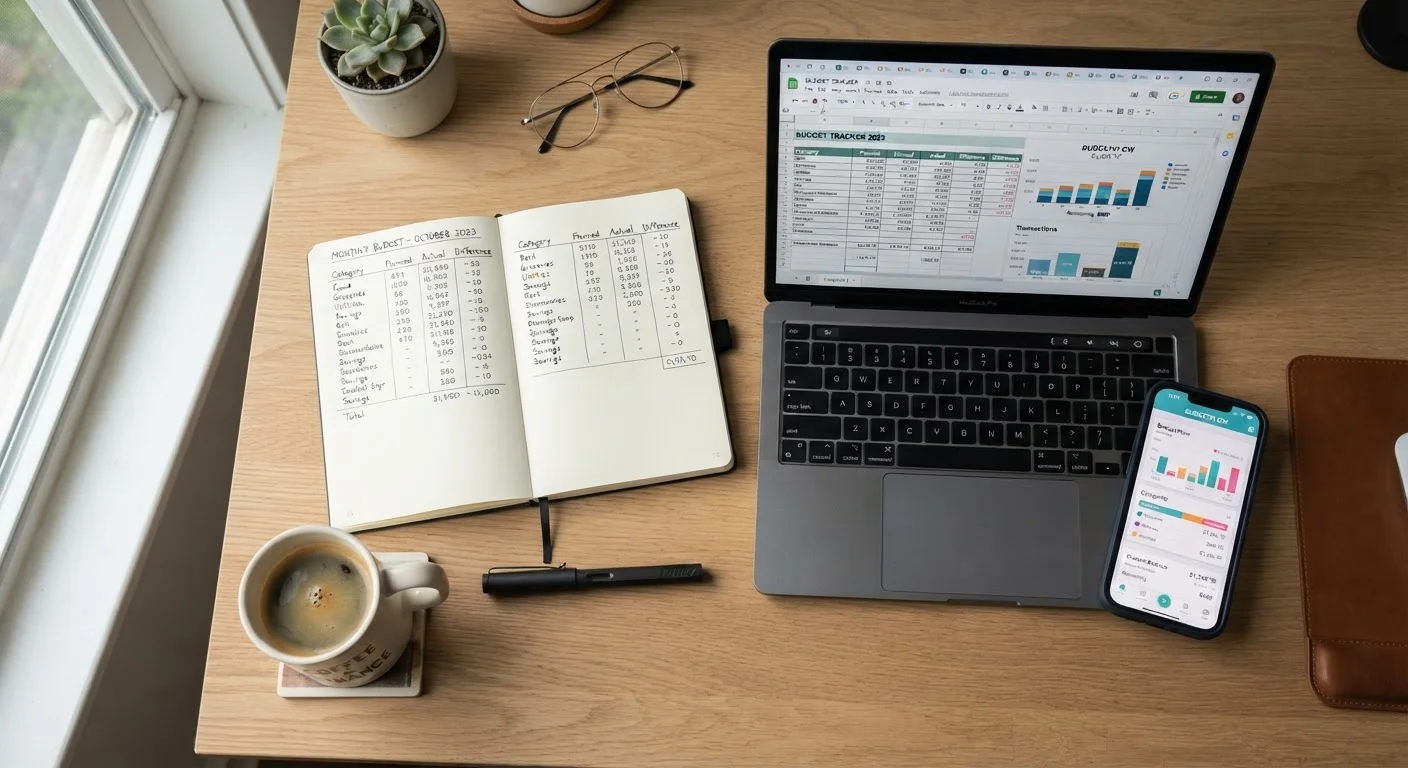
Each tracking method has genuine strengths. Apps work best for people who want automation and spend primarily with cards. Spreadsheets suit those who want control and flexibility without surrendering account access. Pen-and-paper is effective for people who need tactile engagement to stay aware of their spending. The method you'll actually use consistently is the right one for you.
| Best for | Recommended |
|---|---|
| Those who want low-effort, automated tracking | Budgeting Apps |
| Those who want full customization and data privacy | Spreadsheets |
| Those building mindful money habits from scratch | Pen-and-Paper |
| Those who've tried one method and found it incomplete | Hybrid Approach |
Why the Tracking Method You Choose Actually Matters
Knowing where your money goes is the foundation of any working budget. Yet many people start tracking, fall off after two weeks, and conclude that budgeting "doesn't work for them" - when in reality, the tool just wasn't a good fit. If you're new to the process, this primer on personal budgeting can help you understand the core concepts before choosing a tracking method.
The three most common approaches - budgeting apps, spreadsheets, and pen-and-paper - each ask something different of you in terms of time, trust, and technical comfort. Understanding those trade-offs is how you pick one that sticks.
Budgeting Apps: Automation With Trade-offs
Budgeting apps connect directly to your bank accounts and credit cards, pulling in transactions automatically and categorizing them. For people who spend almost entirely by card, this removes most of the manual logging work.
What they do well: Real-time visibility, spending alerts, and built-in charts make patterns easy to spot without manual effort. Many apps also send notifications when you approach a category limit, which acts as a natural nudge.
Where they fall short: To work, apps require you to grant read access to your financial accounts. That's a meaningful privacy consideration - one worth thinking through carefully. App categorization is also imperfect; a charge at a warehouse store might land in "groceries" one month and "shopping" the next, requiring manual correction. Free tiers often have limited features, while paid plans add an ongoing cost.
Apps work best for people comfortable with account linking who want passive, low-friction tracking. They're less ideal for those who pay with cash frequently or who are uncomfortable sharing financial credentials with a third-party platform.
Test Before You Commit
Try your chosen method for two full weeks before deciding it isn't working. Most tracking habits fail in the first few days due to novelty friction, not a genuine mismatch. If you're still struggling after two weeks, then it's worth switching. The goal is a system you return to automatically - not one that feels like a chore every time.
Spreadsheets: Control Without Compromise
A spreadsheet - whether in a free tool like Google Sheets or a desktop program - gives you a blank canvas. You build the categories, formulas, and layout that match how you actually spend. Nothing is shared with an external service.
What they do well: Spreadsheets offer complete customization. You can track irregular income, split a single transaction across categories, or build a running annual summary - none of which apps always handle well. They're also free to use and your data stays local.
Where they fall short: Every transaction must be entered manually, which takes consistent effort. If you skip a week, catching up becomes a chore. Setup also has a learning curve; building formulas and a logical category structure takes time upfront, though many free templates exist to reduce that barrier.
For those who want to go deeper after tracking, a one-month spending audit can turn your logged data into real financial insight. Spreadsheets pair especially well with that kind of review.
| Budgeting Apps | Spreadsheets | Pen-and-Paper | |
|---|---|---|---|
| Setup effort | Low - link accounts and go | Moderate - build or adapt a template | Minimal - buy a notebook |
| Daily effort | Low - mostly automated | High - manual entry required | High - log every transaction by hand |
| Customization | Limited to app's structure | Fully customizable | Fully flexible, no structure enforced |
| Privacy | Requires account access | Data stays with you | Completely private |
| Cost | Free to paid subscription | Free (with free tools) | Negligible - cost of a notebook |
| Spending awareness | Passive - easy to ignore | Moderate - requires review | High - active engagement per entry |
| Best for | Card-based, automation-seekers | Detail-oriented, privacy-focused | Habit-builders, cash users |
Pen-and-Paper: The Mindfulness Advantage
Writing down every expense by hand is the oldest tracking method - and it still works. The act of physically recording a purchase forces a moment of awareness that digital tools can bypass entirely.
What it does well: Research in behavioral economics consistently suggests that manual recording increases spending awareness more than passive tracking. A small notebook in a pocket or purse means you're logging in real time, not reconstructing from memory later. There's no setup cost and no privacy concern.
Where it falls short: Pen-and-paper requires the most discipline. It's easy to forget to log a coffee or a parking meter, and those small gaps accumulate. Totaling categories at the end of the month means additional manual math. It also doesn't produce charts or trend data without extra work.
This method suits people building new habits who benefit from the deliberate friction - each entry is a small act of financial mindfulness. It also works well as a complement to other methods. The behavioral side of budgeting explores why that kind of manual engagement often matters as much as the numbers themselves.
Choosing What Will Actually Work for You
Rather than asking which method is objectively best, ask which one matches your current habits and friction tolerance. A few practical questions to guide the decision:
- Do you pay mostly by card? Apps automate most of the work for card-based spenders.
- Do you value privacy over convenience? Spreadsheets or pen-and-paper keep your data in your hands.
- Are you building a habit from scratch? The deliberate effort of writing expenses down can reinforce awareness during the learning phase.
- Do you want to customize deeply? Spreadsheets allow structures no app replicates.
Many people also find success with a hybrid: using an app for day-to-day tracking but doing a weekly manual review in a notebook or spreadsheet. That review is where real decisions happen. Once you have a handle on where money is going, tools like digital envelope budgeting can add another layer of intentional spending control.
This article is for general informational and educational purposes only and does not constitute personalized financial advice. Consult a qualified financial professional for guidance tailored to your individual circumstances.
The content on this site is provided for informational purposes only and should not be considered a substitute for professional advice. While we strive to provide accurate and up-to-date information, we make no guarantees regarding its completeness or accuracy. Always consult a qualified professional for advice specific to your circumstances before making any decisions.