

Why Three Categories Are Enough
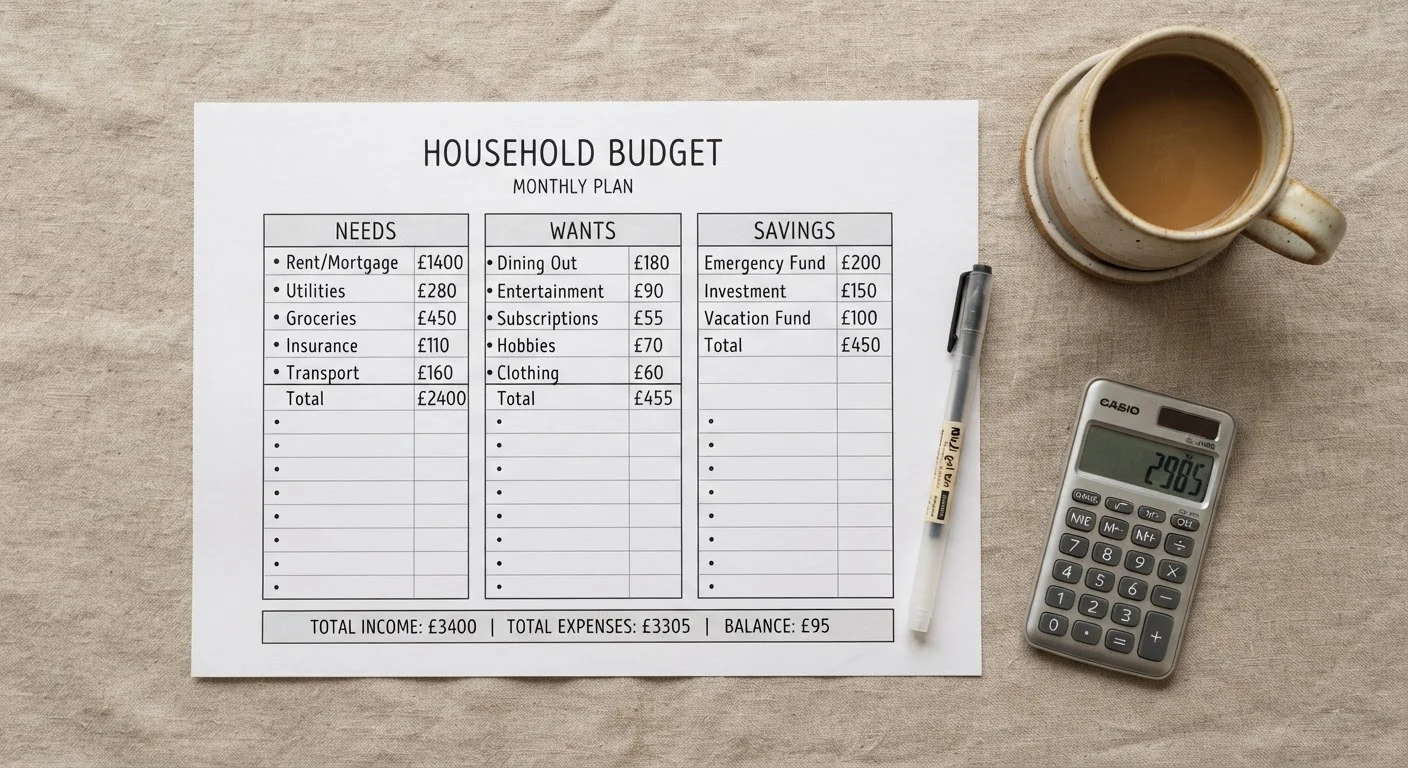
Most budgeting frameworks, no matter how detailed, trace back to three fundamental buckets: needs, wants, and savings. Popularized by the 50/30/20 framework - where 50% of take-home pay goes to needs, 30% to wants, and 20% to savings - this structure gives households a simple scaffold for decision-making without requiring a spreadsheet for every purchase.
The real power of these three categories isn't in the percentages. It's in the act of labeling your spending. When you know which bucket an expense belongs to, trade-offs become much easier to evaluate. If your needs are consuming 65% of your income, you can see exactly why savings feel impossible - and where to start making changes.
If you're building a budget for the first time, see our beginner's guide to personal budgeting for a full walkthrough of first steps and core concepts.
Defining Needs: Non-Negotiable Expenses
Needs are expenses you cannot reasonably eliminate without serious consequences to your health, safety, employment, or legal standing. These include:
- Housing (rent or mortgage payments)
- Utilities (electricity, heat, water)
- Groceries (basic food and household staples)
- Health insurance premiums and essential medical costs
- Transportation required to get to work (car payment, transit pass, fuel)
- Minimum debt payments (to avoid default or penalty)
- Childcare needed for you to work
Notice what isn't on this list: a streaming subscription isn't a need, even if it feels essential. The test is whether going without it would cause genuine hardship - not just discomfort.
Understanding how your needs break down by fixed versus variable costs also matters. Fixed vs. variable expenses affect how much flexibility you have when your income changes.
After-tax income
The amount of money you actually receive after federal, state, and payroll taxes are withheld. This is the figure you should use when applying percentage-based budgeting rules.
Discretionary spending
Money spent on non-essential items or experiences - equivalent to 'wants' in the three-category framework. Discretionary spending is where most people have the greatest flexibility.
Emergency fund
A savings reserve set aside specifically to cover unexpected expenses - job loss, medical bills, car repairs - without going into debt. It is generally treated as part of the Savings category.
Fixed expense
A recurring cost that stays the same from month to month, such as rent or a car payment. Fixed expenses are typically categorized as needs and are the easiest to plan around.
Variable expense
A cost that changes in amount from month to month, such as groceries, gas, or utility bills. Variable expenses can appear in both needs and wants categories depending on the item.
Minimum debt payment
The smallest monthly payment required by a lender to keep an account in good standing. Meeting minimums is a need; paying extra above the minimum is counted as savings or debt payoff.
Defining Wants and Savings - and Why Both Matter
Wants are spending choices that improve your quality of life but could be reduced or eliminated if necessary. Dining out, gym memberships, entertainment, travel, and upgraded versions of things you already have (a newer phone, a premium coffee) fall into this category. Wants aren't wasteful by definition - enjoying your income is a legitimate financial goal. The issue arises when wants crowd out savings.
Savings in this framework covers more than a retirement account. It includes:
- Emergency fund contributions
- Retirement account deposits (401(k), IRA, etc.)
- Goal-based savings (down payment, education, car)
- Extra debt payments beyond the minimum
Treating savings as a third category - not leftover money - is what separates households that build wealth from those that stay stuck. Think of savings as paying your future self first. For a deeper look at building a financial cushion, read about why an emergency fund matters and how to size it.
When debt repayment competes with savings goals, a structured approach helps. Balancing savings and debt repayment in the same budget is achievable with the right allocation method.
The Percentages Are a Starting Point, Not a Rule
The 50/30/20 split is a useful benchmark, but it doesn't fit every household. If you live in a high cost-of-living city, your needs may consume closer to 60% or 70% of income - and that's a real constraint, not a budgeting failure. Use the three categories as a diagnostic lens first: understand where your money is actually going, then adjust targets based on what's realistic for your situation. A monthly budget setup checklist can help you capture every expense before you start labeling categories.
This article is for general informational and educational purposes only and does not constitute personalized financial advice. Consult a qualified financial professional for guidance tailored to your individual situation.
The content on this site is provided for informational purposes only and should not be considered a substitute for professional advice. While we strive to provide accurate and up-to-date information, we make no guarantees regarding its completeness or accuracy. Always consult a qualified professional for advice specific to your circumstances before making any decisions.