

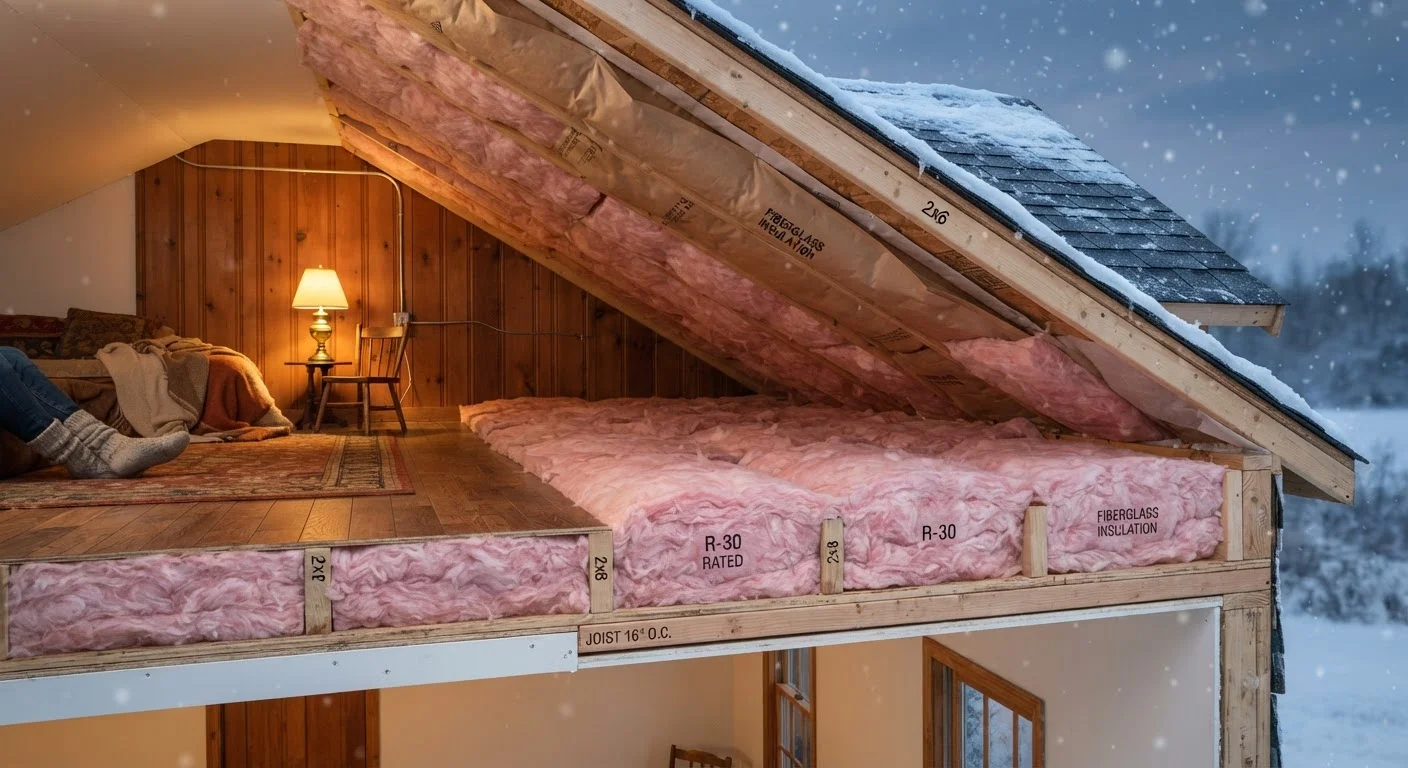
What R-Value Actually Measures
Every insulation product sold in the United States carries an R-value rating - it's the standardized way to express how strongly a material resists heat moving through it. Heat naturally flows from warmer areas to cooler ones, and insulation's job is to slow that process down. A higher R-value means the material does that job more effectively.
R-value is additive: if you have R-19 of existing insulation and you add R-19 more on top, your total becomes R-38. This is why upgrading an under-insulated attic often involves layering rather than full replacement. It also means two different materials can achieve the same R-value at different thicknesses - loose-fill cellulose, for example, requires more depth than spray foam to hit the same rating.
Keep in mind that R-value alone doesn't capture every factor in energy performance. Air leakage, moisture management, and proper ventilation all interact with insulation effectiveness. Understanding how different insulation types compare helps put R-value in fuller context.
90%
U.S. homes that are under-insulated
According to the North American Insulation Manufacturers Association, approximately 9 in 10 American homes lack adequate insulation levels.
R-49 to R-60
Recommended attic R-value for cold climates
The U.S. Department of Energy recommends this range for attics in Climate Zones 5 through 8, which covers much of the northern United States.
8
DOE climate zones across the U.S.
The Department of Energy's Building America climate zone map divides the U.S. into eight zones to guide regionally appropriate energy efficiency decisions.
Why Climate Zone Changes Everything
The Department of Energy divides the continental U.S. into eight climate zones - ranging from Zone 1 (hot and humid, like South Florida) to Zone 7 (very cold, like northern Minnesota and Alaska). Each zone has a recommended attic R-value range because the temperature differential between inside and outside varies so dramatically by region.
In a hot climate, insulation primarily works to keep conditioned indoor air from being overwhelmed by outdoor heat during long summers. In a cold climate, insulation must prevent interior warmth from escaping through the attic during months of freezing temperatures. The physics are the same, but the scale of the challenge is not - which is why a home in Phoenix and a home in Minneapolis need very different insulation levels to achieve similar energy efficiency.
- Zones 1-2 (Hot/Very Hot): Typically R-30 to R-38 recommended for attics
- Zones 3-4 (Mixed/Moderate): Generally R-38 to R-49
- Zones 5-8 (Cold to Very Cold): Often R-49 to R-60 or higher
These ranges reflect Department of Energy guidance for existing homes. New construction may be governed by local building codes, which can differ. Always verify current recommendations with your local building department or energy office.
Start With an Energy Audit
Before purchasing insulation materials, consider scheduling a home energy audit. Many utility companies offer subsidized audits that include blower-door testing to identify exactly where your home is losing energy. An auditor can confirm your current R-value and recommend the most cost-effective improvements for your specific home and climate zone.
Checking and Improving Your Attic's Current R-Value
Before adding insulation, it helps to know what you're working with. If you can safely access your attic, you can estimate your current R-value by measuring the depth of existing insulation and multiplying by the appropriate R-value per inch for that material. Loose-fill fiberglass runs about R-2.5 per inch, cellulose about R-3.5 per inch, and mineral wool batts typically around R-3 to R-4 per inch.
If your attic insulation is compressed, wet, or shows signs of pest damage or mold, address those issues before adding new material. Insulation that has absorbed moisture loses R-value and can harbor structural problems. A home energy auditor can assess your current insulation level and identify air sealing opportunities - air leaks around light fixtures, plumbing penetrations, and attic hatches can undermine even well-rated insulation.
For homeowners comfortable with basic attic work, adding blown-in insulation to bring depth up to the recommended level is a manageable project. Renting a blower machine (commonly available where insulation materials are sold) and working with a helper makes the job more efficient. Always wear proper protective gear - gloves, eye protection, and an N95 or better respirator - when working with insulation materials.
This article is for general informational purposes. For electrical hazards, structural concerns, or required permits, consult a licensed professional and verify local building code requirements before beginning any insulation project.
Frequently Asked Questions
The U.S. Department of Energy generally recommends R-38 to R-60 for attics in most climate zones. Warmer southern climates may require only R-30, while colder northern regions benefit from R-49 or higher. Your local utility or building department can confirm the recommendation for your area.
Yes, in most cases you can add new insulation directly on top of existing material, as long as the current insulation is dry, undamaged, and free of mold. This approach lets you increase your total R-value without a full removal project. Make sure to air seal any gaps before adding the new layer.
The Department of Energy publishes a free climate zone map covering all U.S. ZIP codes, and it's readily available on the Energy Star and energysaver.gov websites. Your state's energy office can also point you to local requirements.
There are diminishing returns after a certain point - doubling R-value doesn't double energy savings. However, meeting or slightly exceeding your zone's recommendation is generally worthwhile. Air sealing alongside adequate insulation typically yields the greatest practical improvement.
Adding blown-in or batt insulation to an accessible attic floor is within reach for many confident DIYers. However, if your attic has inadequate ventilation, signs of moisture damage, knob-and-tube wiring, or other hazards, consult a licensed contractor before proceeding.
The content on this site is provided for informational purposes only and should not be considered a substitute for professional advice. While we strive to provide accurate and up-to-date information, we make no guarantees regarding its completeness or accuracy. Always consult a qualified professional for advice specific to your circumstances before making any decisions.