

Why Insulation Type Matters as Much as Thickness
Many homeowners assume that adding more insulation - any kind - will solve comfort and energy problems. In practice, the type of insulation you choose matters nearly as much as how much you install. Each material has a different thermal resistance rating (R-value), moisture behavior, air-sealing ability, and ideal application. Using the wrong type in the wrong location can trap moisture, leave air gaps, or simply underperform.
R-value measures how well a material resists heat flow. The higher the number, the greater the resistance. But R-value alone doesn't tell the full story - installation quality, air movement, and moisture control all influence real-world performance. Think of this guide as a reference map: it shows you what each insulation type does well and where it belongs in your home.
| Highest R-value per inch | Closed-cell spray foam (~R-6 to R-7/inch) (U.S. Department of Energy, Insulation Materials overview) |
| Most cost-effective for attic floors | Blown-in cellulose or fiberglass (DOE Energy Saver guidance) |
| Recommended attic R-value (most U.S. climate zones) | R-38 to R-60 (DOE Climate Zone recommendations) |
| Insulation type safe against concrete | Rigid foam (EPS or XPS) - not fiberglass batts (Building Science Corporation guidance) |
| Fire-resistant insulation option | Mineral wool (rock wool) (General industry specification) |
Common Insulation Types at a Glance
The five most widely used residential insulation materials each have distinct characteristics worth understanding before you plan any project.
Fiberglass Batts and Rolls
The pink or yellow blanket insulation most homeowners recognize. Batts are pre-cut sections; rolls are continuous. Both fit between standard-spaced wall studs, floor joists, and attic rafters. R-value typically ranges from R-2.9 to R-3.8 per inch. They do not air-seal on their own - gaps around wires and pipes reduce effectiveness significantly. Best for: unfinished walls, floors above unconditioned spaces, and attic floors.
Mineral Wool (Rock Wool / Slag Wool)
Denser than fiberglass, mineral wool batts offer R-3.0 to R-3.3 per inch and are naturally fire-resistant and water-repellent. They hold their shape better than fiberglass and are easier to cut around obstructions. Best for: interior walls for sound control, cathedral ceilings, and areas requiring added fire resistance.
Loose-Fill (Blown-In)
Cellulose (recycled paper) or fiberglass blown into place with a machine. Cellulose delivers around R-3.2 to R-3.8 per inch; blown fiberglass runs R-2.2 to R-2.7 per inch. Loose-fill conforms to irregular spaces and can be blown over existing attic insulation easily. Best for: attic floors, finished wall cavities (dense-pack method), and hard-to-reach spaces.
Spray Polyurethane Foam (SPF)
Available in open-cell and closed-cell formulas. Open-cell foam runs about R-3.5 to R-3.7 per inch and is vapor-permeable, making it useful in areas where drying is needed. Closed-cell foam achieves R-6 to R-7 per inch - the highest of any common insulation - and acts as both an air barrier and a vapor retarder. It is also the most expensive option. Best for: rim joists, crawl spaces, irregular cavities, and any location requiring combined insulation and air sealing. Note: Spray foam installation requires professional application in most cases; improper off-ratio mixing creates toxic off-gassing.
Rigid Foam Board
Available in three types: EPS (expanded polystyrene, ~R-3.8/inch), XPS (extruded polystyrene, ~R-5/inch), and polyisocyanurate (polyiso, ~R-6 to R-6.5/inch). Rigid boards are thin, strong, and moisture-resistant, making them ideal where space is limited. Best for: basement walls, exterior continuous insulation layers, under slab, and garage doors.
R-Value
A measure of thermal resistance - how well a material slows heat transfer. Higher R-values indicate better insulating performance per inch of thickness.
Air Barrier
A material or system that restricts air movement through the building envelope. Distinct from insulation, which slows heat conduction - air sealing addresses convective heat loss.
Vapor Retarder
A material that limits moisture vapor diffusion through walls, ceilings, or floors. Closed-cell spray foam and polyethylene sheeting are common examples; placement varies by climate zone.
Thermal Bridging
Heat loss that occurs through conductive materials (like wood studs or metal framing) that bypass the insulation in a wall or ceiling assembly, reducing overall system R-value.
Dense-Pack
A technique for blowing cellulose or fiberglass into existing closed wall cavities at high density to reduce settling and improve air resistance.
Where Each Type Belongs in Your Home
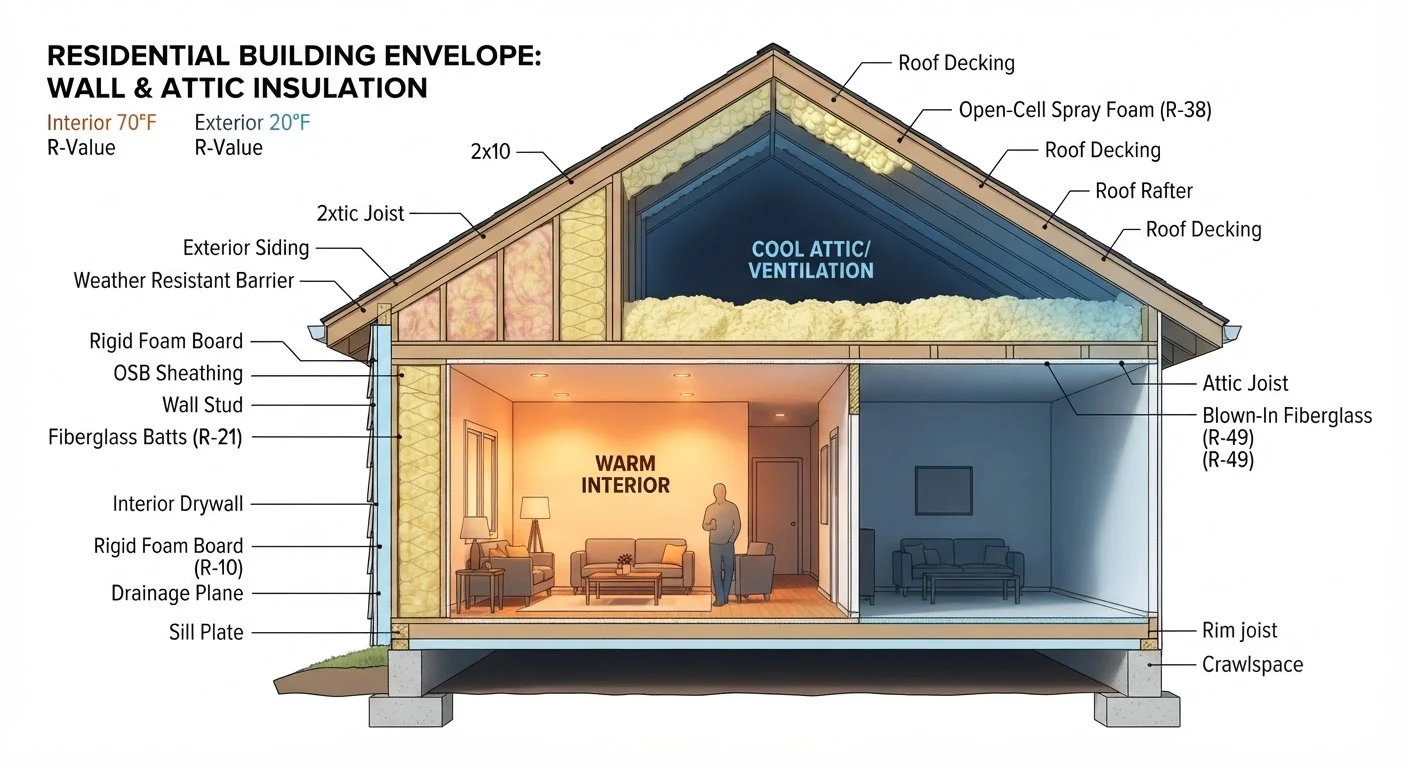
Matching insulation to location is as important as choosing the right R-value. Here is a zone-by-zone breakdown:
- Attic floor (unconditioned attic): Loose-fill cellulose or blown fiberglass - easy to add over existing insulation and cost-effective. Target R-38 to R-60 depending on climate zone.
- Cathedral ceiling / roof deck: Closed-cell spray foam or rigid foam, since there is no attic space for deep fill. Achieving code-required R-values in thin rafter bays often requires combining insulation types.
- Exterior walls (new construction): Fiberglass or mineral wool batts in the cavity, potentially with a rigid foam exterior layer for continuous insulation.
- Basement walls: Rigid foam (XPS or EPS) directly against concrete, covered with a stud wall if needed. Avoid fiberglass batts against concrete - moisture will degrade them.
- Crawl space: Closed-cell spray foam on walls (conditioned crawl space) or fiberglass batts between floor joists above (vented crawl space). Vapor barrier on the ground is essential in either case.
- Rim joists: Closed-cell spray foam cut-and-cobble rigid foam provides both insulation and air sealing in this chronically leaky area.
Before tackling any insulation upgrade, pair it with air sealing - insulation slows heat transfer, but gaps let conditioned air escape directly. For a broader seasonal approach, see our fall weatherization checklist for guidance on combining insulation with other cold-weather prep.
Permits and Professional Help May Be Required
Adding insulation in certain locations - particularly spray foam in unvented roof assemblies or basement retrofits - may require a building permit or inspection depending on your municipality. Spray foam installation should generally be handled by a certified professional due to chemical hazards during application. Always check local building codes before beginning any insulation project.
The content on this site is provided for informational purposes only and should not be considered a substitute for professional advice. While we strive to provide accurate and up-to-date information, we make no guarantees regarding its completeness or accuracy. Always consult a qualified professional for advice specific to your circumstances before making any decisions.