

Option A
Whole Grains
The structurally complete, nutrient-dense option.
Best for: People seeking more fiber, B vitamins, and minerals from their grain-based foods.
Option B
Refined Grains
The processed, longer-shelf-life staple.
Best for: Situations requiring lighter texture, longer storage, or specific culinary outcomes - with awareness of nutrient trade-offs.
What Happens Inside the Kernel During Processing
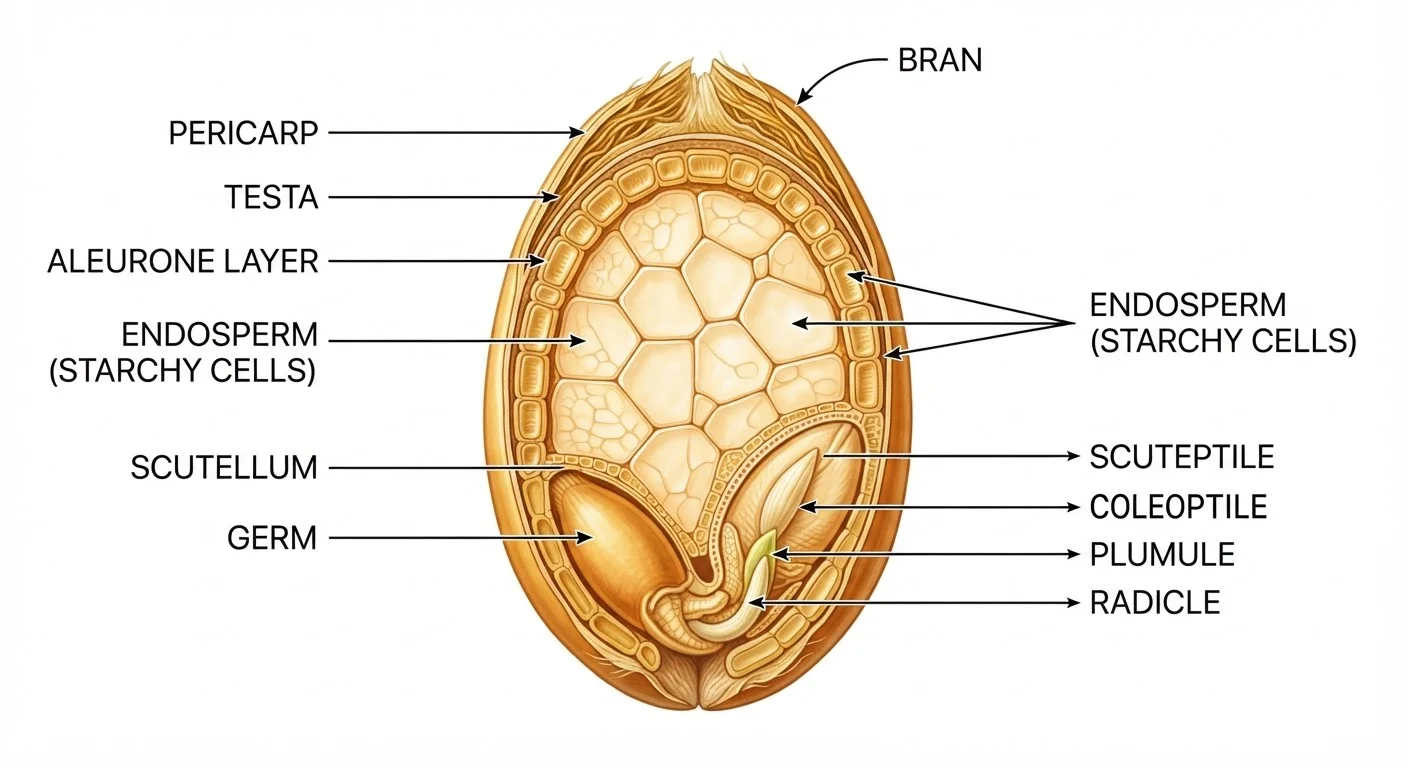
A grain kernel - whether wheat, rice, oats, or corn - is composed of three distinct parts: the bran (the outer layer), the germ (the nutrient-rich embryo), and the endosperm (the starchy interior). Whole grains retain all three. Refined grains, by definition, have had the bran and germ removed, leaving primarily the endosperm.
This structural change isn't cosmetic. The bran is where most of the dietary fiber lives. The germ contains concentrated amounts of vitamin E, B vitamins (particularly thiamine, niacin, and B6), healthy fats, and minerals like iron, zinc, and magnesium. Removing both components results in a product that is dramatically lower in these nutrients - even if it looks similar on the plate.
The endosperm is largely composed of starch and some protein. It's what gives white flour and white rice their fine texture and mild flavor. From a culinary standpoint, refined grains offer properties that many recipes depend on: lightness, elasticity, a longer shelf life, and a neutral taste. These aren't trivial advantages - they explain why refined grains became dominant in industrialized food systems.
| Criterion | Whole Grains | Refined Grains |
|---|---|---|
| Kernel components retained | Bran, germ, endosperm | Endosperm only |
| Dietary fiber content | High | Low (not restored by enrichment) |
| B vitamins | Naturally occurring, full spectrum | Partially restored via enrichment |
| Magnesium & zinc | Present in meaningful amounts | Largely removed, not re-added |
| Phytochemicals | Wide variety from bran and germ | Minimal |
| Glycemic response | Generally lower, slower | Generally higher, faster |
| Shelf life | Shorter (oils in germ can oxidize) | Longer |
| Texture in cooking | Denser, chewier | Lighter, finer |
Enrichment: What Gets Added Back - and What Doesn't
In the United States, most refined grain products sold commercially are enriched, meaning certain nutrients stripped during milling are added back in synthetic form. Federal regulations require that enriched flour contain specific levels of thiamine, riboflavin, niacin, folic acid, and iron.
Enrichment meaningfully restores some of what processing removes. Folic acid fortification in particular has been credited with a measurable reduction in neural tube defects since it became mandatory in 1998, according to the Centers for Disease Control and Prevention (CDC). This is a genuine public health achievement that shouldn't be dismissed.
However, enrichment does not restore everything. Fiber - arguably the most significant nutritional casualty of refining - is not added back. Neither are magnesium, zinc, vitamin E, or the dozens of phytochemicals (plant compounds) found naturally in the bran and germ. When researchers analyze whole grains versus enriched refined grains, the gap in fiber and micronutrient diversity remains substantial.
25%
Lower cardiovascular disease risk with whole grains
A meta-analysis in The BMJ (2016) found roughly 25% lower CVD risk among the highest whole grain consumers compared to the lowest, across multiple cohort studies.
~50%
Fiber lost during grain refining
Milling wheat into white flour removes the majority of dietary fiber found in whole wheat, according to USDA nutritional composition data.
≥50%
Recommended share of grains that should be whole
USDA Dietary Guidelines for Americans recommend that at least half of all grains consumed be whole grains for most age groups.
For readers interested in how overall dietary patterns - not just individual foods - affect health outcomes, our article on plant-based eating versus omnivorous diets examines a related set of trade-offs at the pattern level.
What the Research Shows About Health Outcomes
Large-scale observational research has consistently found associations between higher whole grain consumption and reduced risk of several chronic conditions. A 2016 meta-analysis published in The BMJ found that people who ate the most whole grains had a lower risk of cardiovascular disease, coronary heart disease, and total cancer compared to those who ate the least - though the authors noted that observational studies cannot definitively prove causation.
Mechanically, several pathways are plausible. The fiber in whole grains slows glucose absorption, which helps moderate blood sugar spikes after meals. Fiber also feeds beneficial gut bacteria and supports healthy cholesterol levels. Additionally, the micronutrients and phytochemicals in whole grains may contribute to anti-inflammatory effects, though research in this area is still developing.
It's worth noting that most research compares dietary patterns as a whole, not isolated grain choices. A diet high in refined grains but otherwise rich in vegetables, legumes, and lean proteins may produce different outcomes than a diet heavy in both refined grains and ultra-processed foods. Context matters considerably. Readers with specific health conditions should discuss grain intake with a qualified healthcare provider rather than relying on general population data.
Reading Labels: What to Look For
The phrase 'made with whole grains' doesn't guarantee a product is primarily whole grain. Look for 'whole grain' or 'whole wheat' listed as the first ingredient on the label. Products labeled '100% whole grain' or carrying the Whole Grain Stamp from the Whole Grains Council meet stricter criteria. 'Multigrain' simply means multiple grain types are present - not that any of them are whole.
This article is for general informational and educational purposes only and is not a substitute for professional medical or nutritional advice. Consult a registered dietitian or your healthcare provider for guidance tailored to your individual health needs.
The content on this site is provided for informational purposes only and should not be considered a substitute for professional advice. While we strive to provide accurate and up-to-date information, we make no guarantees regarding its completeness or accuracy. Always consult a qualified professional for advice specific to your circumstances before making any decisions.