

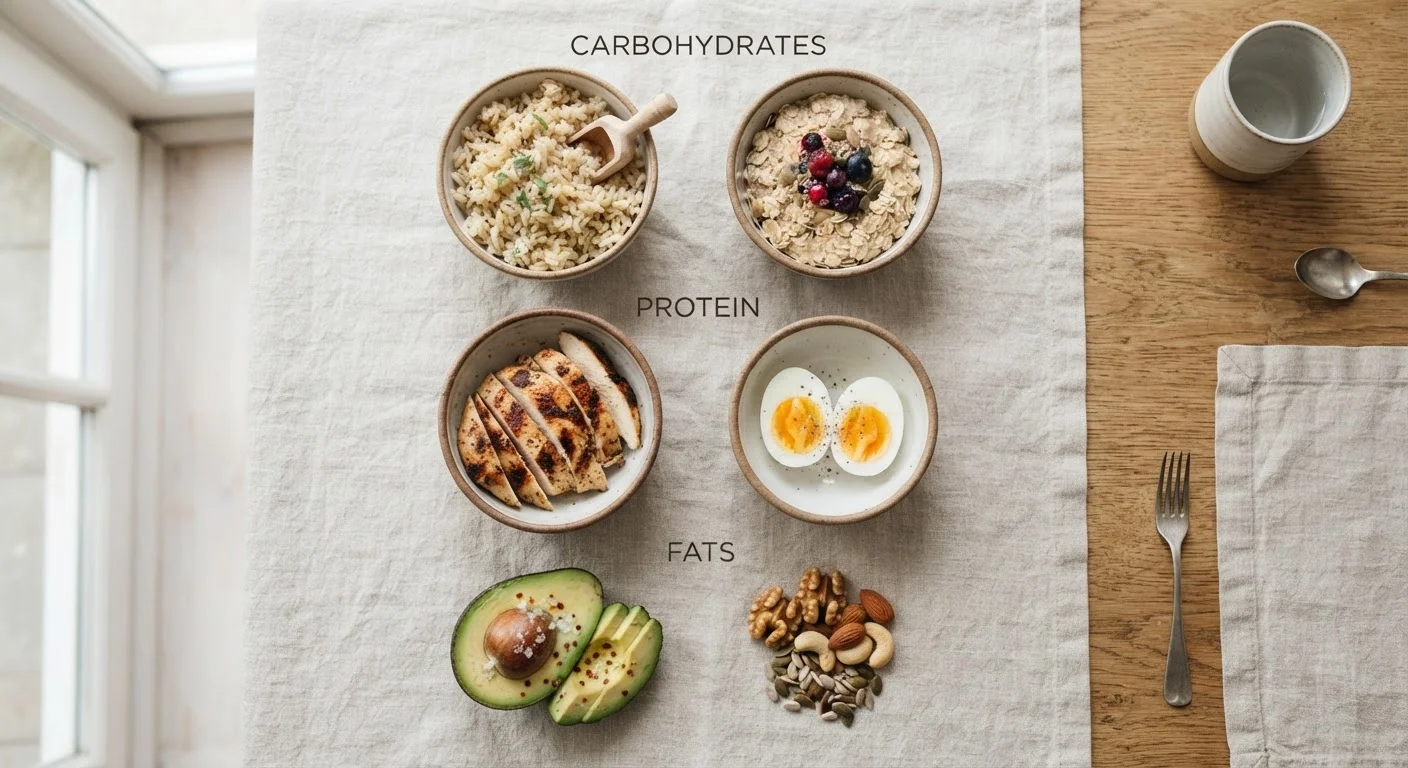
Carbohydrates: Your Body's Primary Fuel
Carbohydrates are the body's first-choice energy source. When you eat carbohydrates - whether from oats, lentils, fruit, or bread - your digestive system breaks them down into glucose, a simple sugar that circulates in the blood and powers cells throughout the body. The brain alone relies almost entirely on glucose for fuel under normal conditions.
Not all carbohydrates behave the same way. Simple carbohydrates (found in fruit, milk, and added sugars) are digested quickly, producing a faster rise in blood glucose. Complex carbohydrates (found in whole grains, legumes, and starchy vegetables) are digested more slowly, providing more sustained energy and typically delivering more fiber and nutrients along the way.
Excess glucose that isn't immediately needed is stored in the liver and muscles as glycogen - a readily available energy reserve that the body draws on during physical activity or between meals. Understanding fiber, a specific type of carbohydrate, goes beyond energy: see our article on why fiber matters and why most Americans undereat it.
Focus on Carbohydrate Quality First
Rather than counting carbohydrate grams, consider the source. Carbohydrates from whole grains, legumes, vegetables, and fruit come packaged with fiber, vitamins, and minerals. Refined carbohydrates with added sugars provide energy with fewer accompanying nutrients. Shifting toward higher-quality sources is generally a more sustainable and beneficial approach than reducing carbohydrates overall.
Protein: Structure, Repair, and Function
Protein is often associated with muscle, but its roles extend far beyond the gym. Every protein in your body is assembled from smaller units called amino acids. Of the 20 amino acids involved in human biology, nine are considered essential - meaning the body cannot synthesize them and must obtain them through food.
Protein supports a remarkable range of functions: building and repairing muscle tissue, synthesizing enzymes that drive chemical reactions, producing hormones such as insulin, creating antibodies that support immune defense, and transporting molecules like oxygen through the blood (hemoglobin is a protein). When calorie intake is insufficient, the body can also use protein as an energy source - though this is not its preferred role.
Animal-based foods (meat, poultry, fish, dairy, eggs) contain all nine essential amino acids and are called complete proteins. Many plant-based sources are incomplete on their own, but eating a variety of plant foods throughout the day - legumes, grains, nuts, seeds - allows the body to obtain all essential amino acids without requiring precise meal-by-meal combining.
10-35%
Recommended protein range as share of daily calories
The Acceptable Macronutrient Distribution Range (AMDR) for protein established by the National Academies of Medicine is 10-35% of total daily calorie intake for adults.
45-65%
Recommended carbohydrate share of daily calories
The National Academies of Medicine AMDR for carbohydrates is 45-65% of total daily energy, reflecting their role as the body's primary fuel source.
20-35%
Recommended fat share of daily calories
The AMDR for total fat is 20-35% of daily calories for adults, with an emphasis on unsaturated fat sources according to major dietary guidelines.
Fat: More Than Stored Energy
Dietary fat has long carried an undeserved reputation. Fat is essential for survival and serves functions that neither carbohydrates nor protein can perform. It is required for the absorption of fat-soluble vitamins - A, D, E, and K - which play roles in vision, bone health, immune function, and blood clotting. Fat also forms the phospholipid bilayer of every cell membrane in the body and is the raw material for steroid hormones including estrogen, testosterone, and cortisol.
The type of fat consumed influences health outcomes more than fat intake alone. Unsaturated fats - found in olive oil, avocados, nuts, seeds, and fatty fish - are associated with cardiovascular benefits in research. Saturated fats - prevalent in red meat and full-fat dairy - are advised in moderation by major dietary guidelines. Trans fats, largely eliminated from the food supply through regulatory action, are considered harmful even in small amounts.
Fat also slows digestion, contributes to feelings of fullness (satiety), and enhances the flavor and texture of food - practical reasons why very-low-fat diets can be difficult to sustain.
For a broader look at nutrition fundamentals, including how macronutrients fit into overall dietary patterns, see our introduction to nutrition fundamentals.
Balance, Quality, and What the Evidence Actually Supports
Decades of nutrition research support one consistent finding: no single macronutrient is the cause of poor health, and no single macronutrient is a cure. The relationship between diet and health is shaped by overall dietary patterns, food quality, lifestyle factors, and individual biology.
Popular diet trends often frame macronutrients as villains or heroes - fat was vilified in the 1980s, carbohydrates became the target in the 2000s, and protein is now frequently over-emphasized. The evidence consistently points away from extremes. For a deeper examination of persistent nutrition misconceptions, our article on nutrition myths that refuse to die addresses common claims against the available science.
When you read a food label, understanding macronutrient content can help you make informed choices. Our guide to reading a Nutrition Facts label breaks down what each number actually means in practice.
“Nutrition science consistently shows that dietary patterns matter more than the precise proportion of any single macronutrient. The quality of foods within each category, and how they fit into an overall eating pattern, is what drives health outcomes over time.”
— Walter Willett, Professor of Epidemiology and Nutrition, Harvard T.H. Chan School of Public Health
This article is for general informational and educational purposes only and does not constitute medical or nutritional advice. Consult a registered dietitian or qualified healthcare provider for guidance specific to your health needs.
Frequently Asked Questions
Most people do not need to count or track macronutrients to maintain good health. Focusing on a varied diet rich in whole foods - vegetables, fruits, legumes, lean proteins, and healthy fats - naturally provides a reasonable balance. Tracking can be useful for specific performance or medical goals, but it isn't necessary for general wellness.
Carbohydrates are not inherently bad. The type and source matter significantly - whole grains, legumes, fruits, and vegetables provide fiber, vitamins, and steady energy. Highly refined carbohydrates with little fiber or nutritional value, consumed in large quantities, are associated with less favorable health outcomes when they displace more nutritious foods.
The Dietary Reference Intake (DRI) for protein is 0.8 grams per kilogram of body weight per day for sedentary adults, though needs increase with physical activity, older age, illness, or recovery. Individual requirements vary considerably, and a healthcare provider or registered dietitian can give personalized guidance.
No - dietary fat is a nutrient consumed in food, while body fat (adipose tissue) is stored energy in the body. Eating fat does not directly translate to gaining body fat; overall calorie balance, activity level, and metabolic factors all play a role. The body can convert excess calories from any macronutrient into stored fat.
Chronically under-consuming any macronutrient can impair specific body functions. Very low carbohydrate intake can reduce energy for high-intensity activity and may affect cognitive performance. Insufficient protein can compromise muscle maintenance and immune function. Too little fat can interfere with fat-soluble vitamin absorption and hormone production. Persistent deficiencies should be evaluated by a healthcare professional.
Yes. Pregnant individuals, older adults, competitive athletes, children, and people managing chronic conditions often have meaningfully different macronutrient needs. General population guidelines are a starting point, but these groups should work with a qualified healthcare provider or registered dietitian for personalized recommendations.
The content on this site is provided for informational purposes only and should not be considered a substitute for professional advice. While we strive to provide accurate and up-to-date information, we make no guarantees regarding its completeness or accuracy. Always consult a qualified professional for advice specific to your circumstances before making any decisions.