

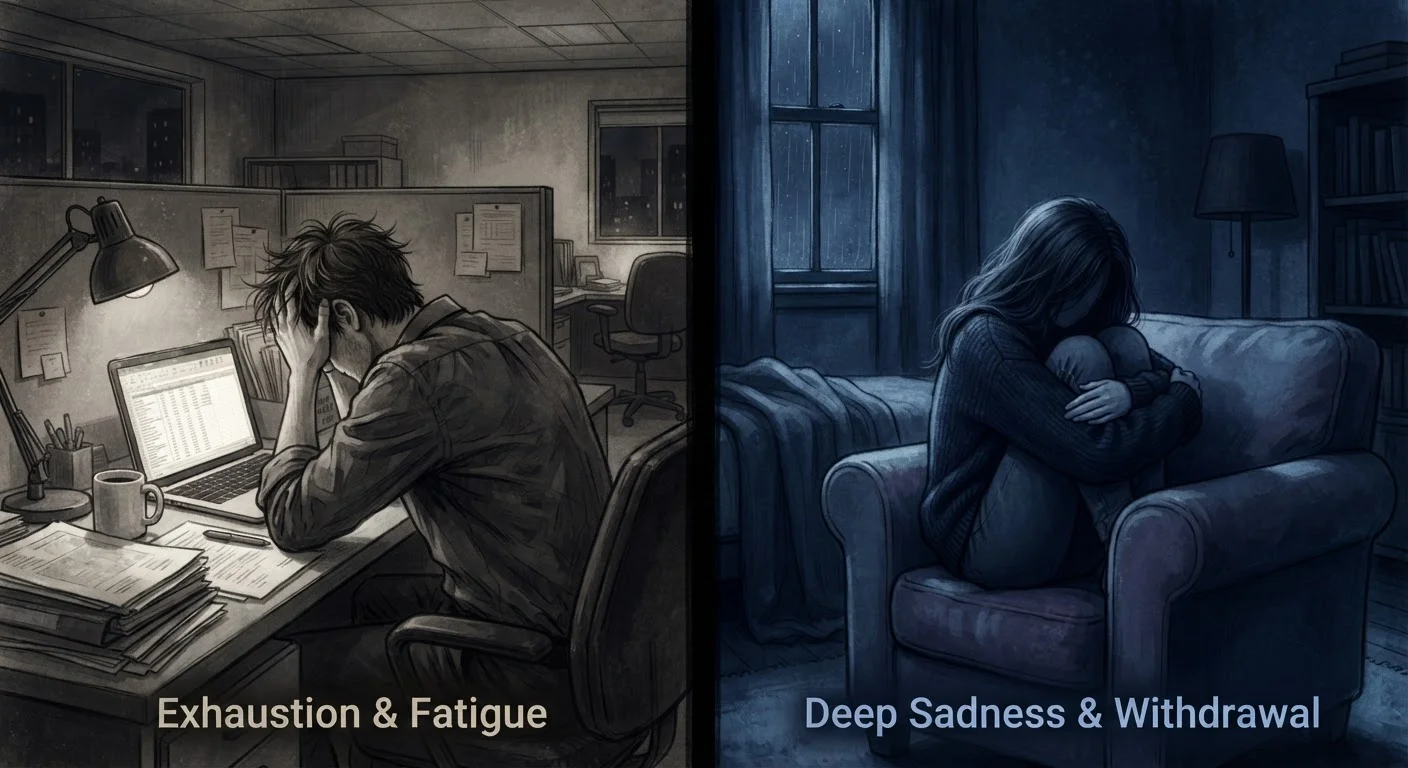
Option A
Depression (Major Depressive Disorder)
A clinically recognized mental health condition with broad, pervasive impact.
Best for: Understanding a medical diagnosis that affects mood, cognition, and physical health across all areas of life.
Option B
Burnout
A state of chronic stress-driven exhaustion rooted in prolonged workplace or caregiving demands.
Best for: Recognizing work- or role-related depletion that may improve with environmental and lifestyle changes.
Defining Each Condition
Depression - formally called Major Depressive Disorder (MDD) - is a recognized medical condition classified in the DSM-5. It involves persistent depressed mood or loss of interest in nearly all activities for at least two weeks, accompanied by changes in sleep, appetite, energy, concentration, and sometimes thoughts of death or self-harm. It has established diagnostic criteria and evidence-based treatment pathways including therapy and, in many cases, medication managed by a healthcare provider.
Burnout, by contrast, is classified by the World Health Organization's ICD-11 as an occupational phenomenon - not a medical condition. It emerges from chronic, unmanaged workplace stress and is defined by three dimensions: emotional exhaustion, increased mental distance or cynicism toward one's job, and reduced professional effectiveness. Burnout is context-specific: it is, by definition, linked to a role or sustained responsibility.
Understanding these distinctions matters because the two respond differently to intervention. To explore the different professionals who can help evaluate or treat these experiences, see our guide to therapy, counseling, and psychiatry.
Where the Symptoms Overlap
The overlap between burnout and depression is substantial, which is why self-diagnosis is unreliable. Both can produce:
- Persistent fatigue that sleep doesn't resolve
- Difficulty concentrating and slowed thinking
- Reduced motivation and withdrawal from activities
- Irritability and emotional flatness
- Physical complaints such as headaches or disrupted sleep
Research published in clinical psychology journals has found that chronic burnout significantly elevates the risk of developing a depressive episode. The two conditions can also coexist, meaning a person may meet criteria for both simultaneously - making professional assessment essential rather than optional.
| Criterion | Depression (MDD) | Burnout |
|---|---|---|
| Classification | Clinical medical diagnosis (DSM-5) | Occupational phenomenon (ICD-11) |
| Primary cause | Biological, psychological, and social factors | Chronic unmanaged work or role stress |
| Scope of impact | All areas of life | Mainly work or caregiving context |
| Improves with rest | Rarely, without treatment | Often partially, when stressor is removed |
| Self-worth affected | Generalized worthlessness and guilt | Cynicism about role, not self as a whole |
| Physical symptoms | Appetite change, weight shift, psychomotor changes | Fatigue, headaches, disrupted sleep |
| Primary treatment | Therapy, medication, or combined care | Stress reduction, boundary-setting, therapy |
Key Differences That Help Distinguish Them
Despite their surface similarities, several features help clinicians - and informed individuals - tell them apart.
Scope: Burnout is contextual. People with burnout often feel capable and even energized outside of work or their primary stressor. Depression is pervasive: low mood and loss of enjoyment extend across relationships, hobbies, and daily life regardless of setting.
Response to relief: A vacation or extended break from the stressor can meaningfully restore someone experiencing burnout. In depression, relief from external pressures typically does not lift the core symptoms.
Self-worth: Depression commonly involves a generalized sense of worthlessness, guilt, or hopelessness about one's entire life and future. Burnout more often produces cynicism or disillusionment specifically about one's role or organization.
Physical symptoms: Depression can include changes in appetite, weight fluctuations, and in more severe presentations, psychomotor changes (noticeably slowed or agitated movement). These features are less characteristic of burnout alone.
Can Burnout Cause Depression?
Yes - accumulated evidence suggests that prolonged, untreated burnout can contribute to the onset of a clinical depressive episode. This does not mean all burnout becomes depression, but the risk is meaningful and well-documented in occupational health research. If burnout symptoms persist or intensify over weeks, professional evaluation is strongly advisable rather than waiting to see if rest alone resolves them.
What to Do If You Recognize These Signs
Neither burnout nor depression should be dismissed as weakness or simply "needing to push through." Both are serious, both are recognized, and both are treatable - though the pathways differ.
For burnout, interventions often include addressing workload, setting clearer boundaries, building recovery habits, and - where possible - changing systemic stressors in collaboration with employers or support networks. Therapy, particularly cognitive-behavioral approaches, can also be highly effective.
For depression, evidence-based treatment typically involves psychotherapy (such as CBT or interpersonal therapy), medication evaluated and prescribed by a psychiatrist or physician, or a combination of both. Social support and lifestyle factors also play a documented supportive role.
The most important step is speaking with a qualified mental health professional who can conduct a thorough evaluation. Attempting to self-diagnose and self-treat either condition - particularly depression - carries real risk. If you or someone you know is experiencing thoughts of self-harm, contact a crisis line such as the 988 Suicide and Crisis Lifeline by calling or texting 988.
This article is for general informational and educational purposes only and does not constitute medical or mental health advice. Always consult a qualified healthcare or mental health professional for concerns about your own symptoms or wellbeing.
The content on this site is provided for informational purposes only and should not be considered a substitute for professional advice. While we strive to provide accurate and up-to-date information, we make no guarantees regarding its completeness or accuracy. Always consult a qualified professional for advice specific to your circumstances before making any decisions.