

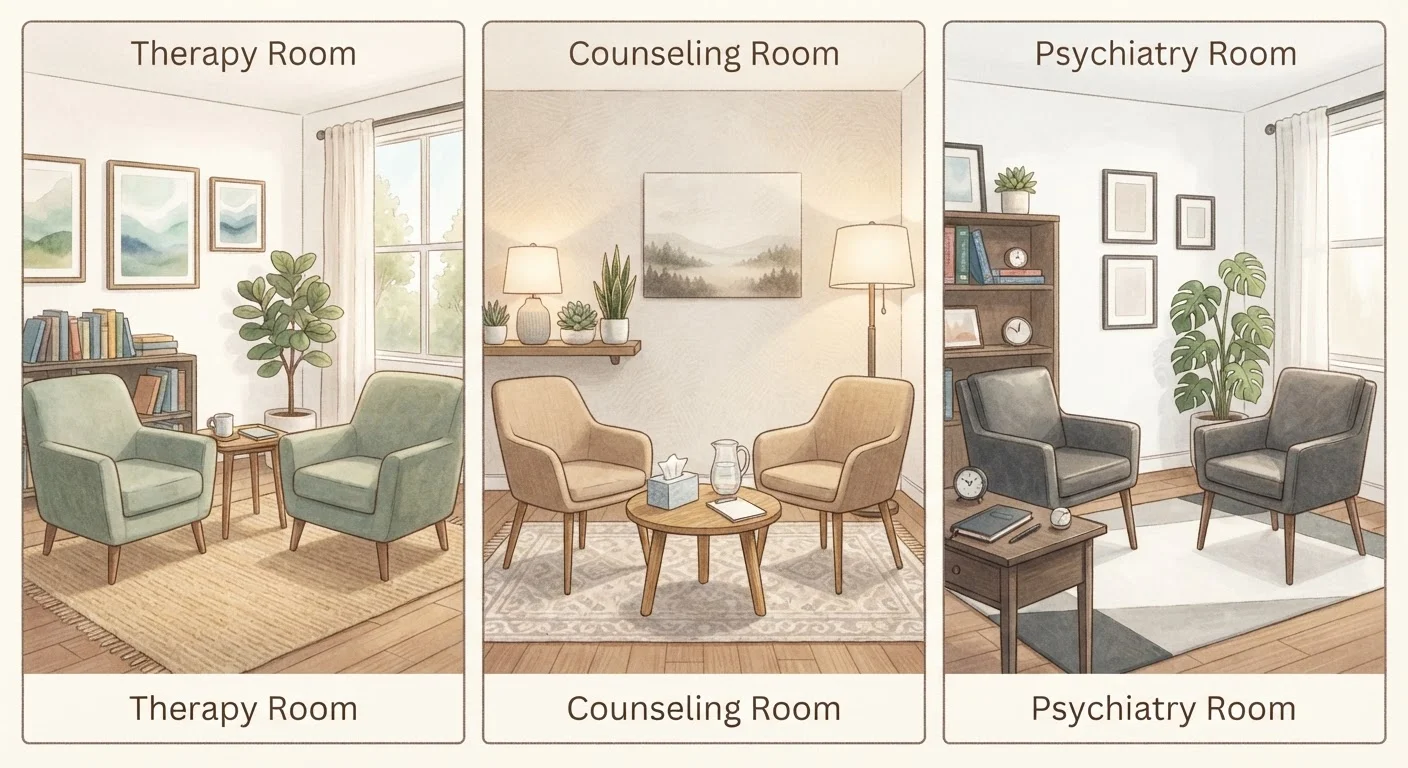
Our Verdict
Therapy, counseling, and psychiatry are complementary - not competing - forms of mental health support. The right fit depends on what you're experiencing, how long you've been struggling, and whether medication may be part of the picture. None of these paths is inherently superior; they often work best in combination.
| Best for | Recommended |
|---|---|
| Exploring patterns, emotions, or past experiences through structured conversation | Therapy (psychotherapy) |
| Navigating a specific life challenge, transition, or short-term stressor | Counseling |
| Managing a condition where medication evaluation or complex diagnosis is needed | Psychiatry |
| Ongoing mental health conditions requiring both talk therapy and medication management | Coordinated care with a therapist and psychiatrist |
Why the Distinctions Matter
When people decide to seek mental health support, one of the first - and most confusing - questions is: who do I actually call? The terms "therapist," "counselor," and "psychiatrist" are often used interchangeably in everyday conversation, but they describe meaningfully different roles, training paths, and services.
Getting clarity on these distinctions isn't just an academic exercise. It can shape how quickly you find the right fit, what your insurance covers, and whether your needs are fully addressed. For a broader introduction to mental health terminology, our plain-English mental health glossary is a useful companion resource.
This article breaks down each role in plain language so you can make a more informed choice - without needing a healthcare degree to do it.
Therapists and Psychotherapists
The title "therapist" typically refers to a licensed mental health professional who provides psychotherapy - structured, evidence-based talk-based treatment. This broad category includes licensed clinical social workers (LCSWs), licensed professional counselors (LPCs), licensed marriage and family therapists (LMFTs), and psychologists (who hold a doctoral degree, either a Ph.D. or Psy.D.).
Therapists work with individuals, couples, families, and groups to address a wide range of concerns: anxiety, depression, trauma, relationship difficulties, grief, and more. They draw on established frameworks such as cognitive behavioral therapy (CBT), dialectical behavior therapy (DBT), and others, tailoring the approach to the individual.
Importantly, most therapists - except in a small number of states with specific prescriptive authority laws - cannot prescribe medication. Their work is rooted in conversation, skill-building, and psychological insight. Sessions are typically ongoing and may span months or years, depending on the person's goals.
Check Credentials Before Your First Appointment
Licensing requirements for mental health professionals vary by state. Before scheduling, you can verify a provider's license through your state's professional licensing board website. Look for active licensure, the specific credential type, and any disciplinary history. This step takes only a few minutes and adds meaningful assurance.
Counselors and the Role of Counseling
Counseling often overlaps with therapy in practice, but the term tends to describe a somewhat more focused, shorter-term type of support. School counselors, career counselors, substance use counselors, and grief counselors are all examples of specialists who work within defined areas.
Licensed counselors complete graduate-level training and supervised hours, and their work is grounded in helping clients navigate specific challenges - a job loss, a relationship breakdown, substance misuse, or a major life transition. The approach is generally more skills-oriented and present-focused than longer-term psychotherapy.
The line between counseling and therapy can blur significantly in practice. Many licensed professional counselors provide what most people would call "therapy," and vice versa. The most important factor is whether the provider is licensed in your state and has experience relevant to your situation.
If you're weighing whether professional support is the right step for you, the article signs you might benefit from talking to a mental health professional offers a practical checklist.
Psychiatrists: Medical Doctors for Mental Health
Psychiatrists are physicians - they hold a medical degree (M.D. or D.O.) and completed a residency in psychiatry after medical school. This medical training is what sets them apart: psychiatrists can diagnose mental health conditions, prescribe and manage medications, and order diagnostic tests such as lab work or brain imaging when appropriate.
Psychiatric care is especially relevant when a mental health condition may have a biological component requiring medication - such as bipolar disorder, schizophrenia, severe depression, or ADHD. Psychiatrists also manage complex cases where multiple conditions co-occur, or where a person's physical health intersects significantly with their mental health.
While some psychiatrists do provide psychotherapy, many - particularly in the current healthcare landscape - focus primarily on medication management and work alongside a therapist who handles ongoing talk-based sessions. This collaborative model can be effective for many people.
| Therapist / Psychotherapist | Counselor | Psychiatrist | |
|---|---|---|---|
| Typical credential | LCSW, LMFT, LPC, Psychologist | LPC, licensed specialist counselor | M.D. or D.O. with psychiatry residency |
| Can prescribe medication | Generally no | No | Yes |
| Primary focus | Talk therapy, emotional processing | Specific life challenges, skill-building | Diagnosis, medication, complex cases |
| Typical session length | 45-60 minutes | 30-60 minutes | 15-60 minutes (varies by purpose) |
| Treatment duration | Months to years | Short- to medium-term | Ongoing as needed |
| Works with other providers | Often collaborates with psychiatrists | May refer to therapists or MDs | Often coordinates with therapists |
Choosing a Path Forward
There's no single correct entry point into mental health care. Many people start with their primary care physician, who can conduct an initial assessment, rule out medical causes for symptoms, and provide referrals. Others go directly to a therapist, a counselor, or a community mental health center.
If you're supporting someone else through a difficult time, supporting a loved one through a mental health crisis outlines evidence-informed ways to help without overstepping. And for those new to these conversations altogether, Mental Health 101 provides a grounding starting point.
The key insight is this: these three roles aren't in competition. They address different aspects of mental health, and many people benefit from more than one type of provider at different stages of their lives. Reaching out - in any form - is a meaningful step.
This article is for general informational purposes only and does not constitute medical advice. Always consult a qualified healthcare professional for guidance about your personal mental health needs.
The content on this site is provided for informational purposes only and should not be considered a substitute for professional advice. While we strive to provide accurate and up-to-date information, we make no guarantees regarding its completeness or accuracy. Always consult a qualified professional for advice specific to your circumstances before making any decisions.