

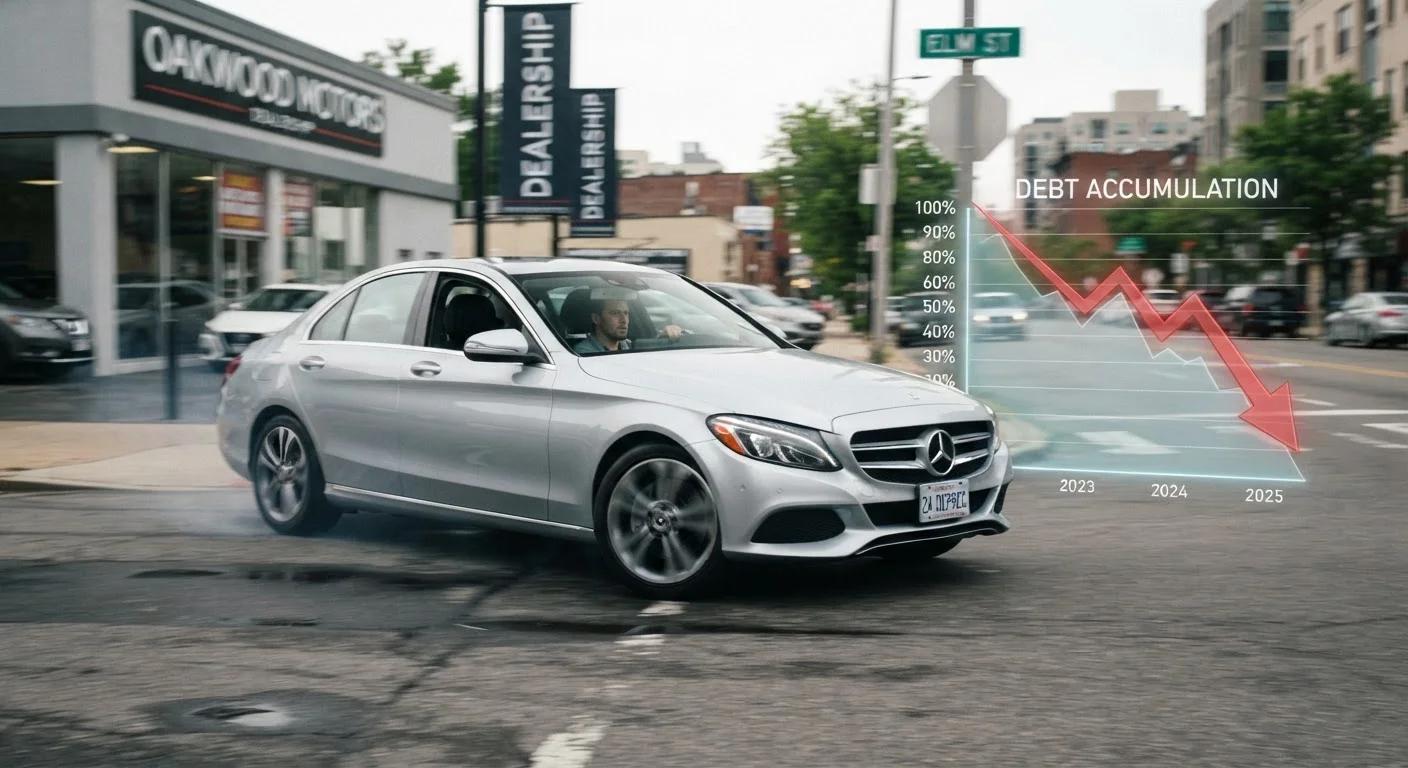
The Moment You Sign, the Clock Starts
The steep first-year depreciation curve isn't a myth or a dealer talking point - it's one of the most consistently documented realities of car ownership. The moment a new vehicle is registered and driven off the lot, it transitions from "new" to "used" in the eyes of the market. That status change alone can account for a meaningful portion of the initial value drop, even before a single mile registers on the odometer.
Why does the market treat this so harshly? A new car sold through a dealership comes with manufacturer pricing, new-vehicle warranties, and the certainty of zero prior ownership. A car registered to a private individual - even one driven only to the end of the block - no longer carries those assurances in the same form. The buyer's premium for a truly new vehicle disappears immediately.
For most new cars, industry data consistently shows a depreciation range of 15-25% over the first 12 months. On a $35,000 vehicle, that translates to a potential loss of $5,250 to $8,750 in the first year alone - more than many drivers pay in annual insurance and fuel combined. As part of the full picture of car ownership costs, this figure deserves serious attention.
15-25%
Typical first-year depreciation for new cars
Industry analysts and automotive valuation sources consistently report this range as the average value loss for new vehicles in the first 12 months of ownership.
~50%
Value retained after five years on average
Many new vehicles retain roughly half their original purchase price after five years, meaning depreciation continues well beyond year one, though it slows considerably after the initial drop.
$6,000+
Estimated first-year loss on a $30,000 vehicle
At a 20% depreciation rate - a commonly cited midpoint - a $30,000 car loses approximately $6,000 in value before its first anniversary, not counting interest, insurance, or maintenance costs.
What's Actually Driving the Drop
Depreciation isn't random. Several specific forces converge in the first year to accelerate value loss:
- New model competition: Manufacturers release updated or redesigned versions of popular models regularly. Each new model year makes the previous version slightly less desirable, pushing down used prices for the prior version.
- Supply and demand dynamics: When a model is widely available new, there's little incentive for buyers to pay a premium for a used one. Scarcity is one of the few forces that can slow depreciation - which is why some trucks and certain SUVs have historically held value better than sedans.
- Mileage accumulation: The average American driver puts roughly 12,000-15,000 miles on a vehicle per year. Each mile signals wear, reduces remaining warranty coverage, and narrows the pool of buyers willing to pay top dollar.
- Reliability perception: A vehicle's brand or model reputation for long-term reliability significantly influences how buyers price used units. Models perceived as unreliable or expensive to maintain depreciate faster.
These factors don't operate in isolation - they compound. A high-mileage vehicle in a model year that's already been superseded by a refresh loses value on multiple fronts simultaneously.
A driver buys a new midsize sedan for $32,000. One year later, with 13,000 miles on the odometer, a dealer quotes a trade-in value of $25,500.
A buyer purchases a popular pickup truck new and later tries to sell it privately after 14 months.
A driver takes out a 72-month loan on a $40,000 SUV with low money down. After 18 months, the vehicle's market value has dropped to $30,000, while the loan balance is still $35,000.
What This Means for Your Ownership Decisions
Understanding depreciation reframes how you think about the true cost of a new car. The sticker price is the starting point, not the full story. As covered in the full lifecycle of car ownership, the gap between what you pay and what you'll eventually recover is one of the most consequential financial variables in the equation.
This is particularly relevant for first-time buyers. If you're navigating a purchase without much prior experience, depreciation is the cost that rarely gets discussed before you sign - but it will affect every subsequent financial decision tied to that vehicle, from refinancing to trade-in timing.
Practically speaking, knowing how depreciation works helps you evaluate when selling or trading in a vehicle makes sense, whether a longer loan term is wise (a car depreciating faster than you pay down the loan creates negative equity), and whether the price of a used alternative actually reflects fair value given its age and mileage.
Depreciation also underscores the importance of long-term thinking. A vehicle kept for eight to ten years spreads the depreciation cost across far more time, reducing its annual impact. The first year's loss doesn't disappear, but it becomes a smaller share of your total cost of ownership. Total cost of ownership is always a more honest measure than the monthly payment alone.
Frequently Asked Questions
Most new cars lose somewhere between 15% and 25% of their purchase price within the first 12 months. The exact figure depends on the make, model, demand, and how many miles are driven. Some vehicles - particularly luxury cars and those with poor reliability reputations - can depreciate even faster.
Once a car leaves the dealership, it is legally and practically classified as used. This status change alone triggers a drop in perceived value, because a buyer would have to purchase it from a private seller rather than a dealer with manufacturer incentives and warranty protections on a new unit.
Vehicles with strong reliability histories, broad market demand, and limited supply tend to depreciate more slowly. Trucks, certain SUVs, and models from brands with well-established durability reputations have historically held their value better than average. However, past resale trends are not a guarantee of future performance.
Yes. Mileage is one of the primary signals buyers and dealers use to assess a vehicle's remaining useful life. A car with significantly above-average annual mileage - generally considered more than 12,000-15,000 miles per year - will typically be valued lower than an equivalent model with fewer miles.
You can't stop depreciation, but keeping your car well-maintained, avoiding excessive mileage, protecting the exterior and interior condition, and keeping service records all help preserve resale value. A vehicle with documented maintenance history is generally worth more at trade-in than one without.
Many financial analysts point to first-year depreciation as a strong argument for buying a lightly used vehicle. When someone else absorbs that initial value drop, you can often acquire a nearly identical vehicle for meaningfully less. This is one of the central trade-offs explored in <a href="/autos-driving/car-ownership-basics/new-car-vs-used-car-a-practical-look-at-the-real-trade-offs">new vs. used car comparisons</a>.
The content on this site is provided for informational purposes only and should not be considered a substitute for professional advice. While we strive to provide accurate and up-to-date information, we make no guarantees regarding its completeness or accuracy. Always consult a qualified professional for advice specific to your circumstances before making any decisions.