

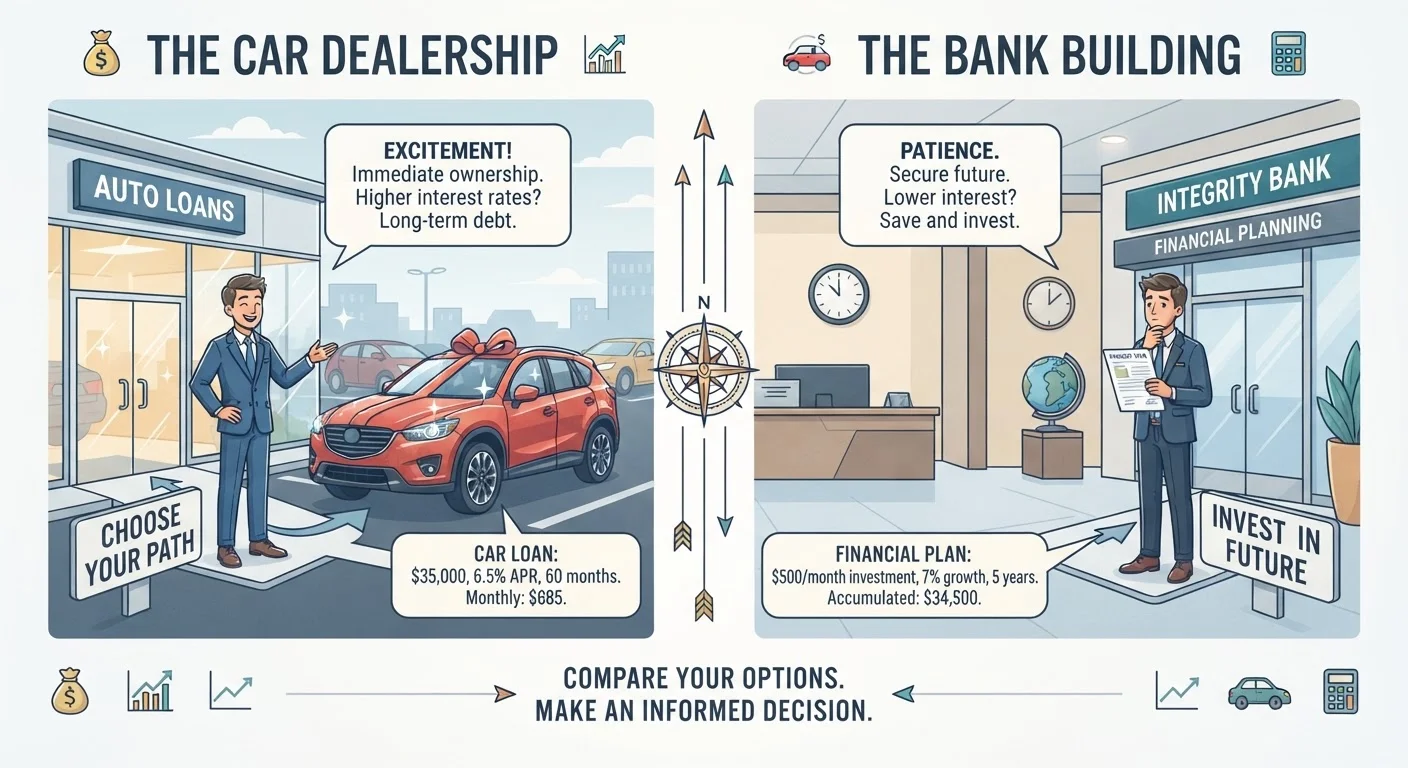
Option A
Dealer Financing
The convenient, one-stop-shop option built into the purchase process.
Best for: Buyers who want to handle the purchase and financing in one visit, especially those who qualify for manufacturer-backed promotional rates.
Option B
Bank or Credit Union Financing
The independent, pre-arranged lending route that puts negotiating power in your hands.
Best for: Buyers who want competitive rates secured before stepping onto a lot and prefer to negotiate the vehicle price separately from financing.
How Each Financing Route Actually Works
When you finance through a dealership, the dealer acts as an intermediary. You fill out a credit application on-site, the dealer submits it to one or more lenders it has relationships with - often including a manufacturer's own lending arm, called a captive lender - and the dealer presents you with loan terms. What many buyers don't realize is that dealers are often permitted to mark up the interest rate above what the lender actually quoted. This markup, sometimes called a dealer reserve, is compensation the dealer receives for arranging the loan. It is legal in most states, though regulations vary.
Direct lending - through a bank or credit union - works differently. You apply for a loan before you shop, receive a pre-approval that specifies a maximum loan amount and interest rate, and then use that offer as your spending ceiling at the dealership. The loan funds go directly to the dealer, and you repay the lender on the agreed terms. Because you've already secured financing, the dealer cannot roll additional cost into the rate without you noticing.
Understanding what lenders actually examine when reviewing your application - including income, debt-to-income ratio, and credit history - will help you approach either channel with realistic expectations.
| Criterion | Dealer Financing | Bank or Credit Union |
|---|---|---|
| Convenience | High - one-stop at the dealership | Moderate - separate application required |
| Rate transparency | Lower - markup possible | Higher - rate is what you agreed to |
| Typical rate competitiveness | Varies; strong with promo offers | Often lower, especially credit unions |
| Negotiating leverage | Lower - price and rate bundled | Higher - price and rate separated |
| Promotional rates available | Yes, via manufacturer programs | Rarely - depends on lender |
| Application timing | At point of sale | Before you shop |
| Best credit profile served | All tiers, but promos need strong credit | All tiers; credit unions more flexible |
The Rate Difference: What the Numbers Often Show
Interest rate differences between dealer financing and direct lending are not always dramatic, but they compound significantly over a four- or five-year loan term. Data from the Federal Reserve and the National Credit Union Administration consistently show that credit unions, as member-owned nonprofits, tend to charge lower average rates on auto loans than both banks and dealer-arranged financing. Banks are generally competitive with dealers, though the gap narrows or reverses when promotional manufacturer rates are in play.
The key distinction is transparency. With a bank or credit union pre-approval, the rate you see is the rate you pay. With dealer financing, the rate presented to you may be higher than the rate the lender actually approved - with the difference going to the dealership. This doesn't mean dealer financing is always worse, but it does mean comparison is essential.
~1-2%
Typical rate advantage of credit unions over banks on auto loans
The National Credit Union Administration has historically reported average new-car loan rates at credit unions running below the national bank average.
Up to 2.5%
Potential dealer rate markup above lender's base rate
The Consumer Financial Protection Bureau has documented that dealer reserve markups on auto loans can vary widely, often ranging from a fraction of a percent to more than two points.
If you're weighing broader questions about how different loan structures compare, the principles covered in our look at fixed-rate vs. adjustable-rate loan structures apply to the same underlying logic of total cost over time.
Practical Considerations Beyond the Interest Rate
Rate is not the only variable worth evaluating. Consider the following factors:
- Loan term flexibility: Banks and credit unions often offer a wider range of repayment terms than dealers working with captive lenders, giving you more control over the monthly payment and total interest.
- Application timing: Pre-approval from a bank or credit union typically involves a hard credit inquiry. Applying to multiple lenders within a 14-45 day window is generally treated as a single inquiry by the major credit bureaus under rate-shopping rules - minimizing the impact on your credit score.
- Manufacturer incentives: Dealers sometimes offer a choice between a low promotional APR and a cash-back rebate. Running the math on both scenarios matters; the rebate applied to a bank loan can sometimes yield a lower total cost than the promotional rate.
- Relationship benefits: If you have an existing account with a bank or credit union, you may qualify for a loyalty rate discount or expedited processing.
For buyers approaching their first purchase, our guide on what first-time car buyers often overlook covers dealer fees and financing terms that catch many shoppers off guard. And if you're still deciding whether purchasing is even the right path, see how it compares in our overview of buying vs. leasing.
This article is for general informational and educational purposes only and does not constitute personalized financial or lending advice. Loan terms, rates, and eligibility vary by lender and individual circumstances. Consult a licensed financial professional before making decisions about borrowing.
The content on this site is provided for informational purposes only and should not be considered a substitute for professional advice. While we strive to provide accurate and up-to-date information, we make no guarantees regarding its completeness or accuracy. Always consult a qualified professional for advice specific to your circumstances before making any decisions.