

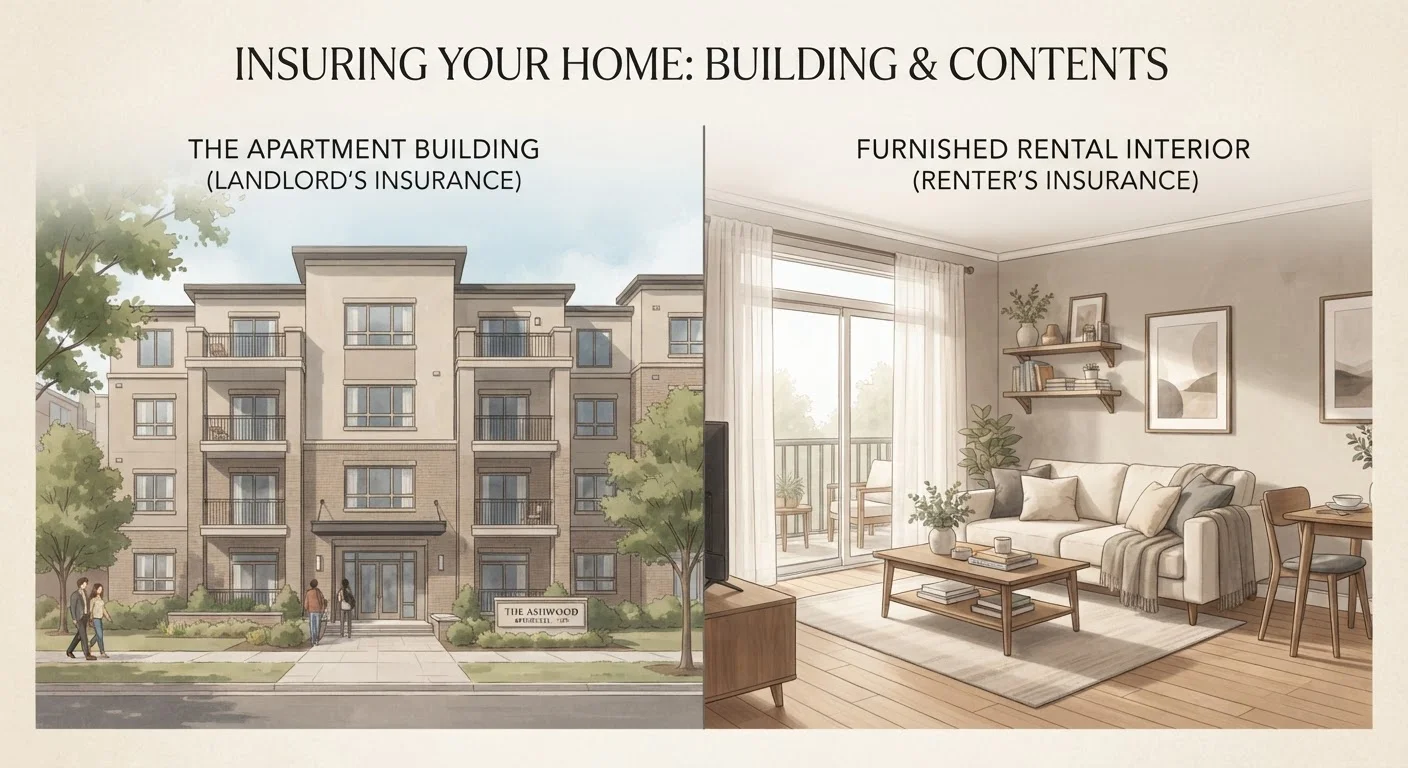
Option A
Landlord's Insurance (Dwelling Policy)
The property owner's shield - covering the building, not your belongings.
Best for: Property owners who need to protect the physical structure, lost rental income, and their own liability exposure.
Option B
Renters Insurance
The tenant's safeguard - covering what you own and your personal liability.
Best for: Renters who want financial protection for personal belongings, temporary living costs, and personal liability claims.
The Core Distinction: What Each Policy Is Designed to Protect
When a covered loss strikes a rental property - a kitchen fire, a burst pipe, a windstorm - two separate insurance policies may be in play. Understanding which covers what is not a technicality; it has direct financial consequences for everyone involved.
A landlord's insurance policy (sometimes called a dwelling policy or rental property policy) is purchased by and for the property owner. It is designed to protect the physical structure of the building - walls, roof, built-in appliances, and common areas - along with the owner's personal liability if someone is injured on the property due to a maintenance issue. Many landlord policies also include loss of rental income coverage, compensating the owner if a covered event makes the unit temporarily unrentable.
A renters insurance policy, by contrast, is purchased by the tenant. It exists to cover three things the landlord's policy completely ignores: the renter's personal property (furniture, electronics, clothing, jewelry), the renter's personal liability (if a guest is injured inside the unit or a tenant accidentally causes damage to a neighbor's property), and additional living expenses if a covered event forces the renter to temporarily relocate.
The simplest way to remember the divide: the landlord's policy covers the shell; the renter's policy covers what's inside - and the person living there.
| Criterion | Landlord's Insurance | Renters Insurance |
|---|---|---|
| Who purchases it | Property owner | Tenant |
| Covers the building structure | Yes | No |
| Covers tenant's personal belongings | No | Yes |
| Personal liability coverage | Owner's liability only | Tenant's liability only |
| Loss of rental income | Often included | Not applicable |
| Additional living expenses for tenant | No | Typically included |
| Typical cost driver | Property value, location | Belongings value, liability limits |
Common Scenarios That Reveal the Gap
Many renters assume their landlord's insurance will protect them if something goes wrong. In practice, that assumption leads to costly surprises. Consider a few real-world situations:
- Theft: A break-in results in a stolen laptop, TV, and camera. The landlord's policy may cover damage to the door or window frame, but no portion of the stolen items - those fall exclusively under the renter's own policy.
- Water damage from a burst pipe: The landlord's policy covers repairs to the plumbing and any structural damage. A renter's soaked furniture and ruined flooring merchandise are not covered unless the renter carries their own policy.
- A guest slips and is injured: If the slip occurs inside the unit due to conditions under the tenant's control (a wet rug, a cluttered hallway), the landlord's liability coverage generally does not apply to the tenant. The renter's own liability coverage responds instead.
- Fire displaces the tenant: The landlord's policy may rebuild the unit. It does not pay for the renter's hotel bill. Loss-of-use coverage within a renters policy typically handles that.
These gaps are not loopholes - they are fundamental to how each policy is structured. Being uninsured as a renter means absorbing those losses personally. As part of a full picture of renting costs, renters insurance is one of the expenses detailed in our coverage of the hidden costs of renting that tenants often underestimate.
Lease Requirements and Renters Insurance
Some landlords require tenants to carry renters insurance as a condition of the lease and may ask for proof of coverage before move-in. Even when not required, carrying a policy is generally considered standard practice for tenants with meaningful personal property. Review your lease carefully - and check with your landlord if the requirement is unclear. For more on what landlords can and cannot require around deposits and lease terms, see our guide on security deposits and tenant protections.
What Renters Should Know Before Choosing a Policy
Renters insurance policies vary by insurer, state, and coverage level, so general education is essential before consulting a licensed agent about a specific plan. Several concepts are worth understanding:
Actual Cash Value vs. Replacement Cost: Policies that pay actual cash value reimburse you for the depreciated worth of a lost item - meaning a five-year-old laptop may pay out far less than what a replacement costs. Replacement cost coverage pays the current cost to replace the item with something comparable. The latter typically costs slightly more in premiums but provides stronger protection.
Named Perils vs. Open Perils: Some policies cover only specific listed events (fire, theft, windstorm). Others use broader language covering all causes of loss not explicitly excluded. Review what perils apply before assuming coverage.
Coverage limits and riders: Standard policies often cap payouts for high-value categories like jewelry, artwork, or electronics. Riders (add-on endorsements) can raise those limits for an additional premium - important if you own items of significant value.
Liability limits: Personal liability coverage within renters policies commonly starts at $100,000. Higher limits are available and may be worth considering depending on individual circumstances. This is general information only - consult a licensed insurance professional for guidance specific to your situation.
Renters should also be aware of their broader legal protections as tenants. Our overview of renter rights and legal protections provides useful context on the federal and state frameworks that shape the landlord-tenant relationship, including responsibilities each party carries.
This article is for general informational purposes only and does not constitute insurance, legal, or financial advice. Coverage terms, exclusions, and regulations vary by provider and by state. Consult a licensed insurance agent or adviser to evaluate options appropriate to your specific situation.
The content on this site is provided for informational purposes only and should not be considered a substitute for professional advice. While we strive to provide accurate and up-to-date information, we make no guarantees regarding its completeness or accuracy. Always consult a qualified professional for advice specific to your circumstances before making any decisions.