

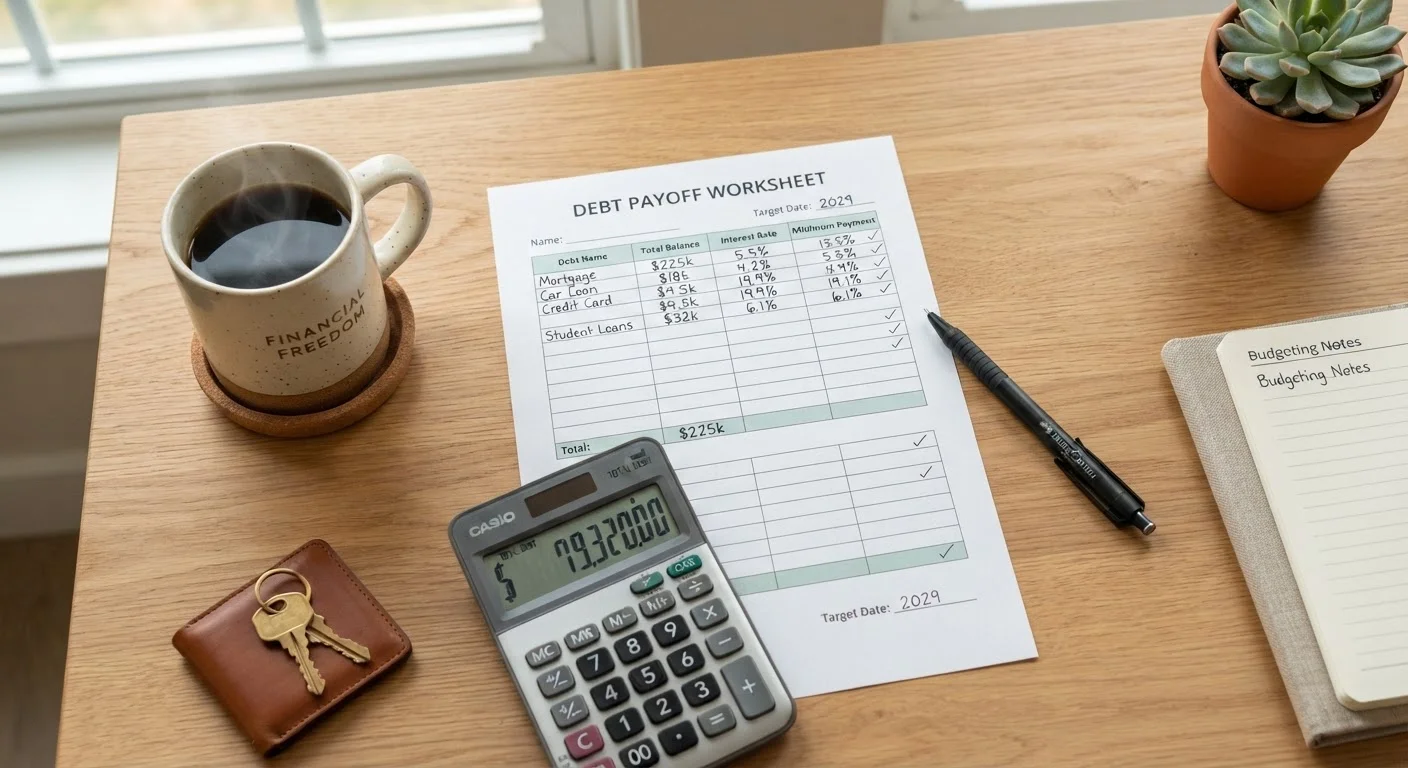
Why a Written Plan Outperforms Good Intentions
Most people with debt know they should pay it down faster. Fewer have a written plan that tells them exactly which account to target, how much extra to pay, and when each balance will reach zero. That gap between intention and structure is where most payoff efforts stall.
A formal debt payoff plan works for one primary reason: it converts a vague financial goal into a series of specific, repeatable actions. When the plan is written down - even on a single sheet of paper - it becomes something to measure against rather than something to feel guilty about.
This walkthrough covers the complete process: gathering the right information, choosing a strategy, protecting yourself with a small savings buffer, and tracking progress. The steps below are designed to be followed in order, though you may need to loop back to earlier steps as your situation changes.
What you will need
Before you begin, gather the materials and information listed above. Having complete data from the start prevents the plan from being built on guesses.
Debt inventory spreadsheet
Lists every debt with its creditor, current balance, interest rate, and minimum payment in one place.
Monthly budget worksheet
Maps income against expenses to identify exactly how much can go toward extra debt payments each month.
Free online debt payoff calculator
Projects your payoff date and total interest paid under different payment amounts and strategies.
Calendar or habit-tracking app
Schedules milestone check-ins and payment due dates so nothing slips through the cracks.
Follow the Steps to Build Your Plan
List Every Debt You Owe
Pull out every account statement - credit cards, personal loans, auto loans, student loans, medical bills - and record the following for each:
- Creditor name
- Current balance
- Annual percentage rate (APR) - the yearly interest cost expressed as a percentage
- Minimum monthly payment
- Due date
Most people underestimate how many accounts they have. Going through bank and credit card statements for the past three months often surfaces forgotten balances. Accuracy here is critical - the rest of the plan rests on this inventory.
Calculate Your Available Monthly Payment Power
Subtract your total minimum debt payments and all essential living expenses (rent or mortgage, utilities, groceries, insurance, transportation) from your monthly take-home income. The amount left over is your discretionary payment power - what you can realistically put toward extra debt reduction each month.
Be honest. Overestimating this number is one of the most common reasons plans collapse within two months. If the number is very small, look for one or two non-essential expenses to trim temporarily. Even an extra $50 to $100 per month accelerates payoff meaningfully over time.
For a structured approach to allocating income across both debt and savings, see building a budget that handles both.
Choose a Payoff Strategy
Two widely recognized methods structure which debt gets the extra payment first:
- Avalanche method: Target the debt with the highest APR first. Once it's gone, roll that payment to the next-highest rate. This typically minimizes total interest paid over time.
- Snowball method: Target the smallest balance first regardless of rate. Early wins can build motivation and psychological momentum.
Neither method is universally superior - the right choice depends on your interest rates, balance sizes, and how motivated you stay when progress feels slow. For a detailed comparison of both approaches, see avalanche vs. snowball compared.
Whichever method you choose, continue making at least the minimum payment on every other debt while concentrating extra dollars on your target account.
Set a Baseline Emergency Reserve
Before aggressively paying down debt, set aside a small, accessible emergency fund - commonly suggested in a range of $500 to $1,000 in a separate savings account. This cushion prevents a single unexpected expense from forcing new credit card charges that undo recent progress.
Once this baseline is in place, direct additional dollars toward your debt target. The question of how much to save versus pay down - especially when you have high-interest debt - involves real trade-offs worth understanding. See the debt vs. savings trade-off explained for a fuller breakdown.
Automate Payments and Set Milestone Markers
Set up automatic minimum payments on every account to eliminate missed-payment risk. Then set a separate recurring transfer or manual payment for your extra amount toward the target debt.
Next, define concrete milestones: the date you expect each debt to reach zero based on your current payment power. Use a free online calculator to project these dates. Write them down or mark them in a calendar. Milestones give you visible progress points and early warning if you're falling behind.
For foundational practices that keep a plan on track long-term, core debt management principles are worth reviewing.
Review and Adjust Quarterly
Every three months, revisit your debt inventory and budget. Update balances, note any rate changes (some loans have variable rates), and recalculate your projected payoff dates. If your income has increased, consider directing a portion of the increase toward debt before it gets absorbed into lifestyle expenses - a practice sometimes called a payment raise.
If your credit profile has improved during your payoff journey, it may be worth understanding whether options like refinancing make sense. However, any consolidation or refinancing decision should be weighed carefully. The trade-offs of debt consolidation deserve a separate, honest look before acting.
Don't Skip Your Emergency Fund Entirely
Putting every spare dollar toward debt while keeping zero savings leaves you vulnerable. One unexpected expense - a car repair, a medical bill - can force you back into debt immediately. Most financial educators recommend keeping at least a small cushion (often cited as $500-$1,000) before accelerating debt payments. See when saving alongside debt makes sense for a fuller discussion.
Review Your Plan Every Three Months
Income, expenses, and interest rates all change over time. Schedule a quarterly check-in to update your debt list, recalculate your payoff timeline, and decide whether to redirect any freed-up cash toward savings or the next balance. Small adjustments early prevent large frustrations later.
Once you've completed all six steps, you will have a debt list, a monthly payment amount, a chosen strategy, a small emergency buffer, automated payments, and a set of milestone dates. That combination - specific, automated, and trackable - is what makes a plan durable rather than aspirational.
If you find the plan reveals a deeper tension between paying down debt and building longer-term savings, that's a real trade-off worth examining deliberately. The budgeting basics hub offers additional frameworks for structuring your finances as a whole.
As your debt decreases and your credit history improves, you may also find it useful to explore rebuilding credit after setbacks to understand how your payoff journey intersects with your overall credit profile.
This Is Education, Not Personalized Advice
This article provides general financial information to help you understand how debt payoff plans work. It is not personalized financial, tax, or legal advice. Your situation depends on factors - income, debt types, interest rates, goals - that only you and a qualified financial professional can fully assess. Consult a licensed adviser before making significant financial decisions.
This article is for general informational and educational purposes only. It does not constitute personalized financial, investment, tax, or legal advice. Consult a qualified financial professional regarding your specific circumstances before making significant financial decisions.
The content on this site is provided for informational purposes only and should not be considered a substitute for professional advice. While we strive to provide accurate and up-to-date information, we make no guarantees regarding its completeness or accuracy. Always consult a qualified professional for advice specific to your circumstances before making any decisions.