

How Compounding Actually Works
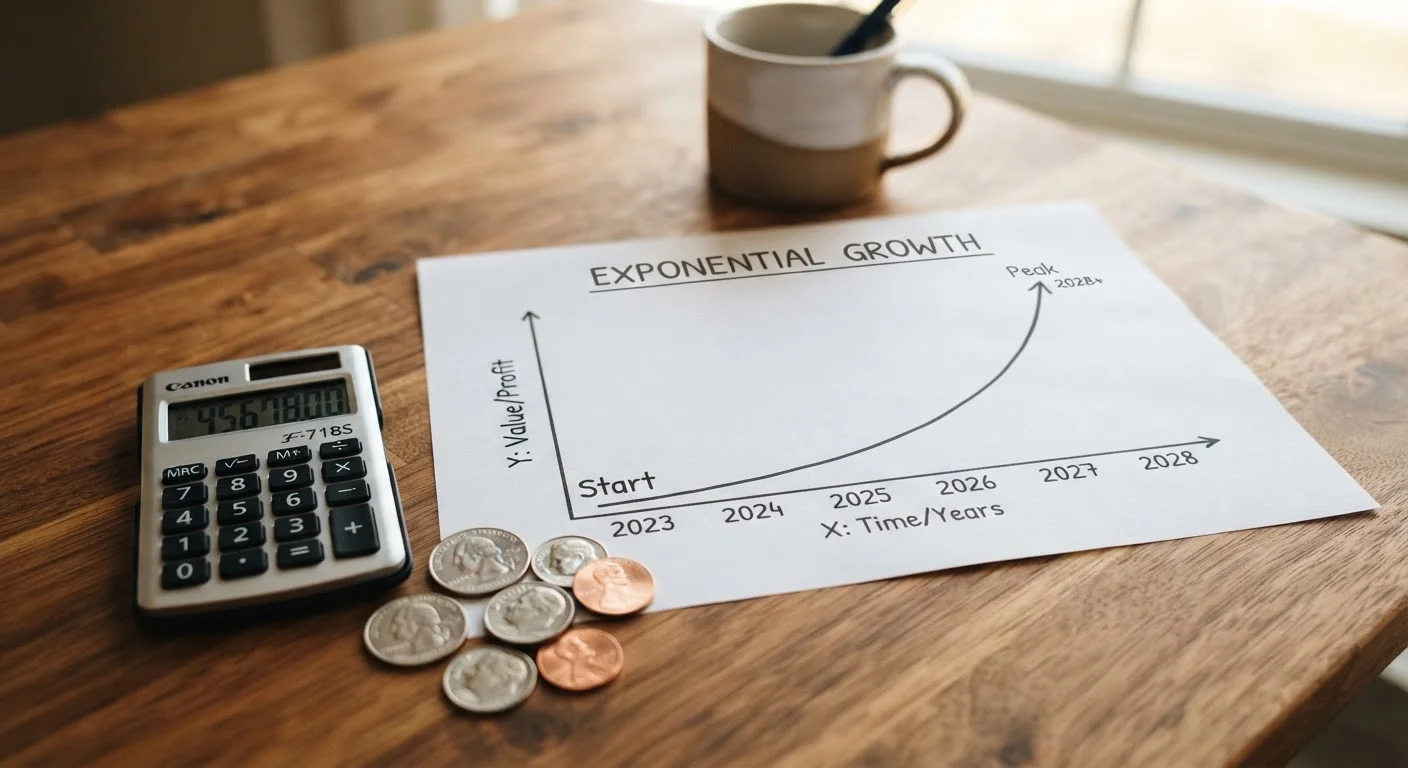
At its core, compound interest is interest earned - or charged - on a growing balance that already includes prior interest. Each compounding period, the interest is added to the principal, and then the next round of interest is calculated on that larger total.
Consider a straightforward example: you deposit $5,000 into an account earning 5% annual interest, compounded annually. After year one, you've earned $250, bringing your balance to $5,250. In year two, you earn 5% on $5,250 - not just the original $5,000 - so your interest is $262.50. By year ten, your balance has grown to roughly $8,144 without any additional contributions.
This self-reinforcing cycle is sometimes described as "interest on interest." Over short periods, the effect is modest. Over decades, it becomes the primary engine of wealth-building - or debt acceleration.
72
Years to double money (Rule of 72 at 6%)
Divide 72 by your interest rate to estimate doubling time; at 6% annual compounding, a sum doubles in approximately 12 years - a widely cited financial planning shortcut.
$2,653
Extra interest on $10,000 at 5% over 10 years
Compound interest (annually) on a $10,000 balance at 5% over 10 years yields roughly $6,289 in total interest, compared to $5,000 under simple interest - a difference of about $1,289.
22%+
Typical credit card APR in the US
According to Federal Reserve data, average credit card interest rates have exceeded 20% APR in recent periods, making daily compounding on carried balances especially costly for borrowers.
The Role of Compounding Frequency
Not all compounding is equal. How often interest is calculated and added to your balance materially affects how much it grows. Common compounding frequencies include:
- Daily - most common for savings accounts and credit cards
- Monthly - typical for many personal loans and mortgages
- Quarterly or annually - found in some bond investments and older savings instruments
More frequent compounding means slightly higher totals. A $10,000 balance at 6% compounded annually grows to about $17,908 in ten years. Compounded monthly, it reaches approximately $18,194 - about $286 more, with no extra effort. On large balances or over longer time horizons, those differences become much more meaningful.
For a broader look at the vocabulary surrounding these concepts, see key financial terms every borrower and saver should know.
Compounding as a Wealth-Building Tool
Compound interest is the mathematical reason that starting to save earlier - even with smaller amounts - often outperforms starting later with larger contributions. Time is the variable with the most leverage.
Someone who invests $200 a month starting at age 25 at an average 7% annual return will accumulate substantially more by retirement than someone who invests $400 a month starting at age 40, despite the second person contributing more total dollars. The earlier investor benefits from roughly 15 additional years of compounding.
Start Small, Start Now
Even modest, consistent contributions to an interest-bearing account benefit significantly from early compounding. If a large monthly contribution isn't feasible, starting with whatever amount is manageable still allows time to work in your favor. Increasing contributions gradually as income grows accelerates the effect further.
This is why financial educators consistently describe time as the most powerful ingredient in long-term investing. For foundational practices that support this thinking, see principles that hold up across every stage of debt and savings management.
Note: Investment returns are not guaranteed. Past performance does not predict future results. Consult a licensed financial adviser before making investment decisions.
When Compounding Works Against You
The same mechanics that build savings can erode financial stability when debt compounds unchecked. Credit card balances, for instance, typically compound daily. If you carry a $3,000 balance at 22% APR and make only minimum payments, the total interest paid over time can far exceed the original balance - and the payoff timeline can stretch for years.
This is why understanding compounding on the debt side is just as critical as understanding it for savings. Prioritizing high-interest debt payoff is, in effect, a guaranteed "return" equal to the interest rate you stop paying. For a closer look at the longer-term consequences, see the hidden costs of carrying debt longer than necessary.
If you're weighing whether to pay down debt or put money into savings, paying off debt vs. building savings explores that trade-off in detail.
A 30-year-old contributes $100 per month to a retirement account earning an average of 6% annually, compounded monthly, and leaves it untouched for 35 years.
A cardholder carries a $2,500 credit card balance at 24% APR, compounding daily, and makes only the $50 minimum payment each month.
Two siblings each deposit $5,000 into a savings account at 4% annual interest, compounded annually. One withdraws earnings each year; the other reinvests them.
This article is for general informational and educational purposes only, and does not constitute personalized financial, investment, or tax advice. Consult a qualified financial professional for guidance specific to your circumstances.
Frequently Asked Questions
Simple interest is calculated only on the original principal balance. Compound interest also includes previously accumulated interest, so the base amount grows over time. On a $10,000 loan at 5% for 10 years, simple interest adds $5,000; compound interest (annual) adds roughly $6,289.
It depends on the account or loan agreement. Savings accounts often compound daily or monthly, while many loans compound monthly. Credit card balances typically compound daily, which is why balances can grow quickly when only minimum payments are made.
Yes - when you earn compound interest in a savings or investment account, your balance grows faster over time because you earn returns on your accumulated earnings. The longer your money stays invested, the more powerful this effect becomes.
It can. When interest compounds on an unpaid balance, the amount you owe grows faster than if only simple interest applied. Carrying credit card balances or making minimum-only payments can lead to significantly higher total repayment costs.
The Rule of 72 is a quick mental math shortcut: divide 72 by your annual interest rate to estimate how many years it takes to double a sum of money with compound interest. At 6% annual growth, for example, money roughly doubles in about 12 years.
Whenever you're making significant decisions about debt repayment strategies or investment accounts, a licensed financial adviser can help you model specific scenarios for your situation. This article provides general education, not personalized financial advice.
The content on this site is provided for informational purposes only and should not be considered a substitute for professional advice. While we strive to provide accurate and up-to-date information, we make no guarantees regarding its completeness or accuracy. Always consult a qualified professional for advice specific to your circumstances before making any decisions.