

Start here
Why Asset Types Matter Before You Invest
Next
Stocks: Ownership Shares in a Company
Then
Bonds: Lending Money for a Fixed Return
When you're ready
Index Funds: Built-In Diversification
Put it together
How These Assets Can Work Together
Why Asset Types Matter Before You Invest
Before putting a single dollar into any investment account, it helps to understand what you are actually buying. The investing world can look overwhelming, but most portfolios are built from just three core building blocks: stocks, bonds, and index funds. Each behaves differently, serves a different purpose, and carries its own level of risk.
If you are still working on getting your financial foundation in place, it is worth reviewing a financial readiness checklist before moving forward - investing before your basics are stable can create more problems than it solves. For those ready to learn the vocabulary, a plain-language glossary of personal finance terms is a helpful companion to this guide.
Stock
A share of stock represents a small ownership stake in a company. Its value rises and falls with the company's performance and broader market conditions.
Bond
A bond is a loan you make to a government or corporation. In return, you receive regular interest payments and your original amount back at a set future date.
Index Fund
An index fund holds a broad basket of stocks or bonds that mirrors a market index, providing automatic diversification at typically low cost.
Asset Allocation
The way you divide your investments among different asset types - such as stocks and bonds - based on your goals, timeline, and tolerance for risk.
Volatility
How much and how quickly an investment's value moves up or down. Higher volatility means larger and more frequent price swings.
Coupon Rate
The fixed annual interest rate a bond pays its holder, expressed as a percentage of the bond's face value.
Maturity Date
The date on which a bond's term ends and the borrower repays the original loan amount to the bondholder.
Expense Ratio
The annual fee an investment fund charges, expressed as a percentage of your invested amount. Lower expense ratios mean more of your money stays working for you.
Stocks: Ownership Shares in a Company
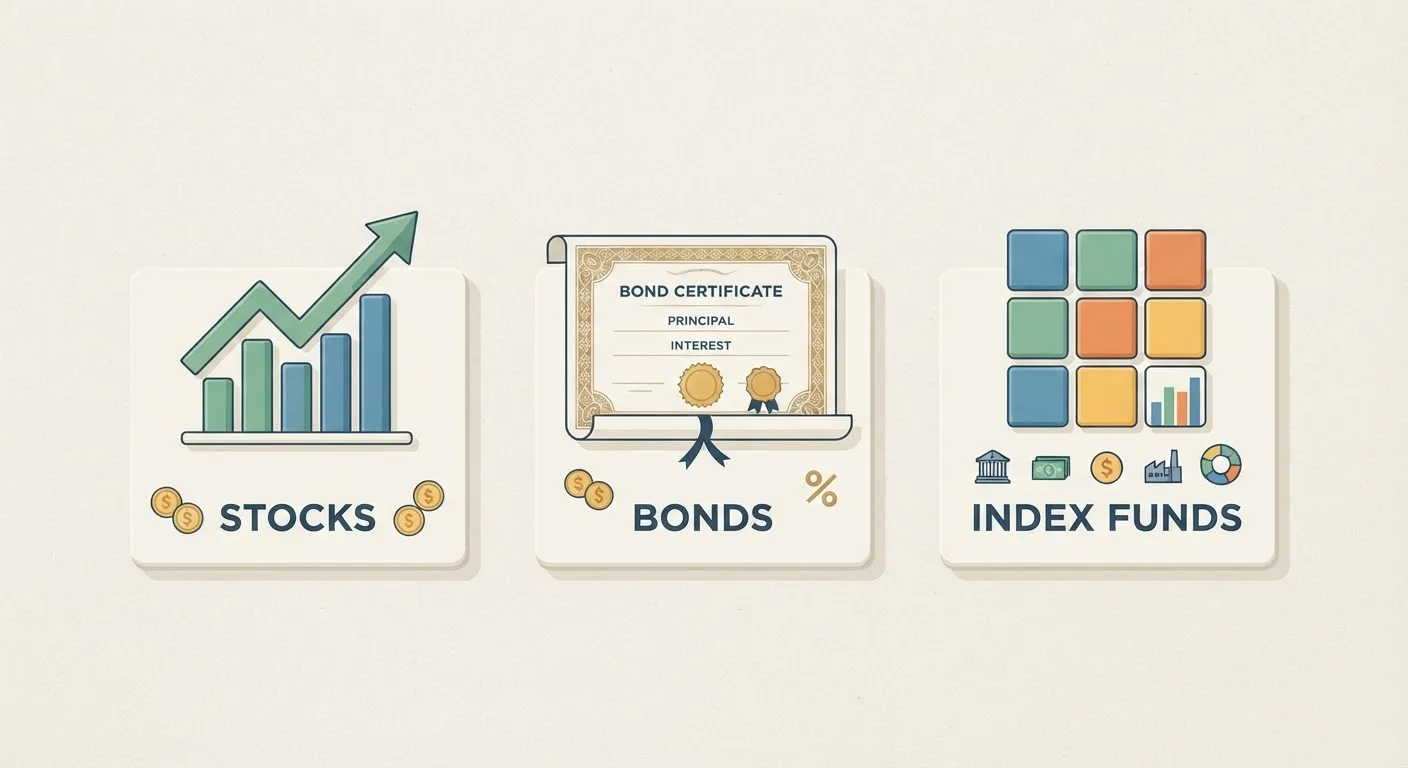
When a company wants to raise money, it can sell small pieces of itself to the public. Each piece is called a share of stock. When you buy shares, you become a part-owner - a shareholder - of that company. If the company grows and becomes more valuable, your shares tend to increase in value too. If the company struggles, your shares can fall in value.
Stocks have historically produced higher long-term returns than other major asset classes, but they come with significant volatility. The value of a share can swing dramatically in a single day based on company news, economic data, or shifts in investor sentiment. This is why stocks are generally considered better suited to investors with longer time horizons - someone who does not need to sell for ten or twenty years can ride out downturns more comfortably than someone who might need the money in two years.
Think in Terms of Time Horizon
Your time horizon - how long before you need the money - is one of the most important factors in choosing asset types. If you have many years before you need to access your investment, you may be better positioned to hold through stock market downturns. If your timeline is short, more stable assets like bonds may warrant a larger share of your portfolio.
Owning stock in just one or two companies concentrates your risk heavily. A single piece of bad news can wipe out a large portion of your investment. This is one reason why diversification - owning many different assets - matters so much. Our article on the principle of diversification explores this concept in depth.
Bonds: Lending Money for a Fixed Return
A bond works differently from a stock. Instead of buying ownership in a company, you are lending money to a borrower - typically a corporation or a government entity - in exchange for regular interest payments and the return of your original loan amount at a set future date called the maturity date.
Because bonds pay a predetermined interest rate (called a coupon rate), their returns are more predictable than stocks. This stability makes bonds appealing for investors who are closer to a financial goal - such as retirement - and cannot afford large drops in their portfolio value. That said, bonds are not risk-free. If an issuer defaults (fails to repay), investors can lose money. Bond prices also move inversely to interest rates: when interest rates rise, existing bond prices generally fall.
U.S. Treasury bonds, issued by the federal government, are widely considered among the lowest-risk bonds available, though all investing carries some level of risk.
Index Funds: Built-In Diversification
An index fund is not a separate asset class - it is a vehicle that holds a collection of stocks, bonds, or both. These funds are designed to mirror the performance of a specific market index, such as the S&P 500, which tracks the performance of 500 large U.S. companies.
When you invest in an S&P 500 index fund, you effectively own a tiny slice of all 500 companies in that index. If one company performs poorly, it has a limited impact on your overall investment because it is just one of many. This built-in spread is a practical way to apply diversification without needing to research and buy hundreds of individual stocks.
Index funds are typically passively managed, meaning there is no team of analysts actively selecting investments. As a result, they generally carry lower fees than actively managed funds. Lower fees mean more of your money stays invested and compounds over time - a meaningful difference over decades. Many index funds are structured as exchange-traded funds (ETFs), which trade on stock exchanges throughout the day like individual stocks.
If you hold index funds inside a tax-advantaged retirement account, the tax treatment can further improve your outcomes. See our overview of 401(k), IRA, and Roth IRA accounts for how these accounts work.
How These Assets Can Work Together
Most financial professionals discuss portfolio construction in terms of asset allocation - the proportion of stocks, bonds, and other assets you hold. A common general principle is that younger investors with longer time horizons can typically afford to hold a higher proportion of stocks, because they have more time to recover from market downturns. As a person approaches retirement, gradually shifting toward a higher proportion of bonds is a traditional strategy to preserve accumulated value.
Index funds make it possible to gain broad exposure to either stocks or bonds - or both - without needing to pick individual securities. Many investors build their entire portfolio using only a few index funds covering different parts of the market.
This Is General Education, Not Personal Advice
The concepts covered here are meant to help you understand how these asset types work, not to tell you what to buy. Individual circumstances - income, debts, dependents, retirement timeline - vary widely. A licensed financial adviser can help translate these concepts into a plan that fits your actual life.
This article is a general educational overview and is not personalised investment advice. The right allocation for your situation depends on your financial goals, income, time horizon, and risk tolerance. A licensed financial adviser can help you build a plan suited to your specific circumstances. Before investing, it also helps to have a solid budgeting foundation - building a budget from the ground up and getting started with personal savings are practical places to begin.
This article is for general informational and educational purposes only and does not constitute personalised investment, tax, or financial advice. Consult a qualified, licensed financial professional before making decisions about your own finances.
Frequently Asked Questions
No investment is completely risk-free. Bonds and bond-heavy index funds are generally considered lower risk than individual stocks, but all investments can lose value. Consult a licensed financial adviser to find an approach suited to your situation.
Many index funds and exchange-traded funds (ETFs) have low or no minimum investment requirements, making them accessible to beginners. Check the specific fund's requirements before investing.
A stock gives you partial ownership in a company, with returns tied to that company's performance. A bond is a loan you extend to a company or government that pays you interest on a schedule, with lower typical volatility than stocks.
Index funds passively track a market index and typically carry lower fees. Actively managed funds have managers making buy/sell decisions, which tends to result in higher costs and does not consistently outperform index funds over time.
Not necessarily. Many brokerage accounts have no minimum deposit requirement, and fractional shares allow you to buy a portion of a stock. Before investing, make sure you have an emergency fund and manageable debt - see our financial readiness checklist for guidance.
Risk tolerance is your ability and willingness to absorb drops in the value of your investments without panic-selling or facing financial hardship. It is shaped by your timeline, income stability, and personal comfort with uncertainty.
The content on this site is provided for informational purposes only and should not be considered a substitute for professional advice. While we strive to provide accurate and up-to-date information, we make no guarantees regarding its completeness or accuracy. Always consult a qualified professional for advice specific to your circumstances before making any decisions.