

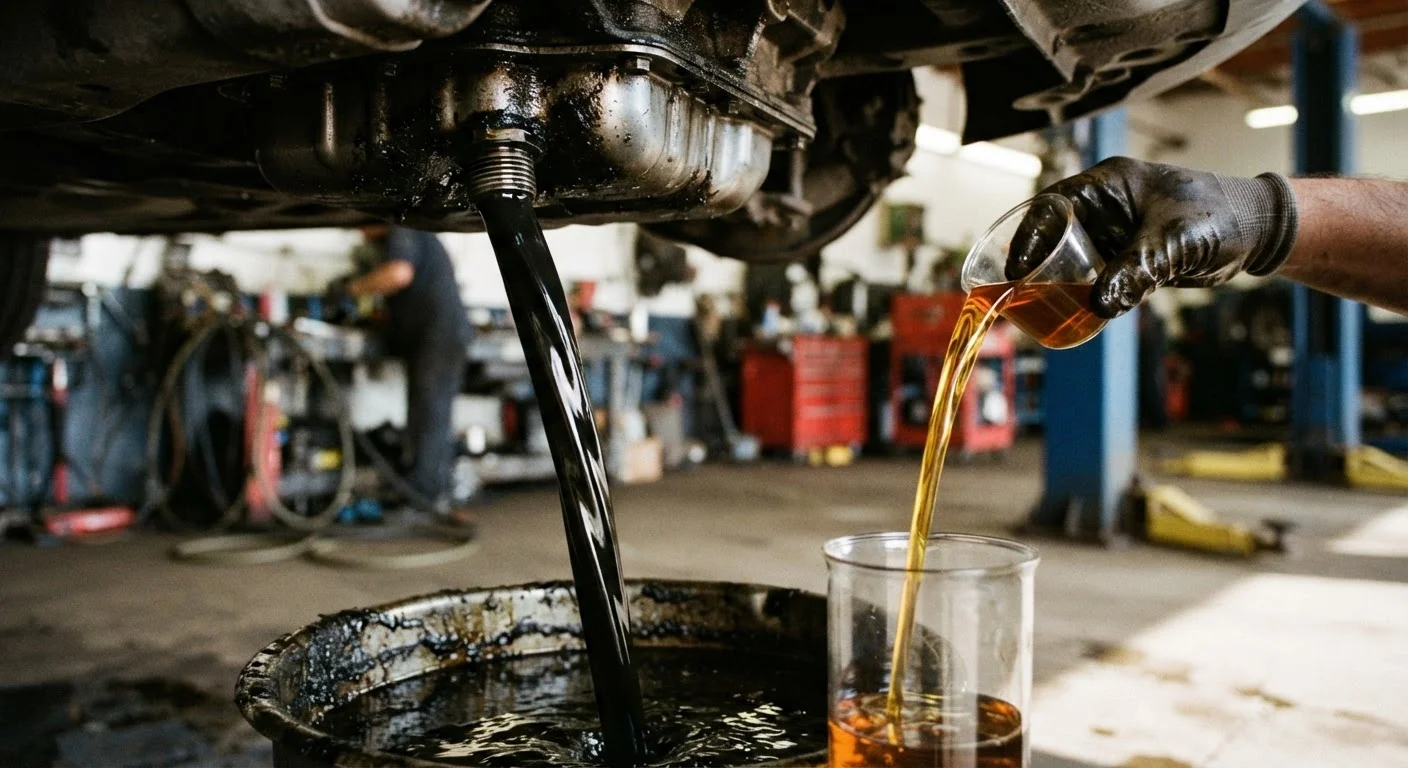
What Oil Actually Does - and What Happens When It Fails
Engine oil performs several critical jobs simultaneously: it lubricates moving metal parts to reduce friction, carries heat away from the combustion chamber, suspends contaminants so they can be caught by the filter, and helps seal gaps between engine components. When oil is fresh and clean, it handles all of these tasks efficiently.
Over time, heat and combustion byproducts break down the oil's chemical structure. Additives that protect against corrosion and oxidation get depleted. The oil thickens, darkens, and loses its ability to flow freely - particularly during cold starts, when engine wear is most severe. At this stage, the oil is no longer protecting your engine. It's contributing to the problem.
For a broader look at how deferred upkeep escalates into serious damage, see what happens when you skip routine car maintenance.
Extending oil change intervals far beyond what your vehicle or driving conditions warrant.
Why it happens: Drivers often assume modern synthetic oil can go indefinitely, or they rely on the old 3,000-mile rule without checking their manual for the actual recommendation.
Ignoring low oil level warnings between scheduled changes.
Why it happens: Many drivers assume that if the oil change isn't due yet, the oil level must be fine. Engines can consume oil, especially older or higher-mileage units.
Dismissing warning lights or unusual engine sounds as minor issues.
Why it happens: Dashboard warning lights are easy to rationalize away, especially if the vehicle seems to be running normally in the short term.
Skipping oil changes to save money in the short term.
Why it happens: A routine oil change feels like an unnecessary expense when everything seems to be running fine, especially for drivers on tight budgets.
Using the wrong oil type or viscosity for your engine.
Why it happens: Drivers sometimes substitute whatever oil is available or cheapest without checking whether it meets the vehicle's specifications.
The Real Cost of Waiting Too Long
Drivers who push past their oil change interval - whether by a few hundred or several thousand miles - often do so without any immediate consequences. That silence is misleading. Engine wear is cumulative and largely invisible until damage has already compounded.
$4,000-$10,000+
Typical engine replacement cost
Engine replacement costs vary widely by vehicle make and model but commonly fall in this range at independent and dealership repair shops.
~$35-$100
Average oil change cost
Standard oil change pricing varies by oil type (conventional vs. full synthetic) and service location across the United States.
7,500-10,000 mi
Typical synthetic oil change interval
Many modern vehicles using full synthetic oil carry manufacturer-recommended intervals in this range, per owner's manual specifications.
Sludge buildup is one of the most serious outcomes of neglected oil changes. When oxidized oil mixes with combustion gases and moisture, it forms a thick, tar-like deposit that can clog oil passages and starve critical engine components of lubrication. Clearing sludge - or replacing components damaged by it - can cost thousands of dollars. An engine replacement can run anywhere from $4,000 to over $10,000 depending on the vehicle.
Compare that to a standard oil change, which typically runs between $35 and $100 depending on oil type and service provider. The arithmetic is straightforward: consistent maintenance is the far cheaper option.
Low Oil Pressure Light: Do Not Ignore It
If your oil pressure warning light activates while driving, this is not a situation to monitor and address later. Continued operation with low oil pressure can cause severe, irreversible engine damage within minutes. Pull over safely as soon as possible and have the vehicle inspected by a qualified mechanic before driving further.
If you're unsure whether your current maintenance habits are actually saving you money, our look at car maintenance myths that drain your wallet may challenge some assumptions.
Knowing Your Actual Interval - and Sticking to It
One persistent misconception is that every vehicle needs an oil change every 3,000 miles. For many modern vehicles using full synthetic oil, the manufacturer-recommended interval may be 7,500 to 10,000 miles or more. Following an unnecessarily short schedule isn't harmful, but assuming a longer interval applies to your older or high-mileage vehicle could be.
Your owner's manual is the authoritative source for your specific vehicle. Driving conditions matter too - frequent short trips, extreme temperatures, towing, or stop-and-go traffic all accelerate oil degradation and may warrant more frequent changes than the standard recommendation.
For a clear reference on maintenance schedules across different tasks and vehicle types, see routine car maintenance and when each task is due.
If your vehicle has an oil life monitoring system, pay attention to it - but don't treat it as infallible. These systems estimate degradation based on driving conditions; they don't directly test the oil itself. When in doubt, a qualified mechanic can assess whether a change is warranted.
This article provides general automotive information for educational purposes. Always consult your vehicle's owner's manual and a qualified mechanic for maintenance decisions specific to your vehicle.
The content on this site is provided for informational purposes only and should not be considered a substitute for professional advice. While we strive to provide accurate and up-to-date information, we make no guarantees regarding its completeness or accuracy. Always consult a qualified professional for advice specific to your circumstances before making any decisions.