

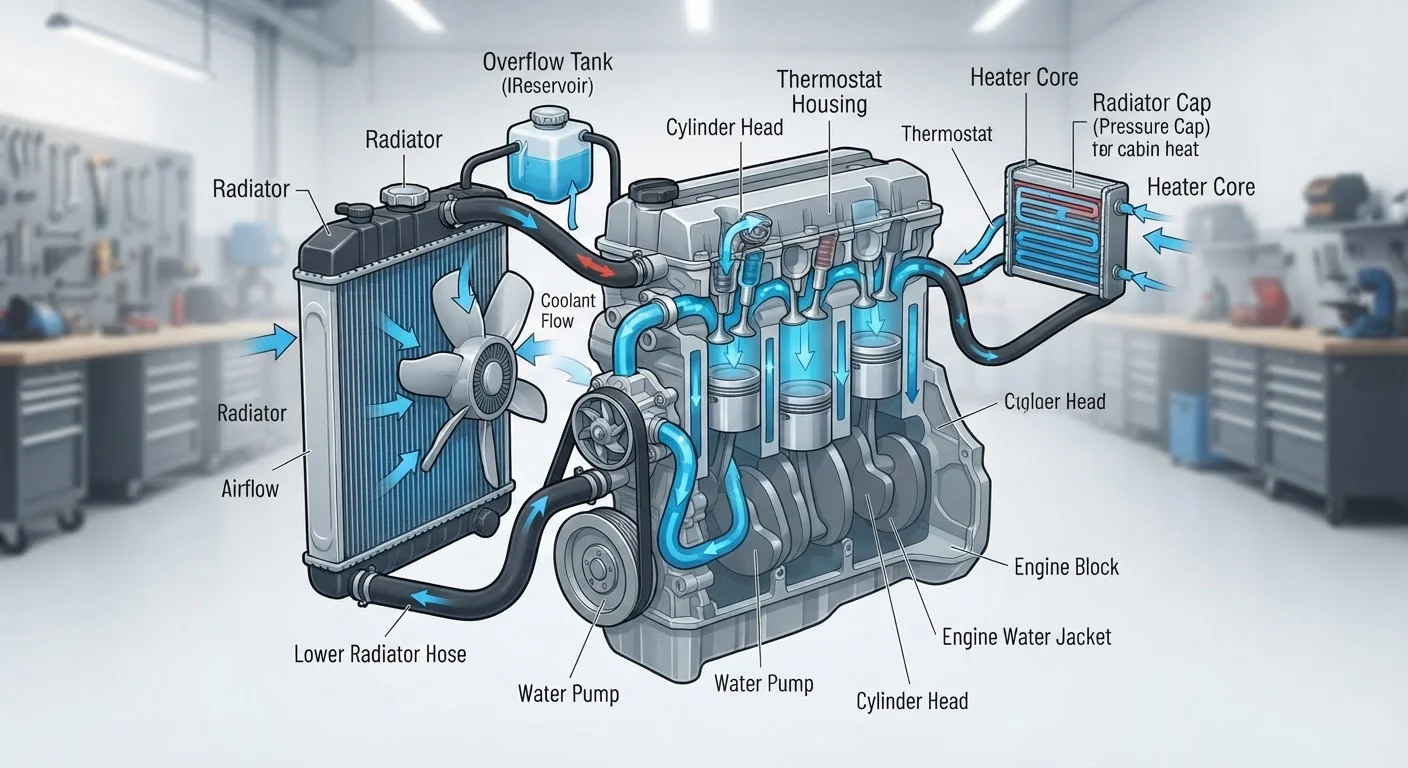
The Core Components and How They Work Together
A car engine generates enormous heat as a byproduct of combustion - enough to destroy itself without active temperature management. The cooling system solves this by moving coolant fluid through a continuous loop, transferring heat away from the engine and shedding it through the radiator.
Here is what each major component does:
- Water pump: The mechanical heart of the system. Driven by the engine's serpentine belt (or timing belt on some vehicles), it circulates coolant through the entire loop at all times the engine is running.
- Thermostat: A temperature-sensitive valve that stays closed when the engine is cold, keeping coolant inside the engine to help it warm up faster. Once the engine reaches operating temperature - typically around 195-210°F - the thermostat opens and allows coolant to flow to the radiator.
- Radiator: A large heat exchanger at the front of the vehicle. Hot coolant passes through thin metal tubes, and airflow - from driving or from the radiator fan - strips the heat away before the cooled fluid returns to the engine.
- Radiator fan: Pulls air through the radiator when the vehicle is stationary or moving slowly, maintaining cooling when natural airflow is insufficient.
- Expansion tank and pressure cap: The system operates under pressure, which raises the coolant's boiling point. The expansion tank accommodates fluid as it expands when hot.
- Heater core: A small secondary radiator inside the dashboard that uses engine heat to warm the cabin - a useful byproduct of the cooling loop.
Coolant Color Is Not a Reliable Freshness Indicator
Coolant comes in green, orange, pink, blue, and other colors depending on the formulation - and dye can be added to any fluid regardless of condition. The color alone does not tell you whether coolant is still providing adequate corrosion protection. Testing with an inexpensive coolant test strip or having a shop check the pH and freeze point is a more reliable approach.
What Happens When the Cooling System Fails
Cooling system failures rarely happen without warning signs, but those warnings are easy to dismiss. Understanding what goes wrong - and how quickly - helps explain why prompt attention matters.
~40%
Engine failures linked to cooling system issues
Industry data and automotive engineering sources consistently identify cooling system failure as one of the leading contributors to major engine damage and roadside breakdowns.
195-210°F
Normal engine operating temperature range
Most gasoline engines are designed to operate within this temperature window; sustained operation above it accelerates wear and risks component failure.
30,000-50,000 mi
Typical coolant flush interval
Most vehicle manufacturers recommend coolant replacement within this mileage range, though some extended-life formulations may allow longer intervals per the owner's manual.
Low coolant: The most common issue. Coolant can be lost through leaks at hoses, the radiator, the water pump seal, or internally through a failing head gasket. A car low on coolant cannot shed heat effectively.
Thermostat failure: A thermostat stuck closed traps hot coolant inside the engine, causing rapid overheating. One stuck open keeps the engine running too cool, reducing efficiency and increasing wear.
Water pump failure: When the pump fails, coolant stops circulating. Engine temperature climbs rapidly. Water pump failure is often preceded by a whining noise from the pump bearing or a coolant leak from the pump weep hole.
Clogged or damaged radiator: Scale, rust, and debris accumulate in aging coolant and can restrict flow through the radiator's narrow passages, reducing its ability to shed heat.
The consequences of sustained overheating escalate quickly. A warped cylinder head, a blown head gasket - which allows coolant and engine oil to mix - or, in severe cases, a cracked engine block are all realistic outcomes. These are among the most expensive repairs a vehicle can require. As outlined in our article on what happens when routine maintenance is skipped, deferred upkeep on fluid systems is one of the most predictable paths to major repair bills.
Keeping the Cooling System Healthy
The cooling system is relatively low-maintenance, but it does require scheduled attention. Here is what responsible ownership looks like:
Never Open a Hot Radiator Cap
The cooling system operates under significant pressure. Removing the radiator cap or cracking a hose fitting while the engine is hot can release scalding coolant and steam instantly. Always allow the engine to cool completely - at least 30 minutes after shutdown - before inspecting or opening any cooling system component.
- Check coolant level regularly: Inspect the translucent expansion tank - not the radiator cap - when the engine is cold. The level should fall between the MIN and MAX marks. Consistently low levels indicate a leak that needs diagnosis, not just repeated top-offs.
- Flush coolant on schedule: Over time, coolant degrades and becomes acidic, corroding metal components from the inside. A flush removes old fluid and contaminants. Follow your vehicle manufacturer's recommended interval.
- Inspect hoses and clamps: Cooling hoses deteriorate from the inside out. Squeeze upper and lower radiator hoses when cold - they should feel firm but pliable, not mushy, cracked, or brittle. Have a mechanic inspect them during routine service.
- Watch the temperature gauge: Know where your gauge normally sits. Any movement toward the hot end - particularly in traffic or on a climb - warrants immediate attention.
- Use the correct coolant type: Coolant formulations vary by manufacturer. Using an incompatible type can cause chemical reactions that damage seals and metal components. Your owner's manual specifies the correct specification.
A well-maintained cooling system is one of the simplest ways to protect a significant mechanical investment. The components are not complex or prohibitively expensive to service - but the damage caused when they fail most certainly can be.
Frequently Asked Questions
Coolant - a mixture of antifreeze and water - absorbs heat from the engine block and carries it to the radiator, where it is dissipated into the surrounding air. It also raises the boiling point and lowers the freezing point of the fluid, protecting the system in extreme temperatures.
Most manufacturers recommend a coolant flush every 30,000 to 50,000 miles, though some modern long-life coolants extend that interval. Check your owner's manual for the interval specific to your vehicle, as using degraded coolant accelerates corrosion inside the system.
Pull over safely as soon as possible, turn off the engine, and do not open the radiator cap while the engine is hot - pressurized coolant can cause serious burns. Allow the engine to cool completely before inspecting fluid levels, and have the vehicle inspected by a qualified mechanic before driving it further.
Driving with a known coolant leak is not advisable. Even a slow leak can deplete coolant levels quickly under load, leading to overheating and potentially catastrophic engine damage within a short distance. Have any visible leak diagnosed and repaired promptly.
Antifreeze is the concentrated chemical (typically ethylene glycol) that is mixed with water to create coolant. Most vehicles use a 50/50 mix of antifreeze and distilled water, which provides both freeze protection and an elevated boiling point.
The content on this site is provided for informational purposes only and should not be considered a substitute for professional advice. While we strive to provide accurate and up-to-date information, we make no guarantees regarding its completeness or accuracy. Always consult a qualified professional for advice specific to your circumstances before making any decisions.